Crude oil trading alert: Geopolitical risk premiums continue to intensify, with WTI crude oil rising for two consecutive days and approaching the $100 mark.
2026-10-23 09:36:21
On Friday during Asian trading hours, WTI crude oil continued its rebound, trading around $99.80 per barrel, while Brent crude oil simultaneously climbed above the $110 mark. The direct trigger for this round of price increases was the escalation of geopolitical conflicts on multiple fronts, but the hedging signals released on the supply side simultaneously resulted in oil prices exhibiting a tug-of-war pattern of "unable to fall further, but hesitant to rise."  The escalating attacks are altering market pricing logic. The Houthi rebels claimed responsibility for the attack on Saudi Arabia's Yanbu port on the Red Sea and also targeted an oil field and an airport in the world's largest crude oil exporter. Meanwhile, Ukraine intensified its attacks on Russian refineries this week, explicitly aimed at disrupting Moscow's ability to expand diesel exports under the recently reached agreement. A research report from an energy consultancy noted that "the complex is receiving a new round of strong risk premium injections due to the Houthi attacks on Saudi infrastructure and rumors of a joint US-Israeli strike against Iran following the midterm elections." Deutsche Bank analysts also stated that they are "starting with oil price movements," with multiple geopolitical developments overnight exacerbating market concerns about further escalation of the conflict. When the targets expand from single chokepoints to ports, airports, oil fields, and refineries, market concerns about the logistics chain evolve from "partial disruptions" to "systemic disturbances," which is the fundamental reason why this round of premiums is more persistent than in previous weeks. An even more crucial signal comes from Saudi Aramco. According to sources familiar with the matter, the state-owned oil company has ordered the evacuation of its headquarters in Dhahran, on the Persian Gulf coast. While Aramco did not immediately respond to requests for comment, this marks the company's first large-scale evacuation since the conflict with Iran began. The symbolic significance of this move extends far beyond actual production impact—it indicates that corporate-level security risk assessments have been substantially upgraded, and such assessments often have inertia: once upgraded, they don't quickly fall back down after a day of calm. For oil prices, this means the lower limit of the risk premium has been raised, making any pullback more likely to be met with buying support at relatively high levels. However, supply-side data is still offsetting these concerns. Export flows from the Middle East have largely recovered to about 80% of pre-war levels, with Saudi Arabia's crude oil exports rising 7.9% month-on-month in August, the highest level since March; furthermore, Russia is expected to ship its first diesel cargo to the United States on Thursday, meaning a further increase in global market supply. This pattern of "conflict escalation and flow recovery coexisting" constitutes the core pricing contradiction in current oil prices: the attacks bring a pulsed premium, while export data reflects structural supply capacity. Historically, premiums only translate into a sustained upward trend when actual shipments experience a sustained disruption. Before that, any surge triggered by single-day news is more likely to be met with profit-taking by hedging and speculative long positions. From the perspective of cross-asset and policy transmission, the high volatility of oil prices is spilling over to other assets through cost channels. Deutsche Bank points out that reports of potential US and Israeli attacks on Iranian energy infrastructure, coupled with ongoing attacks in Saudi Arabia, have exacerbated investor concerns—the market may now be pricing in a prolonged period of elevated oil prices, potentially extending into 2027. High energy prices will directly push up inflation readings in various countries, reinforcing the rationale for major central banks to maintain high interest rates, thereby suppressing the valuations of precious metals and growth stocks through the real interest rate channel. Simultaneously, rising freight and insurance costs due to shipping disruptions will exacerbate global trade anxieties, indirectly putting pressure on the currencies of Asian export-oriented economies. Therefore, crude oil is no longer just a single commodity, but a key starting point in this round of macroeconomic pricing chains, and its increased volatility will inevitably lead to a synchronous rise in cross-asset correlations. When assessing oil prices, investors need to pay attention to their feedback effects on inflation paths and risk appetite, rather than viewing geopolitical events in isolation. On the daily chart, WTI crude oil rebounded for two consecutive days and then stabilized above the 20-day exponential moving average. The short-term moving averages began to flatten and converge before diverging upwards, indicating that the previous correction structure has been broken and the bulls have regained control. The RSI (14) is around 56, returning above the 50 neutral line and not entering the overbought zone, indicating that the upward momentum is being released moderately, which is a typical "bullish trend, approaching resistance" pattern. The upper resistance levels are the psychological level of $100.00 and $101.20. Among them, $100 is both a psychological level and a previous dense trading area. Only if the daily body effectively stands above this position can the medium-term upward space be confirmed. The lower support levels are first at the previous platform of $97.70, then $96.70 and $95.80. Among them, $97.70 is a key defense level in the near term. If it is breached, it may retrace to $96.70 or even lower. On the 4-hour chart, oil prices rebounded from around $97.50 and then slowly moved upwards along the short-term moving average. The MACD histogram is expanding above the zero line, and the fast and slow lines are diverging upwards, indicating that the bulls are in control in the short term. If the price retraces to $98.30-$98.60 and finds support, there is still a chance to retest the resistance zone of $99.50-$100.00. If the price breaks below $98.00 with significant volume, it may seek support at $97.70 or even $96.70.
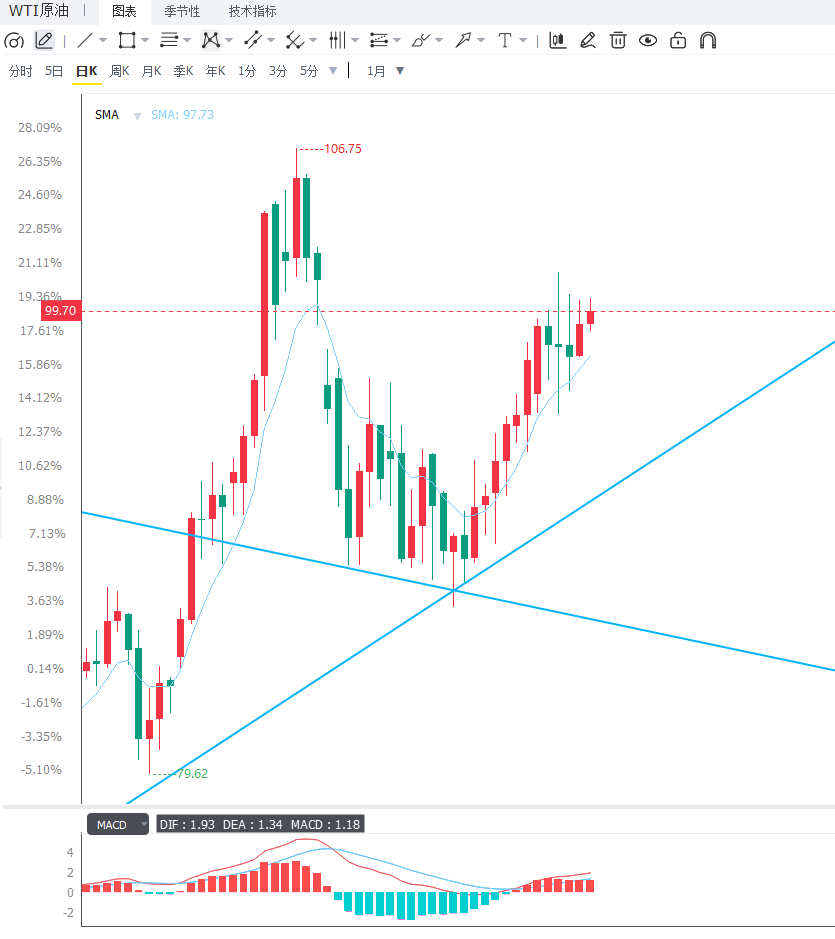 Editor's Summary: The core contradiction in the short term for crude oil lies in the escalating geopolitical attacks and Aramco's first large-scale evacuation, which raises the lower limit of the premium. Meanwhile, the recovery of Middle Eastern exports to 80% of pre-war levels, Saudi Arabia's 7.9% month-on-month increase in August exports, and increased Russian diesel cargoes constitute a substantial supply offset. The combined effect of these two factors suggests that oil prices are more likely to fluctuate repeatedly within the $97.70-$100.00 range. Three variables need to be closely monitored going forward: first, the duration of the evacuation of the Dhahran headquarters and the resumption of production arrangements, which directly determine whether this event is a temporary disturbance or a substantial production reduction; second, the port conditions of Yanbu, the safety of navigation in the Strait of Hormuz, and the frequency of Ukrainian attacks on Russian refineries, which are key to whether the risk premium can be sustained; and third, whether Middle Eastern crude oil flows can continue to approach pre-war levels, which is the core evidence to verify whether it is "expectation-driven" or "substantial shortage." In the medium term, before a significant breakout from the range, oil prices will maintain a high-level oscillation pattern. Confirmation of the trend direction still requires the final clarification of the geopolitical situation and global demand expectations.
The escalating attacks are altering market pricing logic. The Houthi rebels claimed responsibility for the attack on Saudi Arabia's Yanbu port on the Red Sea and also targeted an oil field and an airport in the world's largest crude oil exporter. Meanwhile, Ukraine intensified its attacks on Russian refineries this week, explicitly aimed at disrupting Moscow's ability to expand diesel exports under the recently reached agreement. A research report from an energy consultancy noted that "the complex is receiving a new round of strong risk premium injections due to the Houthi attacks on Saudi infrastructure and rumors of a joint US-Israeli strike against Iran following the midterm elections." Deutsche Bank analysts also stated that they are "starting with oil price movements," with multiple geopolitical developments overnight exacerbating market concerns about further escalation of the conflict. When the targets expand from single chokepoints to ports, airports, oil fields, and refineries, market concerns about the logistics chain evolve from "partial disruptions" to "systemic disturbances," which is the fundamental reason why this round of premiums is more persistent than in previous weeks. An even more crucial signal comes from Saudi Aramco. According to sources familiar with the matter, the state-owned oil company has ordered the evacuation of its headquarters in Dhahran, on the Persian Gulf coast. While Aramco did not immediately respond to requests for comment, this marks the company's first large-scale evacuation since the conflict with Iran began. The symbolic significance of this move extends far beyond actual production impact—it indicates that corporate-level security risk assessments have been substantially upgraded, and such assessments often have inertia: once upgraded, they don't quickly fall back down after a day of calm. For oil prices, this means the lower limit of the risk premium has been raised, making any pullback more likely to be met with buying support at relatively high levels. However, supply-side data is still offsetting these concerns. Export flows from the Middle East have largely recovered to about 80% of pre-war levels, with Saudi Arabia's crude oil exports rising 7.9% month-on-month in August, the highest level since March; furthermore, Russia is expected to ship its first diesel cargo to the United States on Thursday, meaning a further increase in global market supply. This pattern of "conflict escalation and flow recovery coexisting" constitutes the core pricing contradiction in current oil prices: the attacks bring a pulsed premium, while export data reflects structural supply capacity. Historically, premiums only translate into a sustained upward trend when actual shipments experience a sustained disruption. Before that, any surge triggered by single-day news is more likely to be met with profit-taking by hedging and speculative long positions. From the perspective of cross-asset and policy transmission, the high volatility of oil prices is spilling over to other assets through cost channels. Deutsche Bank points out that reports of potential US and Israeli attacks on Iranian energy infrastructure, coupled with ongoing attacks in Saudi Arabia, have exacerbated investor concerns—the market may now be pricing in a prolonged period of elevated oil prices, potentially extending into 2027. High energy prices will directly push up inflation readings in various countries, reinforcing the rationale for major central banks to maintain high interest rates, thereby suppressing the valuations of precious metals and growth stocks through the real interest rate channel. Simultaneously, rising freight and insurance costs due to shipping disruptions will exacerbate global trade anxieties, indirectly putting pressure on the currencies of Asian export-oriented economies. Therefore, crude oil is no longer just a single commodity, but a key starting point in this round of macroeconomic pricing chains, and its increased volatility will inevitably lead to a synchronous rise in cross-asset correlations. When assessing oil prices, investors need to pay attention to their feedback effects on inflation paths and risk appetite, rather than viewing geopolitical events in isolation. On the daily chart, WTI crude oil rebounded for two consecutive days and then stabilized above the 20-day exponential moving average. The short-term moving averages began to flatten and converge before diverging upwards, indicating that the previous correction structure has been broken and the bulls have regained control. The RSI (14) is around 56, returning above the 50 neutral line and not entering the overbought zone, indicating that the upward momentum is being released moderately, which is a typical "bullish trend, approaching resistance" pattern. The upper resistance levels are the psychological level of $100.00 and $101.20. Among them, $100 is both a psychological level and a previous dense trading area. Only if the daily body effectively stands above this position can the medium-term upward space be confirmed. The lower support levels are first at the previous platform of $97.70, then $96.70 and $95.80. Among them, $97.70 is a key defense level in the near term. If it is breached, it may retrace to $96.70 or even lower. On the 4-hour chart, oil prices rebounded from around $97.50 and then slowly moved upwards along the short-term moving average. The MACD histogram is expanding above the zero line, and the fast and slow lines are diverging upwards, indicating that the bulls are in control in the short term. If the price retraces to $98.30-$98.60 and finds support, there is still a chance to retest the resistance zone of $99.50-$100.00. If the price breaks below $98.00 with significant volume, it may seek support at $97.70 or even $96.70. Editor's Summary: The core contradiction in the short term for crude oil lies in the escalating geopolitical attacks and Aramco's first large-scale evacuation, which raises the lower limit of the premium. Meanwhile, the recovery of Middle Eastern exports to 80% of pre-war levels, Saudi Arabia's 7.9% month-on-month increase in August exports, and increased Russian diesel cargoes constitute a substantial supply offset. The combined effect of these two factors suggests that oil prices are more likely to fluctuate repeatedly within the $97.70-$100.00 range. Three variables need to be closely monitored going forward: first, the duration of the evacuation of the Dhahran headquarters and the resumption of production arrangements, which directly determine whether this event is a temporary disturbance or a substantial production reduction; second, the port conditions of Yanbu, the safety of navigation in the Strait of Hormuz, and the frequency of Ukrainian attacks on Russian refineries, which are key to whether the risk premium can be sustained; and third, whether Middle Eastern crude oil flows can continue to approach pre-war levels, which is the core evidence to verify whether it is "expectation-driven" or "substantial shortage." In the medium term, before a significant breakout from the range, oil prices will maintain a high-level oscillation pattern. Confirmation of the trend direction still requires the final clarification of the geopolitical situation and global demand expectations.
- Risk Warning and Disclaimer
- The market involves risk, and trading may not be suitable for all investors. This article is for reference only and does not constitute personal investment advice, nor does it take into account certain users’ specific investment objectives, financial situation, or other needs. Any investment decisions made based on this information are at your own risk.