Industry insiders: The easing of tensions in the Middle East has led to an increase in gold prices, presenting opportunities for gold mining stocks; they are optimistic about the future of gold.
2026-10-23 11:04:23
The escalating situation in Iran and disruptions to global energy supply are driving up inflation, forcing central banks to maintain tight monetary policies and putting downward pressure on gold prices in the short term. Chris Mancini, co-manager of the GoldX Gold Fund, argues that the conflict is merely delaying the rise in gold prices, and that gold mining companies can still generate substantial cash flow even with high gold prices.
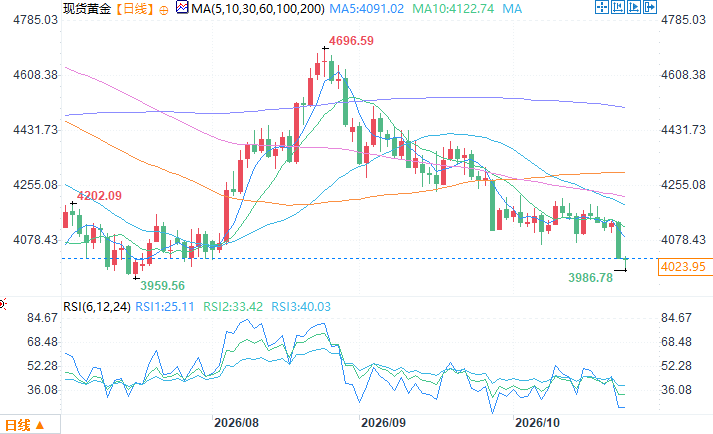 Spot gold daily chart source: FX678. At 11:02 AM Beijing time on October 23, spot gold was trading at $4018.95 per ounce.
Geopolitical factors are driving up oil prices, but this is hindering gold's performance in the short term.
Mancini stated that if the situation in Iran and the disruptions to oil shipments through the Strait of Hormuz had subsided by summer, gold prices might have already reached $5,000 per ounce. Geopolitical conflicts are pushing up energy prices, further increasing inflation, which in turn strengthens market expectations that the Federal Reserve Chairman will continue to raise interest rates. These expectations are currently the biggest short-term drag on gold. However, in his view, this is only a temporary obstacle and will not reverse the long-term positive fundamentals for gold. He further explained that even if the Fed continues to raise interest rates to combat inflation, high borrowing costs and oil prices will ultimately drag down economic growth. At that point, the Fed will have to readjust its monetary policy stance, opening up upward potential for gold.The gold mining industry is expected to see improved profitability in the third quarter, but cost pressures should not be underestimated.
With the gold mining industry set to release its third-quarter financial reports, Mancini predicts a strong overall profitability and robust free cash flow. However, rising energy and labor costs will likely drag down performance, with some mining companies potentially falling short of market expectations. He stated, "The overall trend is that profitability will be quite good, but many companies are unlikely to meet market consensus." He also cautioned investors against being misled by seemingly weaker-than-expected data, noting that the industry's underlying profitability remains resilient. Labor inflation pressures are even higher than diesel costs, and with gold prices hovering near $4,000 per ounce, many mining companies are launching new projects and expanding capacity, increasing labor demand and pushing up wages. However, in this gold bull market, mining companies have not replicated the aggressive expansion of the early 2010s. Capital expenditures for new projects are controllable, costs are easier to manage, and capital discipline is significantly better than in the previous cycle.The gold mining sector is undervalued but lacks investor attention; dividends may be the key to breaking the deadlock.
Despite the robust balance sheets and ample cash flow of mining companies, the gold mining sector continues to struggle to attract broad-based investment. Mancini observed at a Denver mining conference that while mining executives and professional gold investors were optimistic, mainstream institutions showed little interest. He stated, "These stocks are already undervalued, but ordinary institutional investors still have no intention of entering the market." Historically, significant gold price surges have often been followed by prolonged declines, leading many investors to question the sustainability of high gold prices. He believes that in addition to sustained gold price strength, mining companies need to optimize their shareholder return strategies. Currently, companies prefer share buybacks, but the market reaction has been muted. Increasing dividends is a more effective way to attract external capital. He cited Newmont as an example: with a market capitalization of approximately $120 billion, the company could allocate about $8 billion for buybacks and $1 billion for dividends this year, resulting in substantial overall returns. However, the low dividend yield makes it difficult to attract investment. If more funds were redirected to dividends, higher dividends would significantly enhance the sector's attractiveness and differentiate it from interest-free physical gold.Conclusion
Chris Mancini remains bullish on the gold mining sector, but the timing of a new round of price surges is still uncertain. US employment data will be a key catalyst; if the October jobs report, released in early November, shows a loss of 100,000 jobs, the market will bet that the Federal Reserve will stop tightening, potentially leading to a rapid rise in gold prices. Spot gold daily chart source: FX678. At 11:02 AM Beijing time on October 23, spot gold was trading at $4018.95 per ounce.
- Risk Warning and Disclaimer
- The market involves risk, and trading may not be suitable for all investors. This article is for reference only and does not constitute personal investment advice, nor does it take into account certain users’ specific investment objectives, financial situation, or other needs. Any investment decisions made based on this information are at your own risk.