Institutions: The logic of devaluation trading still holds true; gold prices have room to rise before the end of the year.
2026-10-23 13:50:21
Gold prices have retreated from their highs above $5,000 per ounce, with significantly increased volatility. Should investors exit the market? Market strategists at HSBC Asset Management offer a cautiously optimistic answer: gold still has solid strategic reasons for allocation, and the "devaluation trade" is far from over. However, recent market performance also suggests that no single asset can withstand all risks, and diversification itself needs to be further diversified.
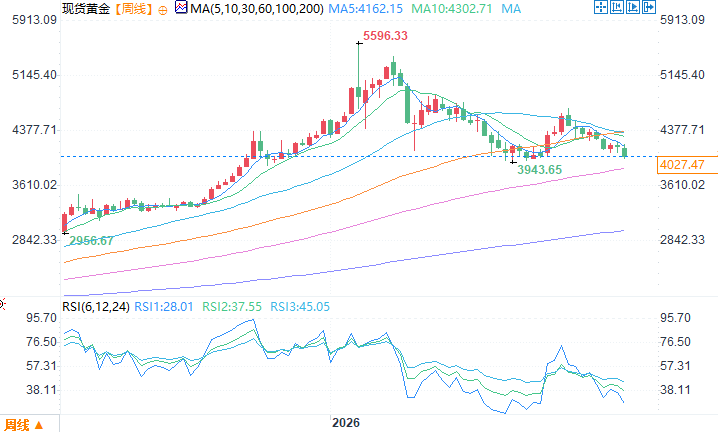 Spot gold weekly chart source: FX678. As of 13:48 Beijing time on October 23, spot gold was trading at $4025.47 per ounce.
The bull market has faded, but the strategic logic remains.
In a recent report, market strategists at HSBC Asset Management wrote that the spectacular bull run in gold earlier this year, which saw prices soar above $5,000 an ounce, has faded. "Prices are falling, volatility is rising—should investors give up?" they asked. They cautioned that while gold has underperformed since the beginning of the year against a backdrop of high oil prices, rising interest rates, and soaring bond yields, "geopolitical fragmentation and central bank reserve diversification continue to support demand, and gold still has a compelling strategic case in portfolios." The strategists further noted that the "depreciation trade"—shifting capital to "hard assets" like gold—can continue amid lingering debt and inflation concerns. "Although volatility has spiked, it doesn't look as bad compared to historical levels."With recent hedging failures, diversification tools have become crucial.
However, HSBC also warned that recent market movements show gold has failed to serve as an effective hedge against stock market pullbacks. Strategists pointed out, "Stock market crashes can trigger margin calls, forcing investors to liquidate their gold positions to raise cash. Therefore, while gold appears to be a robust hedge against systemic risk in a multipolar world, it cannot guarantee a buffer against short-term volatility." They concluded, "This reminds us that no single asset can withstand all types of market stress, and that's why diversification remains a crucial strategy for investors today."Gold prices are driven by yields, with short-term range-bound trading and a medium-term bullish outlook.
HSBC previously stated in July that despite rising US Treasury yields and a stronger dollar, increasing diversification demand, central bank purchases, and ETF inflows should support further upside for gold prices by the end of 2026. Willem Sels, Global Chief Investment Officer, and Lucia Ku, Global Head of Wealth Insights, wrote: "Gold did not rise during the Middle East conflict, largely moving in tandem with the stock market. Our analysis shows that US Treasury yields are the main driver of gold prices. We believe that gold prices are likely to remain range-bound in the short term against the backdrop of higher real yields and a stronger dollar. However, diversification demand, central bank purchases, and stable ETF inflows should support gold prices in the medium term. We continue to view gold as an effective diversification tool for broader portfolio risk." Sels and Ku explained that when yields rise, the opportunity cost of holding non-yielding assets increases, thus putting downward pressure on gold prices; furthermore, gold's effectiveness as a stock hedge is poor in 2026, largely moving in tandem with the stock market. They expect gold prices to trade within a range in the short term, but "diversified demand, central bank purchases, and inflows into stabilizing ETFs continue to support our bullish view on gold and its role as a broader portfolio risk diversification tool. We expect gold prices to have further upside potential before the end of the year ."Gold in conflict is like an insurance policy that has been cashed out.
Back in May, HSBC's chief precious metals analyst, James Steel, stated that gold's performance throughout the Iranian conflict was entirely in line with expectations. He noted that demand from major Asian countries had been consistently strong, with the country's gold exchange trading at a premium—the difference between the domestic price and the global price was approximately $20—indicating robust domestic demand, primarily concentrated in the institutional sector. He said, "Interestingly, demand is coming less from traditional jewelry, coins, and small bars, and more from large bars, mainly institutionally, due to regulatory reforms in both countries. Top insurance companies in major Asian countries are now allowed to stockpile gold bars, and asset managers in India are also permitted to do so." When asked what lessons had been learned from the spot price peak of around $5,600 per ounce at the end of January and the subsequent pullback during the Middle East conflict, Steel said, "I think the rally was a bit too strong. We brought in a lot of money that hadn't been in the market for a long time, or even never traded gold. You could say the market was overbought, especially looking at the Commodity Futures Trading Commission data." He refuted critics' claims that "gold is not a safe haven and has failed." He said, "On the contrary, because with rising oil prices, renewed inflation concerns, rising bond yields, and a stronger dollar, stocks are falling. In this atmosphere, people need readily available cash, and that's exactly what gold provides. We are indeed seeing a liquidation in the gold market, but it's mainly a reaction to the financial markets. In a sense, gold is an insurance policy, and that policy is being cashed out."The correlation between gold and oil is weakening; gold combines the characteristics of a hard asset and liquidity.
Steele was also asked about the historical relationship between gold and oil prices. He said, "It's interesting because I can recall periods when they were positively correlated. In the 1970s, gold and oil prices were positively correlated, meaning that when oil prices rose, gold prices rose too; the same was true in the 1980s, when oil prices fell, gold prices fell too; and in the 1990s, as oil's importance in the global economy declined, this correlation seemed to break down. Now the correlation is only about 0.15, sometimes even negative… currently it's negative." When asked whether gold is an alternative asset in an investor's portfolio or a separate asset, Steele believes it can be considered an alternative asset. He said, "It's quite unique; it's both a hard asset and highly liquid and actively traded. In the long run, it often doesn't correlate with Apple or Nvidia. For example, Canadian farmland is also a hard asset, but it can't be quickly converted into cash. That's the beauty of gold: it's both a hard asset and highly liquid and highly traded." He added that many asset managers who had never included gold in their portfolios before are now starting to do so because they are looking for alternative assets, and this trend is expected to reappear.Conclusion
The short-term pullback in gold prices and the temporary failure of its hedging function have not shaken HSBC's medium- to long-term confidence in gold as a portfolio diversification tool. In an environment intertwined with debt, inflation, and geopolitical fragmentation, the underlying theme of "trading for depreciation" remains, but investors should remember the reminder: a single asset cannot cope with all pressures, and truly sound allocation means diversifying itself. Spot gold weekly chart source: FX678. As of 13:48 Beijing time on October 23, spot gold was trading at $4025.47 per ounce.
- Risk Warning and Disclaimer
- The market involves risk, and trading may not be suitable for all investors. This article is for reference only and does not constitute personal investment advice, nor does it take into account certain users’ specific investment objectives, financial situation, or other needs. Any investment decisions made based on this information are at your own risk.