The euro failed to break through the "French barrier" against the dollar.
2026-10-23 19:26:21
Capital outflows from France are dragging down the euro. Safe-haven demand is pushing up the yen and Swiss franc. Meanwhile, shifts in risk sentiment are reshaping global capital flows, highlighting the traditional roles of the dollar, yen, and Swiss franc.  Amid a sharp decline in US Treasury yields, the US dollar is attempting to regain its upward trend. The US Dollar Index (DXY) is supported by both rising oil prices and a weaker euro (the largest weighted currency in the basket of major currencies). Capital outflows triggered by the sell-off of French assets, coupled with market speculation about potential intervention in the European Central Bank (ECB) bond market, have continued to put pressure on the euro against the dollar. It's worth noting that the decline in US Treasury yields should have been bearish for the dollar, but the dollar has not weakened as a result—this seemingly contradictory combination precisely illustrates that the market's focus has shifted from "yield differentials" to "Europe's own credit risk," with the dollar's strength stemming more from the "relative strength" of its weaker counterpart. Non-residents hold 55% of French debt, while this proportion is more moderate in the US, at approximately 30%-33%, not to mention Japan's 13%. According to Barclays estimates, approximately 31% of French debt is held by non-European investors. The sell-off of French assets directly led to capital outflows and pushed the euro weaker against major global currencies. A high proportion of foreign ownership means that if the fiscal or political situation in France deteriorates, the withdrawal of foreign capital will create a self-reinforcing spiral: selling will depress asset prices, and falling prices will further stimulate selling, ultimately accelerating the decline of the euro. Furthermore, market participants are increasingly discussing various options for the European Central Bank (ECB) to quell the bond market panic. Initially, the ECB might resort to verbal intervention, followed by reducing the scale of bond issuance, thus constituting a policy easing. Finally, as a last resort, there is the TPI (Transmission Protection Instrument)—a program used to purchase government bonds of stressed countries. The latter two measures are, in a sense, monetary stimulus, increasing the supply of euros, which, against the backdrop of the Federal Reserve tightening policy, is likely to put pressure on the euro against the dollar. In other words, even if the ECB intervenes to "put out the fire," the side effect will be injecting more euro liquidity into the market. This, with one side tightening and the other easing, will further widen the interest rate differential between Europe and the US, depressing the euro. Meanwhile, amid the French budget crisis, the sell-off in technology stocks, concerns about escalating conflicts in the Middle East, and the uncertainty brought about by the US midterm elections, the Swiss franc and the Japanese yen have regained their role as safe-haven assets. This "perfect storm" environment, with multiple negative factors converging, is precisely the time for funds to seek certainty. The Swiss franc and the Japanese yen, with their safe-haven attributes and relatively sound fiscal fundamentals, have once again become safe havens for capital. The 10-year US Treasury yield fell below 5%, pushing the dollar/yen pair to a five-week low, but the pair subsequently rebounded from that level, supported by rising Brent crude oil prices.
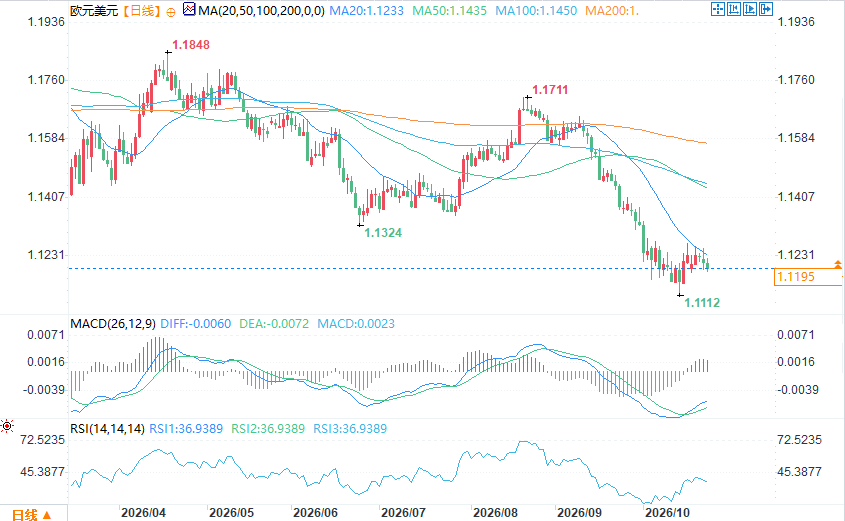 (EUR/USD Daily Chart Source: FX678) According to Claus Vistesen of Pansen Macro, Japanese investors hold approximately 10%-15% of French debt. Against the backdrop of the Bank of Japan tightening monetary policy and rising safe-haven demand, these investors are increasingly turning their attention to Japanese bonds. The natural consequence is that the euro has weakened against the yen to a 12-month low, falling 5.7% since the end of August. A peak formed around 188, echoing the highs of 1990. At that time, that marked a global reversal: a 14% drop in the following eight weeks, a drop of over 20% in the next year, and a decline of nearly 50% over the subsequent decade. While historical patterns don't simply repeat themselves, the key level of 188 still holds strong psychological and technical significance for traders—if the euro/yen pair tops again near this area, its potential downside is considerable. However, with a series of major central bank meetings scheduled for the last week of October, the possibility of the foreign exchange market entering a consolidation and wait-and-see phase is increasing. Before the interest rate decisions of major central banks such as the Federal Reserve and the European Central Bank are finalized, speculative funds are likely to remain on the sidelines. This means that the euro/dollar exchange rate may fluctuate within a range in the short term, awaiting new directional guidance from policymakers.
Amid a sharp decline in US Treasury yields, the US dollar is attempting to regain its upward trend. The US Dollar Index (DXY) is supported by both rising oil prices and a weaker euro (the largest weighted currency in the basket of major currencies). Capital outflows triggered by the sell-off of French assets, coupled with market speculation about potential intervention in the European Central Bank (ECB) bond market, have continued to put pressure on the euro against the dollar. It's worth noting that the decline in US Treasury yields should have been bearish for the dollar, but the dollar has not weakened as a result—this seemingly contradictory combination precisely illustrates that the market's focus has shifted from "yield differentials" to "Europe's own credit risk," with the dollar's strength stemming more from the "relative strength" of its weaker counterpart. Non-residents hold 55% of French debt, while this proportion is more moderate in the US, at approximately 30%-33%, not to mention Japan's 13%. According to Barclays estimates, approximately 31% of French debt is held by non-European investors. The sell-off of French assets directly led to capital outflows and pushed the euro weaker against major global currencies. A high proportion of foreign ownership means that if the fiscal or political situation in France deteriorates, the withdrawal of foreign capital will create a self-reinforcing spiral: selling will depress asset prices, and falling prices will further stimulate selling, ultimately accelerating the decline of the euro. Furthermore, market participants are increasingly discussing various options for the European Central Bank (ECB) to quell the bond market panic. Initially, the ECB might resort to verbal intervention, followed by reducing the scale of bond issuance, thus constituting a policy easing. Finally, as a last resort, there is the TPI (Transmission Protection Instrument)—a program used to purchase government bonds of stressed countries. The latter two measures are, in a sense, monetary stimulus, increasing the supply of euros, which, against the backdrop of the Federal Reserve tightening policy, is likely to put pressure on the euro against the dollar. In other words, even if the ECB intervenes to "put out the fire," the side effect will be injecting more euro liquidity into the market. This, with one side tightening and the other easing, will further widen the interest rate differential between Europe and the US, depressing the euro. Meanwhile, amid the French budget crisis, the sell-off in technology stocks, concerns about escalating conflicts in the Middle East, and the uncertainty brought about by the US midterm elections, the Swiss franc and the Japanese yen have regained their role as safe-haven assets. This "perfect storm" environment, with multiple negative factors converging, is precisely the time for funds to seek certainty. The Swiss franc and the Japanese yen, with their safe-haven attributes and relatively sound fiscal fundamentals, have once again become safe havens for capital. The 10-year US Treasury yield fell below 5%, pushing the dollar/yen pair to a five-week low, but the pair subsequently rebounded from that level, supported by rising Brent crude oil prices. (EUR/USD Daily Chart Source: FX678) According to Claus Vistesen of Pansen Macro, Japanese investors hold approximately 10%-15% of French debt. Against the backdrop of the Bank of Japan tightening monetary policy and rising safe-haven demand, these investors are increasingly turning their attention to Japanese bonds. The natural consequence is that the euro has weakened against the yen to a 12-month low, falling 5.7% since the end of August. A peak formed around 188, echoing the highs of 1990. At that time, that marked a global reversal: a 14% drop in the following eight weeks, a drop of over 20% in the next year, and a decline of nearly 50% over the subsequent decade. While historical patterns don't simply repeat themselves, the key level of 188 still holds strong psychological and technical significance for traders—if the euro/yen pair tops again near this area, its potential downside is considerable. However, with a series of major central bank meetings scheduled for the last week of October, the possibility of the foreign exchange market entering a consolidation and wait-and-see phase is increasing. Before the interest rate decisions of major central banks such as the Federal Reserve and the European Central Bank are finalized, speculative funds are likely to remain on the sidelines. This means that the euro/dollar exchange rate may fluctuate within a range in the short term, awaiting new directional guidance from policymakers.
- Risk Warning and Disclaimer
- The market involves risk, and trading may not be suitable for all investors. This article is for reference only and does not constitute personal investment advice, nor does it take into account certain users’ specific investment objectives, financial situation, or other needs. Any investment decisions made based on this information are at your own risk.