The US dollar fell below 1.40 against the Canadian dollar. How will Canadian retail data reshape the pricing of interest rate hikes?
2026-10-23 21:32:21
On Friday, October 23, Statistics Canada released its retail trade report, showing that retail sales rose 0.7% month-over-month in September, continuing the growth trend from August. Meanwhile, the USD/CAD exchange rate fell below the 1.40 level, hovering near a one-month low, with market focus significantly increasing on the Bank of Canada's interest rate decision on October 28. Consumer spending data and energy price-driven inflation together constitute the main fundamental background for the current volatility of the Canadian dollar. 
 Exchange rate fluctuations are interconnected with interest rate expectation gaps, energy prices, and trade-related factors. As a commodity currency, the Canadian dollar is highly sensitive to crude oil prices, and high energy prices both push up inflation and affect the structure of real income and expenditure.
Latest data on Canadian retail sales
Statistics Canada releases its monthly retail trade data, typically about seven weeks after the end of the reference month, along with preliminary estimates for the following month. The 0.7% month-over-month increase in September follows a revised increase in August, creating a continuation of the previous month's expansion. Core retail sales (excluding auto and parts dealerships, gas stations, and fuel suppliers) receive greater market attention because fluctuations in auto sales and gasoline prices can easily distort the total. Previously released RBC cardholder spending data showed a core sales increase of approximately 0.5% month-over-month in September, cross-validating the official preliminary data. Food and beverage retailers saw a 1.1% increase in sales, with furniture and appliances also performing strongly, contrasting with continued weakness in housing-related data. Gas station sales saw nominal growth driven by price increases, but the actual change in purchase volume after breaking down price and volume was limited. The data is broken down by sub-sectors, including general merchandise, health and personal care, building materials and gardening equipment, and apparel, and includes e-commerce and provincial results. This report only counts goods sold through physical stores and online channels, excluding spending on services such as travel, dining, and entertainment, thus representing a portion of consumer health indicators.Bank of Canada policy expectations and market pricing changes
The Bank of Canada has maintained its overnight interest rate target at 2.25%, unchanged for several consecutive meetings. The next interest rate decision will be announced on October 28th, along with the quarterly monetary policy report. Market pricing indicates a near 80% probability of a 25 basis point rate hike to 2.50%. Bank of Canada Governor Tiff Macklem recently stated during an IMF meeting in Bangkok that the ongoing conflict in the Middle East has kept crude oil and petroleum product prices high, leading to a significant upward revision of inflation forecasts. He noted that if inflation fails to return to the 2% target on its own, policy adjustments are expected. The Consumer Price Index (CPI) rose 3.1% year-on-year in September, up from 3.0% in August, primarily driven by a 27.8% year-on-year increase in gasoline prices. Excluding gasoline, inflation was 2.2%. Among the core indicators monitored by the Bank of Canada, the CPI-trim was 1.8%, and the CPI-median was 1.9%. Regarding the labor market, employment fell by 68,000 in September, and the unemployment rate rose to 6.5%. Compared to the Federal Reserve, the market has priced in a lower rate hike at the Fed's October meeting, leading to a divergence in near-term policy paths and putting downward pressure on the USD/CAD exchange rate.Recent trends in the USD/CAD exchange rate
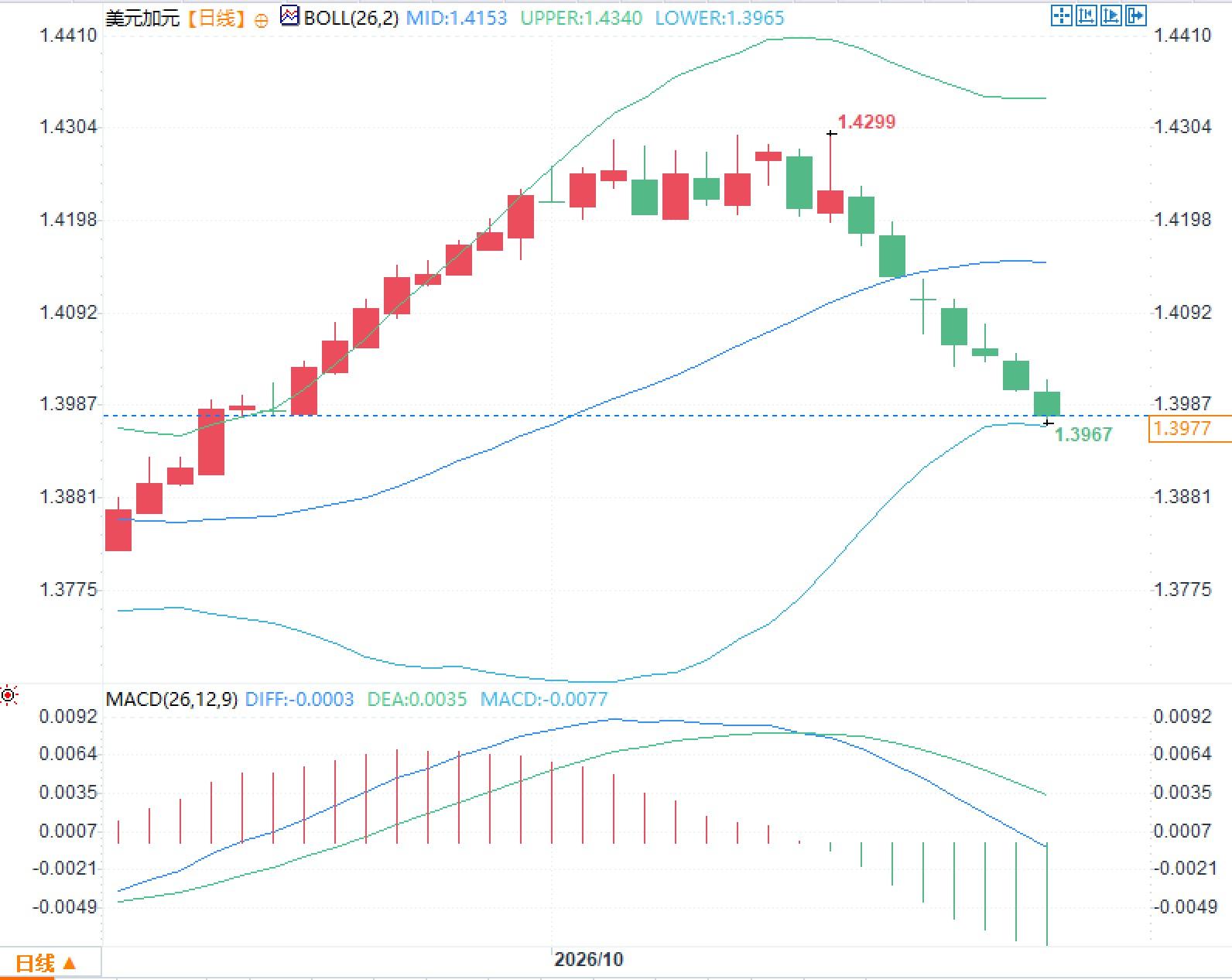
The USD/CAD pair has fallen below the 1.40 level. Over the past week, the exchange rate fluctuated between approximately 1.3975 and 1.417, showing an overall downward trend. From a technical chart perspective, the Bollinger Band middle line is around 1.4153, the upper line is at 1.4340, and the lower line is at 1.3965; the price is currently trading below the middle line and approaching the lower line area. In the MACD indicator, the DIFF is -0.0003, the DEA is 0.0035, and the histogram is negative, indicating weak short-term momentum. Exchange rate fluctuations are interconnected with interest rate expectation gaps, energy prices, and trade-related factors. As a commodity currency, the Canadian dollar is highly sensitive to crude oil prices, and high energy prices both push up inflation and affect the structure of real income and expenditure.The Relationship Between Consumer Spending Resilience and Economic Background
Retail sales data provides input for monthly GDP estimates and is one of the most closely watched Canadian indicators after employment and CPI. The strength of core sales influences pricing in the Bank of Canada's interest rate path, and consequently, the Canadian dollar. In the current environment, tariffs, price levels, and sentiment changes test household spending power. RBC data shows that discretionary service spending (education, entertainment, travel, etc.) remained the main driver of growth in September, although the moving average growth rate slowed in March; spending on necessities (excluding gasoline) continued to grow, supported by groceries and utilities. Housing-related sales remained weak, contrasting with the relative strength in furniture and appliances, reflecting the difference in household spending between high-value durable goods and everyday consumption. Retail data does not cover service spending, which accounts for a significant portion of consumption; therefore, overall consumer health needs to be observed in conjunction with other high-frequency indicators. High energy prices directly push up nominal spending through gasoline and heating fuels, but actual purchases may not expand in tandem. These factors collectively influence the Bank of Canada's trade-off between its inflation target and growth momentum.Frequently Asked Questions
Question 1: Why do preliminary estimates of retail sales often receive more market attention than full-month data? Answer: Preliminary estimates are released closer to the present, are more timely, and historically, they show a higher degree of agreement with the final reading. Full-month data, due to statistical lag, leads the market to tend to use the latest preliminary signals to adjust expectations for consumption and growth when pricing. Question 2: What is the connection between the recent drop in USD/CAD below 1.40 and the divergence in policy pricing between the Bank of Canada and the Federal Reserve? Answer: The market's pricing in a Bank of Canada rate hike next week is significantly higher than its pricing in a near-term Fed rate hike. When the interest rate expectation gap widens, the Canadian dollar gains support against the US dollar, pushing the USD/CAD exchange rate lower. Energy prices and trade factors also affect this currency pair. Question 3: With retail sales growth and a weakening labor market coexisting, how should we understand the actual state of consumer spending? Answer: Nominal retail growth is partly driven by prices, and core and volume-price breakdown data are closer to actual purchase volume. Discretionary categories still provide support, but declining employment and rising unemployment indicate pressure on the income side. Service spending and actual purchasing power require further data verification.- Risk Warning and Disclaimer
- The market involves risk, and trading may not be suitable for all investors. This article is for reference only and does not constitute personal investment advice, nor does it take into account certain users’ specific investment objectives, financial situation, or other needs. Any investment decisions made based on this information are at your own risk.