Despite Trump's expansion of oil infrastructure spending, oil prices still surged past $102!
2026-10-23 22:00:21
Trump invoked the Defense Production Act to ramp up domestic oil infrastructure development; however, escalating tensions between the Houthis and Saudi Arabia in the Bab el-Mandeb Strait, coupled with rigid commercial constraints on shale oil production, have led to continued oil price increases. On October 22, Trump signed a memorandum under the Defense Production Act to promote the expansion of energy infrastructure in the United States, including oil production, storage, pipelines, and refining, in an attempt to alleviate the pressure of high oil prices caused by the Iranian conflict. Meanwhile, Iran's Tasnim News Agency reported that Saudi warplanes launched airstrikes on the port of Moha in Yemen, attacking the port area three times, indicating that the influence of the Houthis and Saudi Arabia on the Bab el-Mandeb Strait is deepening. However, the shale oil industry is constrained by practical limitations such as capital discipline, long-term profitability assessments, and bottlenecks in oilfield services and well locations. Administrative incentives are difficult to quickly translate into substantial incremental growth, resulting in a significant time lag in their effect on suppressing oil prices. 
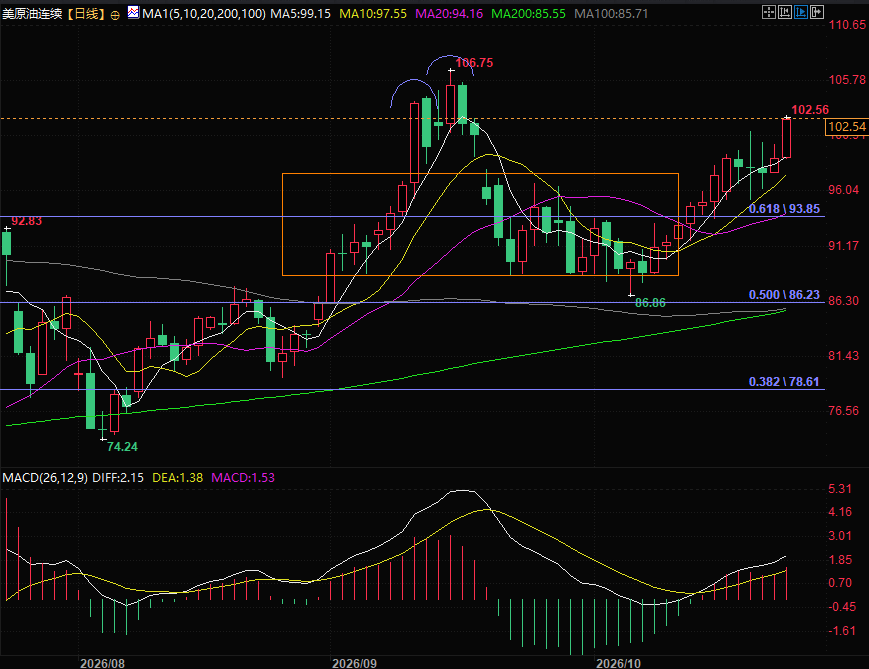 (WTI crude oil futures daily chart, source: FX678) At 21:57 Beijing time, WTI crude oil futures are currently trading at 102.24.
Background: Trump signed a memorandum to promote the expansion of oil production across the entire supply chain under the guise of defense.
On October 22, Trump signed a memorandum invoking the Defense Production Act of 1950, authorizing the Secretary of War to accelerate infrastructure development in the U.S. domestic oil industry chain under the guise of national security. This initiative utilizes financial tools such as direct procurement, long-term procurement commitments, loans, and guarantees to cover oil and gas exploration and production, storage, shipping terminals, pipelines, and refining capacity. It also exempts some routine approval processes within the act, aiming to offset the pressure of rising oil prices due to the conflict with Iran. This action follows his executive order on the energy emergency issued in January 2025. The government had previously announced plans to support the expansion of commercial and military fuel production at Delek's refinery in Texas; in April of this year, Trump also invoked the same act to boost the coal and liquefied natural gas industry chains. With Brent crude oil currently holding above $113 per barrel, and U.S. gasoline and diesel retail prices remaining high, coupled with the approaching midterm elections in November, this memorandum simultaneously reflects energy security concerns and considerations related to the election cycle.Real-world constraints: Shale oil production increases cannot circumvent objective commercial and physical limitations.
Despite policy incentives, the pace of production increases in the shale oil industry will not accelerate rapidly following administrative directives. The core reason is that shale oil companies have established mature capital discipline, and production increases are subject to clear preconditions. After multiple rounds of oil price crashes and subsequent company exits, the operational focus of US-listed shale oil companies has long since shifted from "pushing production at any cost" to ensuring stable cash flow, reducing debt, and distributing dividends and repurchasing shares. Industry standard practice dictates that before approving new drilling capital expenditures, companies must confirm stable profitability over the next six months; short-term price spikes alone are insufficient to support large-scale drilling. Companies are generally concerned that the current oil price increase stems from short-term geopolitical disturbances in the Middle East. If the conflict eases and oil prices quickly fall, previous drilling and fracturing investments will become loss-making assets, leading to negative feedback from the capital market.In addition, multiple hard constraints also limit the release of elastic supply:
High-quality, high-return well sites continue to be depleted, and the number of readily available production wells (DUCs) is steadily decreasing, resulting in a thinning of short-term idle capacity. There is a shortage of oilfield service workers, fracturing equipment, and drilling rigs, and the expansion cycle for oilfield service capacity itself is several months long. The approval processes for pipeline, storage tank, and offshore terminal projects are lengthy, and even if upstream producers are willing to increase production, bottlenecks in crude oil transportation remain. There is a significant divergence in break-even points across different basins, with break-even oil prices in peripheral blocks generally at $60-65 per barrel. Weakening long-term oil price expectations will directly suppress drilling activity. A Dallas Fed energy survey continues to show that shale oil executives' primary concern is the extreme volatility of geopolitically driven oil prices, coupled with numerous external conflicts and policy uncertainties, making it difficult to build a stable long-term profit model.Objective assessment from the memorandum: Focus on expectation management; it's difficult to quickly suppress oil prices in the short term.
In the short term, this memorandum leans more towards an expectation management tool. On one hand, it signals to voters and the market that the government has ways to cope with high oil prices; on the other hand, relying on the financial support and targeted orders within the bill, it prioritizes long-cycle infrastructure projects such as refinery upgrades, storage tanks, and pipelines, which will be more effective in ensuring the supply of military fuel. Procurement commitments and loan guarantees can partially hedge companies' long-term price risks and are suitable for locking in defense-related fuel orders, but it is unlikely to trigger an immediate and significant increase in upstream shale oil production. In the medium to long term, the bill can only provide fiscal incentives and simplified approval processes; it cannot rewrite the underlying business logic. The government can provide funding and ease approvals, but it cannot bear the losses caused by declining oil prices for oil and gas companies. If the long-term crude oil price curve cannot stably stay above the industry's break-even point, capital will still constrain corporate capital expenditures, and the pace of incremental shale oil production will remain slow.Market Implications: While supply is expected to improve marginally in the medium to long term, it is difficult to offset the Middle East risk premium in the short term.
From a crude oil trading perspective, this policy represents a potential medium- to long-term supply-side benefit, but its short-term incremental impact is very limited. The current core driver of oil prices is the risk premium from the Strait of Hormuz and Middle East conflicts; domestic infrastructure expansion is unlikely to quickly offset this disruption. In summary, this memorandum is positioned to support the US domestic energy supply chain, rather than a magic bullet to immediately lower oil prices. The core factor determining the actual increase in shale oil production remains whether the long-term oil price curve can consistently stay above the break-even point and whether the capital market will re-accept the business model of production expansion. Technically: Previous articles have consistently suggested that oil prices are likely to continue rising. WTI crude oil has not fallen despite bearish factors and is near its previous high, leading to a surge in stop-loss orders from short sellers. (WTI crude oil futures daily chart, source: FX678) At 21:57 Beijing time, WTI crude oil futures are currently trading at 102.24.
- Risk Warning and Disclaimer
- The market involves risk, and trading may not be suitable for all investors. This article is for reference only and does not constitute personal investment advice, nor does it take into account certain users’ specific investment objectives, financial situation, or other needs. Any investment decisions made based on this information are at your own risk.