Houthi attacks reignite supply concerns, oil prices rise across the board this week, Iran threatens Persian Gulf undersea cable
2026-10-24 08:04:21
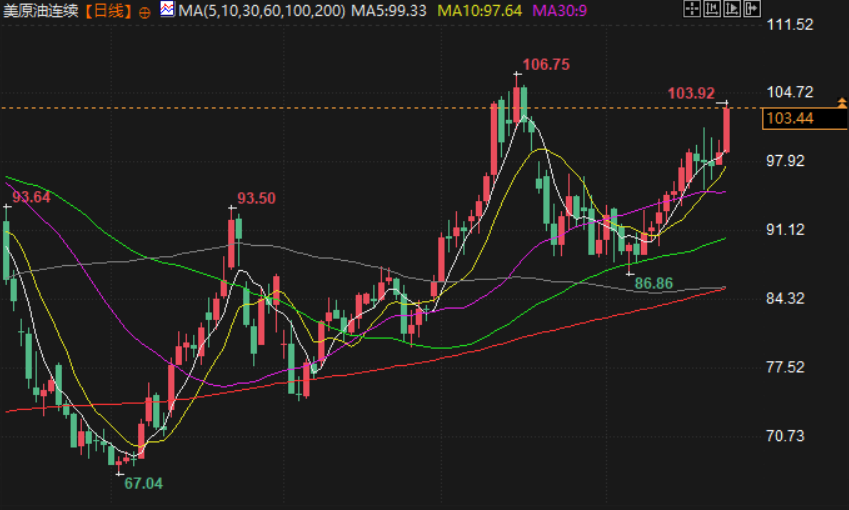
Oil prices rose this week, with WTI crude oil up 4.44% to close at $103.44 per barrel, a more than one-month high; Brent crude oil rose 6.51% to close at $116.80 per barrel, having reached a seven-month high of $117.40 per barrel earlier in the week. The core trigger for this round of oil price increases was the Houthi attacks on Saudi Arabia, particularly attacks on energy infrastructure, which sparked market concerns about further disruptions to energy supplies in the Middle East.  On a deeper level, Saudi Aramco's order to evacuate its headquarters in Dhahran, eastern Saudi Arabia, on Thursday carries strong symbolic significance: the core energy institution of the world's largest crude oil exporter has entered a risk response state, amplifying geopolitical risk premiums. Meanwhile, the UAE Ministry of Climate Change and Environment announced an oil spill off the coast of Umm Al Quwain, the cause and identity of which remain unconfirmed. The combined impact of the attack and the oil spill has shifted market focus from Middle Eastern exports, shipping, and infrastructure security to mere inventory data. Seven-month high oil prices indicate that traders are repricing potential supply disruptions. US Strategic Reserve Emergency Release The US Department of Energy approved the emergency release of up to 400,000 barrels of crude oil from the Strategic Petroleum Reserve to address supply disruptions affecting Phillips 66's Lake Charles refinery in Louisiana. The refinery has a daily processing capacity of approximately 264,000 barrels; 400,000 barrels roughly equates to about one and a half days of processing capacity. Therefore, this release is more targeted and emergency-oriented than a large-scale price-suppressing tool. The Department of Energy stated that this move will help offset temporary disruptions and support continued production of transportation fuels to Louisiana and surrounding markets. However, the background is more noteworthy: Strategic Petroleum Reserves (SPRs) have fallen to their lowest level since 1982. The Trump administration used reserves due to supply chain disruptions caused by the US-Iran war, and former President Biden also used them after the Russia-Ukraine conflict. This means that the US's policy buffer against a new round of supply shocks is narrowing. Meanwhile, rising fuel prices are putting pressure on the US midterm elections, and releasing SPRs has both a supply-guarantee function and clear political and economic implications. The market will judge that the US has limited emergency reserves available, and if Middle East risks escalate in the future, policy tools will rely more on diplomacy, allied coordination, and trade arrangements. Germany Sells Strategic Reserves Germany's national petroleum reserve agency, EBV, issued a tender notice, planning to sell diesel, heating oil, and crude oil from its strategic reserves. This is the first time Germany has sold its strategic oil reserves since the G7 agreed to release them under pressure from Trump in early October. This action indicates that, facing high oil prices and diesel supply pressure, Europe is beginning to transform its strategic reserves from a "static safety cushion" into a "market adjustment tool." Germany's sale echoes the US's release of reserves, forming a transatlantic policy response, but with different logics: the US emphasizes emergency allocations to address refinery supply disruptions, while Germany directly increases market supply by selling refined petroleum products and crude oil through tenders. The effectiveness depends on the pace of sales, buyer structure, and shipping cycles. More importantly, the G7's coordinated release of reserves indicates that this round of price pressures is seen as an energy security issue requiring collective action; however, reserves are dwindling, and if the Houthi attacks continue or the risk in the Strait of Hormuz increases, Europe's subsequent buffer space will be compressed. US-Russia Diesel Agreement and First Shipments Ship tracking data shows that the Maltese-flagged medium-sized tanker Agioi Fanendes loaded 40,000 tons of ultra-low sulfur diesel at the Russian Baltic port of Primorsk on October 22, and is expected to arrive in the US on November 7. This will be the first shipment of Russian diesel received by the US since former President Biden announced a ban on imports of Russian oil and petroleum products in 2022. Trump presented this unexpected Russian diesel import agreement as part of his efforts to lower high diesel prices ahead of the November 3 midterm elections. The political implications of this arrangement outweigh its commercial ones. Trump also waived parts of a new U.S. sanctions bill against Russia and warned that the U.S. would ban diesel exports to Europe unless Europe releases more strategic reserves. The agreement also includes Russia agreeing to lift its own diesel export ban; Trump announced on October 9 that Russia would immediately export 300,000 tons of diesel to the U.S. and global markets, 500,000 tons in November, and an additional 1 million tons thereafter. The Russian Foreign Minister stated that by the end of the year, Russian diesel exports would return to normal levels of 3 million to 3.5 million tons per month. This demonstrates the deepening politicization of energy trade: the U.S. traded sanctions waivers and import arrangements for easing diesel prices, Russia seized the opportunity to resume exports, and Europe was pressured to shoulder more reserve release pressure. Subsequent shipping and payment issues could still affect the implementation of the agreement. The Iran War and the Threat of Submarine Cables Trump stated on Friday that the U.S. might launch another military operation against Iran, saying, "We might have another small-scale, epic firefight." The current war has been ongoing for nearly eight months, and rising fuel prices are putting pressure on the U.S. midterm elections. On the one hand, he claimed the US could end the war quickly, while on the other hand, he questioned whether the conflict should be resolved completely or allowed to subside gradually. Earlier this month, he also stated that the US would not attack Iran before the midterm elections, when control of Congress was uncertain. Trump also claimed that oil was being transported smoothly through the Strait of Hormuz, saying, "We got everything we wanted." Iran's response extended the risks to digital infrastructure. Two senior Iranian security officials stated that Tehran had plans to target submarine communication cables in the Persian Gulf should the US and Israel launch another attack, and would attempt to obstruct repairs to damaged cables in order to prolong the disruption of communications, including internet connectivity; one of them stated that "there will no longer be any red lines." The deputy head of political affairs for the Iranian Revolutionary Guard, Javani, said on Wednesday that if Iranian infrastructure were attacked, the seven major submarine internet cables under the Strait of Hormuz might be targeted. According to data from the International Telecommunication Union, submarine fiber optic cables carry approximately 99% of global internet data traffic; however, TeleGeography's research director, Mordin, stated that international bandwidth transmitted through the Strait of Hormuz accounts for less than 1% of the global total, so the impact on the global internet is likely limited. Rezai also warned that data centers and artificial intelligence facilities in the Gulf region linked to the United States could be targeted. Such rhetoric is intended to escalate deterrence and pressure Gulf states and US companies to put pressure on Washington. Overall, this represents a risk of energy and digital corridors intersecting, but the global communications disruption should not be overestimated; regional disruptions and delayed repairs are more realistic risks. Ukraine-Russia-US Abu Dhabi Talks Ukrainian President Zelensky stated that peace negotiators from Ukraine, Russia, and the United States have agreed to hold a technical-level meeting in Abu Dhabi in the first half of November and hope to follow up with a trilateral summit. He said he spoke with US envoys Kushner and Witkov on Friday after their meeting with Russian President Putin earlier this week. Any peace agreement must provide strong security guarantees for Ukraine and provide 10 years of funding to maintain the Ukrainian military. The fact that a similar meeting scheduled for this month ultimately failed to take place indicates that negotiations remain constrained by Russia's attitude and the conditions of all parties. The current oil market is dominated by geopolitical risk premiums: Houthi attacks on Saudi energy facilities, the UAE oil spill, the threat of war from Iran, and security concerns in the Strait of Hormuz have all contributed to pushing up Brent and US crude prices. On the policy front, the policy buffer is narrowing: the US SPR (Special Purpose Price) has fallen to its lowest level since 1982, yet it still approved an emergency allocation of 400,000 barrels; Germany sold strategic reserves under G7 coordination; and the US further suppressed diesel prices through Russian diesel imports and partial sanctions waivers. These measures can alleviate supply and price pressures in the short term, but they also indicate that conventional inventory and diplomatic tools are being used intensively. Meanwhile, the politicization of energy trade and the risks associated with digital infrastructure have broadened market observation. The US-Russia diesel agreement is directly linked to the midterm elections, and Europe is being asked to release more reserves; Iran's inclusion of undersea cables, data centers, and artificial intelligence facilities in its deterrent rhetoric, while having limited impact on the global internet, has increased regional communication and repair risks; and the Abu Dhabi talks between Ukraine, Russia, and the US could affect sanctions against Russia and energy supply expectations. The following should be closely monitored: whether the Houthi attacks continue, whether shipping in the Hormuz is disrupted, the pace of SPR and European reserve releases, the delivery of Russian diesel to ports, the progress of the Abu Dhabi talks in November, and policy changes before and after the US midterm elections. These variables will determine whether the high oil prices are a short-term shock or a more persistent risk reassessment.
On a deeper level, Saudi Aramco's order to evacuate its headquarters in Dhahran, eastern Saudi Arabia, on Thursday carries strong symbolic significance: the core energy institution of the world's largest crude oil exporter has entered a risk response state, amplifying geopolitical risk premiums. Meanwhile, the UAE Ministry of Climate Change and Environment announced an oil spill off the coast of Umm Al Quwain, the cause and identity of which remain unconfirmed. The combined impact of the attack and the oil spill has shifted market focus from Middle Eastern exports, shipping, and infrastructure security to mere inventory data. Seven-month high oil prices indicate that traders are repricing potential supply disruptions. US Strategic Reserve Emergency Release The US Department of Energy approved the emergency release of up to 400,000 barrels of crude oil from the Strategic Petroleum Reserve to address supply disruptions affecting Phillips 66's Lake Charles refinery in Louisiana. The refinery has a daily processing capacity of approximately 264,000 barrels; 400,000 barrels roughly equates to about one and a half days of processing capacity. Therefore, this release is more targeted and emergency-oriented than a large-scale price-suppressing tool. The Department of Energy stated that this move will help offset temporary disruptions and support continued production of transportation fuels to Louisiana and surrounding markets. However, the background is more noteworthy: Strategic Petroleum Reserves (SPRs) have fallen to their lowest level since 1982. The Trump administration used reserves due to supply chain disruptions caused by the US-Iran war, and former President Biden also used them after the Russia-Ukraine conflict. This means that the US's policy buffer against a new round of supply shocks is narrowing. Meanwhile, rising fuel prices are putting pressure on the US midterm elections, and releasing SPRs has both a supply-guarantee function and clear political and economic implications. The market will judge that the US has limited emergency reserves available, and if Middle East risks escalate in the future, policy tools will rely more on diplomacy, allied coordination, and trade arrangements. Germany Sells Strategic Reserves Germany's national petroleum reserve agency, EBV, issued a tender notice, planning to sell diesel, heating oil, and crude oil from its strategic reserves. This is the first time Germany has sold its strategic oil reserves since the G7 agreed to release them under pressure from Trump in early October. This action indicates that, facing high oil prices and diesel supply pressure, Europe is beginning to transform its strategic reserves from a "static safety cushion" into a "market adjustment tool." Germany's sale echoes the US's release of reserves, forming a transatlantic policy response, but with different logics: the US emphasizes emergency allocations to address refinery supply disruptions, while Germany directly increases market supply by selling refined petroleum products and crude oil through tenders. The effectiveness depends on the pace of sales, buyer structure, and shipping cycles. More importantly, the G7's coordinated release of reserves indicates that this round of price pressures is seen as an energy security issue requiring collective action; however, reserves are dwindling, and if the Houthi attacks continue or the risk in the Strait of Hormuz increases, Europe's subsequent buffer space will be compressed. US-Russia Diesel Agreement and First Shipments Ship tracking data shows that the Maltese-flagged medium-sized tanker Agioi Fanendes loaded 40,000 tons of ultra-low sulfur diesel at the Russian Baltic port of Primorsk on October 22, and is expected to arrive in the US on November 7. This will be the first shipment of Russian diesel received by the US since former President Biden announced a ban on imports of Russian oil and petroleum products in 2022. Trump presented this unexpected Russian diesel import agreement as part of his efforts to lower high diesel prices ahead of the November 3 midterm elections. The political implications of this arrangement outweigh its commercial ones. Trump also waived parts of a new U.S. sanctions bill against Russia and warned that the U.S. would ban diesel exports to Europe unless Europe releases more strategic reserves. The agreement also includes Russia agreeing to lift its own diesel export ban; Trump announced on October 9 that Russia would immediately export 300,000 tons of diesel to the U.S. and global markets, 500,000 tons in November, and an additional 1 million tons thereafter. The Russian Foreign Minister stated that by the end of the year, Russian diesel exports would return to normal levels of 3 million to 3.5 million tons per month. This demonstrates the deepening politicization of energy trade: the U.S. traded sanctions waivers and import arrangements for easing diesel prices, Russia seized the opportunity to resume exports, and Europe was pressured to shoulder more reserve release pressure. Subsequent shipping and payment issues could still affect the implementation of the agreement. The Iran War and the Threat of Submarine Cables Trump stated on Friday that the U.S. might launch another military operation against Iran, saying, "We might have another small-scale, epic firefight." The current war has been ongoing for nearly eight months, and rising fuel prices are putting pressure on the U.S. midterm elections. On the one hand, he claimed the US could end the war quickly, while on the other hand, he questioned whether the conflict should be resolved completely or allowed to subside gradually. Earlier this month, he also stated that the US would not attack Iran before the midterm elections, when control of Congress was uncertain. Trump also claimed that oil was being transported smoothly through the Strait of Hormuz, saying, "We got everything we wanted." Iran's response extended the risks to digital infrastructure. Two senior Iranian security officials stated that Tehran had plans to target submarine communication cables in the Persian Gulf should the US and Israel launch another attack, and would attempt to obstruct repairs to damaged cables in order to prolong the disruption of communications, including internet connectivity; one of them stated that "there will no longer be any red lines." The deputy head of political affairs for the Iranian Revolutionary Guard, Javani, said on Wednesday that if Iranian infrastructure were attacked, the seven major submarine internet cables under the Strait of Hormuz might be targeted. According to data from the International Telecommunication Union, submarine fiber optic cables carry approximately 99% of global internet data traffic; however, TeleGeography's research director, Mordin, stated that international bandwidth transmitted through the Strait of Hormuz accounts for less than 1% of the global total, so the impact on the global internet is likely limited. Rezai also warned that data centers and artificial intelligence facilities in the Gulf region linked to the United States could be targeted. Such rhetoric is intended to escalate deterrence and pressure Gulf states and US companies to put pressure on Washington. Overall, this represents a risk of energy and digital corridors intersecting, but the global communications disruption should not be overestimated; regional disruptions and delayed repairs are more realistic risks. Ukraine-Russia-US Abu Dhabi Talks Ukrainian President Zelensky stated that peace negotiators from Ukraine, Russia, and the United States have agreed to hold a technical-level meeting in Abu Dhabi in the first half of November and hope to follow up with a trilateral summit. He said he spoke with US envoys Kushner and Witkov on Friday after their meeting with Russian President Putin earlier this week. Any peace agreement must provide strong security guarantees for Ukraine and provide 10 years of funding to maintain the Ukrainian military. The fact that a similar meeting scheduled for this month ultimately failed to take place indicates that negotiations remain constrained by Russia's attitude and the conditions of all parties. The current oil market is dominated by geopolitical risk premiums: Houthi attacks on Saudi energy facilities, the UAE oil spill, the threat of war from Iran, and security concerns in the Strait of Hormuz have all contributed to pushing up Brent and US crude prices. On the policy front, the policy buffer is narrowing: the US SPR (Special Purpose Price) has fallen to its lowest level since 1982, yet it still approved an emergency allocation of 400,000 barrels; Germany sold strategic reserves under G7 coordination; and the US further suppressed diesel prices through Russian diesel imports and partial sanctions waivers. These measures can alleviate supply and price pressures in the short term, but they also indicate that conventional inventory and diplomatic tools are being used intensively. Meanwhile, the politicization of energy trade and the risks associated with digital infrastructure have broadened market observation. The US-Russia diesel agreement is directly linked to the midterm elections, and Europe is being asked to release more reserves; Iran's inclusion of undersea cables, data centers, and artificial intelligence facilities in its deterrent rhetoric, while having limited impact on the global internet, has increased regional communication and repair risks; and the Abu Dhabi talks between Ukraine, Russia, and the US could affect sanctions against Russia and energy supply expectations. The following should be closely monitored: whether the Houthi attacks continue, whether shipping in the Hormuz is disrupted, the pace of SPR and European reserve releases, the delivery of Russian diesel to ports, the progress of the Abu Dhabi talks in November, and policy changes before and after the US midterm elections. These variables will determine whether the high oil prices are a short-term shock or a more persistent risk reassessment.
- Risk Warning and Disclaimer
- The market involves risk, and trading may not be suitable for all investors. This article is for reference only and does not constitute personal investment advice, nor does it take into account certain users’ specific investment objectives, financial situation, or other needs. Any investment decisions made based on this information are at your own risk.