Federal Reserve Outlook: Rate hikes paused in October, but may resume in December.
2026-10-24 02:06:22
Despite strong inflation data in September and signals from the Federal Reserve that further policy measures are likely needed to curb inflation, the market and economists have reached a consensus that the Fed will keep interest rates unchanged at its FOMC meeting on October 28. However, persistently high price pressures remain a concern, and ING predicts that the Fed will resume interest rate hikes in December.  The Federal Reserve chose to hold rates steady, allowing time for observation. September's core CPI rose 0.3% month-on-month, exceeding market expectations and briefly pushing the probability of an October rate hike above 50%. However, this market sentiment did not last. Statements from Fed Vice Presidents Philip Jefferson and Michelle Bowman, along with Governor Chris Waller, signaled that there was no need to rush into adjusting monetary policy, quickly calming market volatility. Fed Chairman Kevin Warsh subsequently spoke at an IMF meeting in Bangkok, refraining from emphasizing an immediate rate hike, a stark contrast to his statements at the Jackson Hole meeting prior to the September rate hike, further lowering market expectations for an October rate increase. Admittedly, the latest employment data fell short of expectations, and sectors highly sensitive to interest rates, such as real estate, are facing increasing downward pressure. However, the overall US economy is growing strongly, and inflation remains above the policy target. Fed officials have also clearly stated that further tightening of monetary policy is needed to bring inflation back to the target range. The latest summary of the Federal Reserve's economic projections shows that four FOMC members expect a cumulative 50 basis point increase in interest rates from now until the end of the year, meaning a unanimous vote is unlikely at this meeting. Beth Hammark, Neal Kashkari, and Lori Logan, who voted for a rate hike at the July meeting despite the majority's insistence on keeping rates unchanged, are likely to vote against it again at the October meeting. The public statement from this meeting is expected to be brief, and Chairman Warsh's press conference will likely maintain a concise and pragmatic style. He is not keen on providing clear policy guidance, and his remarks will likely focus on objectively stating the current situation: the US economy is generally resilient, unemployment remains low, but inflation remains above target. Subsequent monetary policy adjustments will depend entirely on subsequent economic data, and officials generally believe there is still room for further tightening.
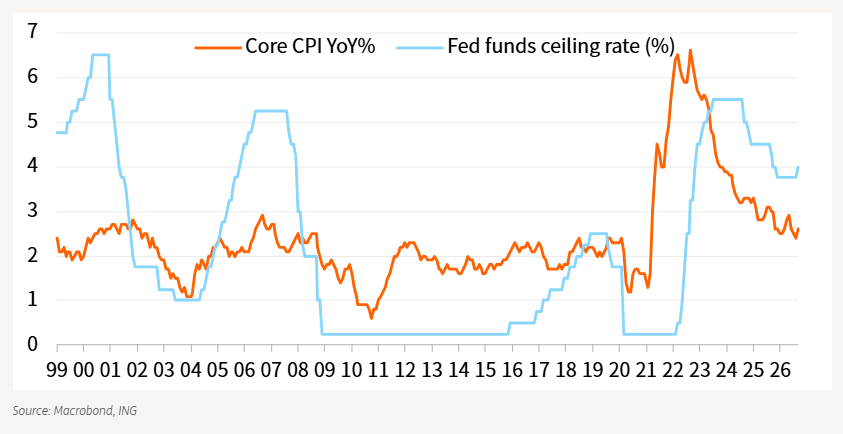 (US Core CPI Year-on-Year and Federal Funds Policy Rate Trends) Looking Towards the December FOMC Meeting: A Rate Hike Still Possible Before the December FOMC meeting, the market will receive two employment reports and one inflation data point. The November CPI data will be released the day after the December meeting, but Fed officials will almost certainly have access to it in advance. This means the Fed will have more information than the market, so the possibility of a policy surprise at the December meeting cannot be completely ruled out. We predict the Fed will raise rates by 25 basis points in December, bringing the target range for the federal funds rate to 4%–4.25%. After the rate hike, the Fed will enter a long pause period, maintaining interest rates at the current level until December 2027, at which point it will reverse the December 2026 rate hike. This assessment is consistent with current mainstream market expectations; the Fed's own baseline forecast also points to one more rate hike this year, with interest rates remaining unchanged throughout 2027. The sharp rise in US Treasury yields and the strengthening of the dollar have already tightened financial conditions to some extent. Our Fed rate path projection is based on the assumption that within months of the midterm elections, the market will reach an agreement to improve energy supply in the Persian Gulf, and more importantly, shipping and insurance costs will significantly decline. With refineries already operating at full capacity, lower shipping and insurance costs are the key to reducing retail prices of refined oil products. If this scenario materializes, inflationary pressures will be substantially alleviated. US wage growth will be only 3%, remaining moderate as the largest cost for businesses; and housing, which accounts for 35% of the inflation basket, will experience further deflation. Based on this, we believe that overall US inflation will fall back to the 2% target level in the second half of 2027. Of course, the downside risk to our baseline scenario stems from the conflict lasting longer than expected. If geopolitical conflicts remain unresolved, the Fed may continue to raise interest rates in the first quarter of 2027. However, at the same time, rising energy prices coupled with weak wage growth will further erode residents' real purchasing power; bond yields will continue to rise, and mortgage and corporate financing rates will reach new cyclical highs, increasing the risk of economic weakness. Once the economic scenario becomes more stressful, the Federal Reserve's rate cuts in the second half of 2027 will be faster and larger than the baseline forecast. The Fed will not intervene in the bond market for the time being, allowing the US Treasury market to self-regulate . The US Treasury market performed well over the past week, with the previously escalating effects of financial tightening easing somewhat. The 10-year Treasury yield fell below 5%, a stark contrast to its previous high of over 5.25%. However, we do not believe this round of yield declines can be sustained, but this market shift has created conditions for the FOMC to adopt a more dovish stance at this meeting. Increased market risk aversion has amplified the potential risks to the US economy, further increasing the probability of maintaining the current interest rate in October. Continued pressure on the French bond market has triggered anxiety in global bond markets, bringing marginal systemic pressure. In this market environment, the Fed does not want to further exacerbate market panic through rate hikes, making maintaining the current interest rate at the October meeting a reasonable choice. Whether the 10-year Treasury yield can continue to stay below 5% is another matter. Driven by factors such as sticky inflation, fiscal deficits, and the AI industry boom, we believe the 10-year US Treasury yield is likely to climb back above 5%, although the exact timing is difficult to predict. For yields to break through 5% again, risk market sentiment first needs to stabilize. However, regardless, the Fed will not actively disrupt the existing bond market structure at its October meeting. Chairman Warsh still considers balance sheet reduction a policy goal, but a clear plan for balance sheet reduction is still some time away, and we expect relevant recommendations from various committees to be disclosed around the end of the year. Currently, market liquidity is generally stable, and the repurchase market has improved significantly compared to last year. The Warsh-era FOMC meetings have become a bellwether for the dollar's direction. The Fed's statements are likely to continue supporting high US yields, and the dollar is expected to retain most of its gains since September. If the dollar experiences a downward correction, the driving factor is more likely to be a renewed risk aversion triggered by the technology sector, rather than a dovish signal from the Fed. The dollar strengthened significantly from September to early October, accumulating a 4% gain, before entering a period of consolidation. Interest rate differentials are currently the most crucial variable affecting the US dollar. The pullback in US tech stocks has suppressed market expectations for interest rate hikes, and this month's interest rate differential conditions have already slightly weakened for the dollar. Looking at a longer timeframe, the FOMC meetings chaired by Warsh this year have largely set the trend for the dollar over the next 4-6 weeks: the June meeting was hawkish, the July meeting was interpreted as dovish, and the September meeting saw the Fed implement a hawkish rate hike. Looking back at the July FOMC meeting, Warsh suggested that the bond market was already playing a role in tightening policy, a statement that drew considerable criticism. We speculate that Warsh will learn from this experience and will not simply equate widening credit spreads and stock market declines with tightening financial conditions, nor use this as a reason to reduce rate hikes. As long as Warsh adheres to policy logic and prioritizes maintaining the credibility of monetary policy, US short-term yields will receive strong support, and the dollar will largely be able to maintain its gains since early September. Conversely, high energy prices coupled with political risks in France will continue to drag down the euro's performance, and EUR/USD may fall back to its yearly low, approaching the 1.11 level.
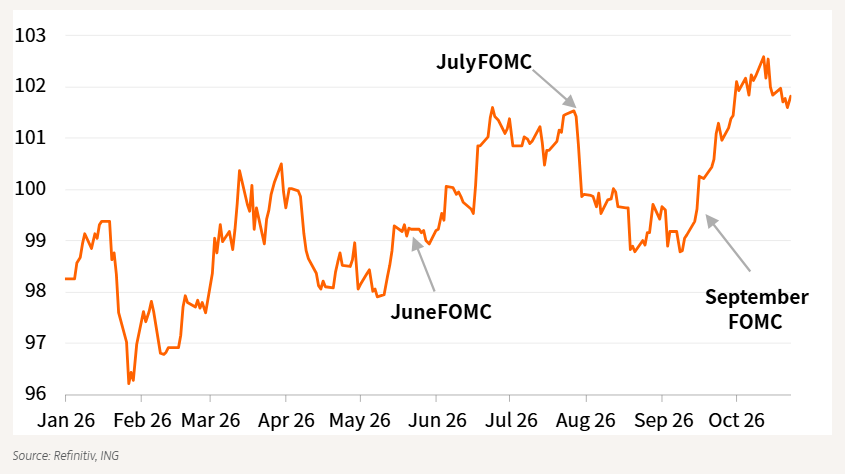 (The FOMC meeting chaired by Warsh and the trend of the US dollar index)
The Federal Reserve chose to hold rates steady, allowing time for observation. September's core CPI rose 0.3% month-on-month, exceeding market expectations and briefly pushing the probability of an October rate hike above 50%. However, this market sentiment did not last. Statements from Fed Vice Presidents Philip Jefferson and Michelle Bowman, along with Governor Chris Waller, signaled that there was no need to rush into adjusting monetary policy, quickly calming market volatility. Fed Chairman Kevin Warsh subsequently spoke at an IMF meeting in Bangkok, refraining from emphasizing an immediate rate hike, a stark contrast to his statements at the Jackson Hole meeting prior to the September rate hike, further lowering market expectations for an October rate increase. Admittedly, the latest employment data fell short of expectations, and sectors highly sensitive to interest rates, such as real estate, are facing increasing downward pressure. However, the overall US economy is growing strongly, and inflation remains above the policy target. Fed officials have also clearly stated that further tightening of monetary policy is needed to bring inflation back to the target range. The latest summary of the Federal Reserve's economic projections shows that four FOMC members expect a cumulative 50 basis point increase in interest rates from now until the end of the year, meaning a unanimous vote is unlikely at this meeting. Beth Hammark, Neal Kashkari, and Lori Logan, who voted for a rate hike at the July meeting despite the majority's insistence on keeping rates unchanged, are likely to vote against it again at the October meeting. The public statement from this meeting is expected to be brief, and Chairman Warsh's press conference will likely maintain a concise and pragmatic style. He is not keen on providing clear policy guidance, and his remarks will likely focus on objectively stating the current situation: the US economy is generally resilient, unemployment remains low, but inflation remains above target. Subsequent monetary policy adjustments will depend entirely on subsequent economic data, and officials generally believe there is still room for further tightening. (US Core CPI Year-on-Year and Federal Funds Policy Rate Trends) Looking Towards the December FOMC Meeting: A Rate Hike Still Possible Before the December FOMC meeting, the market will receive two employment reports and one inflation data point. The November CPI data will be released the day after the December meeting, but Fed officials will almost certainly have access to it in advance. This means the Fed will have more information than the market, so the possibility of a policy surprise at the December meeting cannot be completely ruled out. We predict the Fed will raise rates by 25 basis points in December, bringing the target range for the federal funds rate to 4%–4.25%. After the rate hike, the Fed will enter a long pause period, maintaining interest rates at the current level until December 2027, at which point it will reverse the December 2026 rate hike. This assessment is consistent with current mainstream market expectations; the Fed's own baseline forecast also points to one more rate hike this year, with interest rates remaining unchanged throughout 2027. The sharp rise in US Treasury yields and the strengthening of the dollar have already tightened financial conditions to some extent. Our Fed rate path projection is based on the assumption that within months of the midterm elections, the market will reach an agreement to improve energy supply in the Persian Gulf, and more importantly, shipping and insurance costs will significantly decline. With refineries already operating at full capacity, lower shipping and insurance costs are the key to reducing retail prices of refined oil products. If this scenario materializes, inflationary pressures will be substantially alleviated. US wage growth will be only 3%, remaining moderate as the largest cost for businesses; and housing, which accounts for 35% of the inflation basket, will experience further deflation. Based on this, we believe that overall US inflation will fall back to the 2% target level in the second half of 2027. Of course, the downside risk to our baseline scenario stems from the conflict lasting longer than expected. If geopolitical conflicts remain unresolved, the Fed may continue to raise interest rates in the first quarter of 2027. However, at the same time, rising energy prices coupled with weak wage growth will further erode residents' real purchasing power; bond yields will continue to rise, and mortgage and corporate financing rates will reach new cyclical highs, increasing the risk of economic weakness. Once the economic scenario becomes more stressful, the Federal Reserve's rate cuts in the second half of 2027 will be faster and larger than the baseline forecast. The Fed will not intervene in the bond market for the time being, allowing the US Treasury market to self-regulate . The US Treasury market performed well over the past week, with the previously escalating effects of financial tightening easing somewhat. The 10-year Treasury yield fell below 5%, a stark contrast to its previous high of over 5.25%. However, we do not believe this round of yield declines can be sustained, but this market shift has created conditions for the FOMC to adopt a more dovish stance at this meeting. Increased market risk aversion has amplified the potential risks to the US economy, further increasing the probability of maintaining the current interest rate in October. Continued pressure on the French bond market has triggered anxiety in global bond markets, bringing marginal systemic pressure. In this market environment, the Fed does not want to further exacerbate market panic through rate hikes, making maintaining the current interest rate at the October meeting a reasonable choice. Whether the 10-year Treasury yield can continue to stay below 5% is another matter. Driven by factors such as sticky inflation, fiscal deficits, and the AI industry boom, we believe the 10-year US Treasury yield is likely to climb back above 5%, although the exact timing is difficult to predict. For yields to break through 5% again, risk market sentiment first needs to stabilize. However, regardless, the Fed will not actively disrupt the existing bond market structure at its October meeting. Chairman Warsh still considers balance sheet reduction a policy goal, but a clear plan for balance sheet reduction is still some time away, and we expect relevant recommendations from various committees to be disclosed around the end of the year. Currently, market liquidity is generally stable, and the repurchase market has improved significantly compared to last year. The Warsh-era FOMC meetings have become a bellwether for the dollar's direction. The Fed's statements are likely to continue supporting high US yields, and the dollar is expected to retain most of its gains since September. If the dollar experiences a downward correction, the driving factor is more likely to be a renewed risk aversion triggered by the technology sector, rather than a dovish signal from the Fed. The dollar strengthened significantly from September to early October, accumulating a 4% gain, before entering a period of consolidation. Interest rate differentials are currently the most crucial variable affecting the US dollar. The pullback in US tech stocks has suppressed market expectations for interest rate hikes, and this month's interest rate differential conditions have already slightly weakened for the dollar. Looking at a longer timeframe, the FOMC meetings chaired by Warsh this year have largely set the trend for the dollar over the next 4-6 weeks: the June meeting was hawkish, the July meeting was interpreted as dovish, and the September meeting saw the Fed implement a hawkish rate hike. Looking back at the July FOMC meeting, Warsh suggested that the bond market was already playing a role in tightening policy, a statement that drew considerable criticism. We speculate that Warsh will learn from this experience and will not simply equate widening credit spreads and stock market declines with tightening financial conditions, nor use this as a reason to reduce rate hikes. As long as Warsh adheres to policy logic and prioritizes maintaining the credibility of monetary policy, US short-term yields will receive strong support, and the dollar will largely be able to maintain its gains since early September. Conversely, high energy prices coupled with political risks in France will continue to drag down the euro's performance, and EUR/USD may fall back to its yearly low, approaching the 1.11 level. (The FOMC meeting chaired by Warsh and the trend of the US dollar index)
- Risk Warning and Disclaimer
- The market involves risk, and trading may not be suitable for all investors. This article is for reference only and does not constitute personal investment advice, nor does it take into account certain users’ specific investment objectives, financial situation, or other needs. Any investment decisions made based on this information are at your own risk.