Global currency markets await a "super week" of central bank policies! The Federal Reserve's policy faces political noise, and the European Central Bank cannot avoid the French issue.
2026-10-24 07:40:23
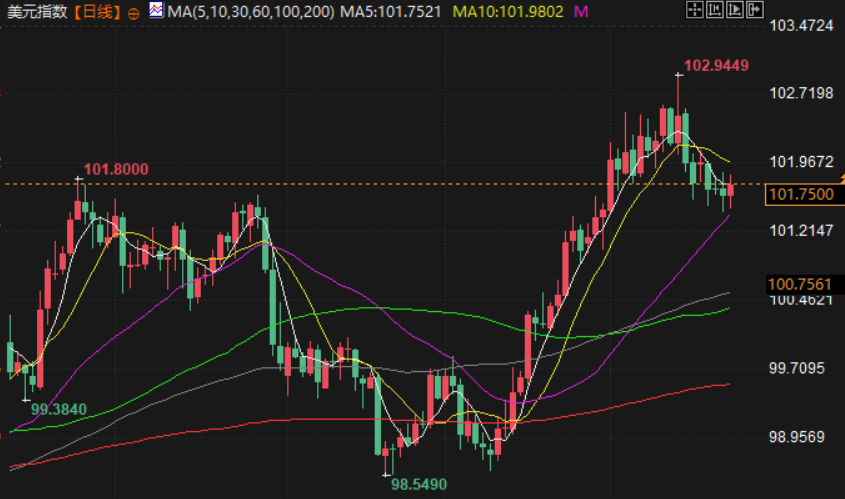
The dollar index rose 0.12% on Friday to close at 101.75. The dollar index remained relatively stable this week. With the midterm elections approaching, the risk of escalating geopolitical tensions in the Middle East has increased, and market concerns about inflation have resurfaced. Bets on a Fed rate hike have weakened, and the market expects the Fed to keep interest rates unchanged next week. Federal funds rate futures traders have reduced their bets on a Fed rate hike in December, but still believe the probability is 81%.  The University of Michigan's final consumer sentiment index for October was 48.0, lower than September's final reading of 48.1, marking the second-lowest on record and only higher than the historical low of 44.8 in May. The survey also showed that the Middle East conflict was pushing up prices, leading to a pessimistic outlook among households. Politically, with the midterm elections approaching, voters are pessimistic about the economy and the performance of President Trump and the Republican Party in managing it. Independent respondents' confidence fell from 47.7 to 42.4, only slightly above the historical low of 40.6, indicating that independent voters were the main source of the decline in confidence. More importantly, inflation expectations remain high: the one-year inflation expectation has risen from 4.6% to 4.7%, and the five-year expectation from 3.4% to 3.5%. Survey director Hsu warned that high inflation expectations in the post-pandemic era pose a risk to the Federal Reserve's 2% target, while overall consumer spending remains resilient; if some spending is precautionary to avoid future price increases, a decline in inflation may be more difficult. This means that the coexistence of weak consumer confidence and resilient spending may make the Federal Reserve more cautious and less likely to ease monetary policy too quickly. The European Central Bank cannot ignore the French problem. The euro fell 0.12% against the dollar on Friday, closing at 1.1200. The core trigger was a sell-off in French government bonds, pushing its debt risk premium to its highest level since the 2011 eurozone sovereign debt crisis. Market concerns extend beyond the budget deficit itself, including escalating social unrest in France, questions about political implementation, and the risk of Moody's potentially downgrading France's sovereign credit rating on Friday. The French Interior Minister's announcement of deploying 70,000 police officers, supported by special forces, indicates that the protests have spilled over from fiscal issues to concerns about social order and policy credibility. The euro touched 175.08 against the yen, its lowest level since October 2025. Declining French fiscal credibility will push up French bond yields and interest rate spreads within the eurozone, with investors demanding higher risk compensation for euro assets, thus putting pressure on the euro. Although pressure on European bond markets eased somewhat on Friday, the Moody's review and weekend protests still pose challenges, meaning that market pricing in France has expanded from "budget issues" to "social and political implementation capabilities." Berenberg economists point out that the European Central Bank (ECB) cannot avoid the French issue at next week's meeting, and its response should address three aspects: First, the French crisis is impacting the Eurozone's growth and inflation prospects, which the ECB must consider, reinforcing the rationale for maintaining interest rates. Second, if the crisis worsens, the ECB may hint at having transmission protection tools to prevent the risk from contagion to other countries. Third, the ECB will emphasize that it will only support France if Paris returns to a more sustainable fiscal policy path. This reflects the ECB's dilemma between preventing contagion and moral hazard: on the one hand, France is a core Eurozone economy, and widening interest rate differentials could threaten monetary policy transmission; on the other hand, unconditional support would weaken member states' fiscal discipline. Therefore, the ECB is more likely to adopt a "conditional support" communication strategy, retaining deterrent tools while shifting the responsibility for fiscal adjustments back to the French government. This stance will also affect the euro: policy tools can mitigate tail risks, but cannot replace France's own fiscal and political repairs. The Bank of Japan is cautiously weighing its options. The dollar fell 0.73% against the yen this week, hitting a one-month low of 156.07 on Friday. AI-related stocks were sold off on Thursday, triggering increased safe-haven demand and flowing into the yen. The yen's weekly strength stemmed more from declining risk appetite than a fundamental reversal of the USD/JPY interest rate differential. With the dollar/yen exchange rate still high, the USD/JPY interest rate differential and carry trades continue to limit the yen's appreciation. The probability of a December rate hike by the Bank of Japan is 61%. These probability figures suggest that "holding steady" does not equate to a policy shift, and the market is still pricing in a tightening path. MUFG analyst Hardman's statement that "declining risk appetite and increased safe-haven demand" explain the yen's late-day strength, but if the market re-trades for the policy difference between the Federal Reserve and the Bank of Japan, the yen could still fluctuate. Japan's core consumer inflation rate in September exceeded the Bank of Japan's 2% target for the first time in nine months, strengthening the case for a near-term rate hike. The Bank of Japan raised its benchmark interest rate to 1.25% last month, a 31-year high, and indicated its readiness to continue increasing borrowing costs to prevent inflation from exceeding its 2% target. Meanwhile, soaring construction costs, labor shortages, and demand from foreign investors have driven up housing prices in the three major metropolitan areas. Bank of Japan Governor Kazuo Ueda will deliver a speech at the IMF Central Bank Seminar in Washington on November 6, shortly after the October 30 interest rate decision and before the December meeting. The market will be closely watching his speech for signals regarding the pace of interest rate hikes this year, the yen's exchange rate, and global carry trades. The Bank of Japan must therefore carefully balance monetary policy normalization with financial stability.
The University of Michigan's final consumer sentiment index for October was 48.0, lower than September's final reading of 48.1, marking the second-lowest on record and only higher than the historical low of 44.8 in May. The survey also showed that the Middle East conflict was pushing up prices, leading to a pessimistic outlook among households. Politically, with the midterm elections approaching, voters are pessimistic about the economy and the performance of President Trump and the Republican Party in managing it. Independent respondents' confidence fell from 47.7 to 42.4, only slightly above the historical low of 40.6, indicating that independent voters were the main source of the decline in confidence. More importantly, inflation expectations remain high: the one-year inflation expectation has risen from 4.6% to 4.7%, and the five-year expectation from 3.4% to 3.5%. Survey director Hsu warned that high inflation expectations in the post-pandemic era pose a risk to the Federal Reserve's 2% target, while overall consumer spending remains resilient; if some spending is precautionary to avoid future price increases, a decline in inflation may be more difficult. This means that the coexistence of weak consumer confidence and resilient spending may make the Federal Reserve more cautious and less likely to ease monetary policy too quickly. The European Central Bank cannot ignore the French problem. The euro fell 0.12% against the dollar on Friday, closing at 1.1200. The core trigger was a sell-off in French government bonds, pushing its debt risk premium to its highest level since the 2011 eurozone sovereign debt crisis. Market concerns extend beyond the budget deficit itself, including escalating social unrest in France, questions about political implementation, and the risk of Moody's potentially downgrading France's sovereign credit rating on Friday. The French Interior Minister's announcement of deploying 70,000 police officers, supported by special forces, indicates that the protests have spilled over from fiscal issues to concerns about social order and policy credibility. The euro touched 175.08 against the yen, its lowest level since October 2025. Declining French fiscal credibility will push up French bond yields and interest rate spreads within the eurozone, with investors demanding higher risk compensation for euro assets, thus putting pressure on the euro. Although pressure on European bond markets eased somewhat on Friday, the Moody's review and weekend protests still pose challenges, meaning that market pricing in France has expanded from "budget issues" to "social and political implementation capabilities." Berenberg economists point out that the European Central Bank (ECB) cannot avoid the French issue at next week's meeting, and its response should address three aspects: First, the French crisis is impacting the Eurozone's growth and inflation prospects, which the ECB must consider, reinforcing the rationale for maintaining interest rates. Second, if the crisis worsens, the ECB may hint at having transmission protection tools to prevent the risk from contagion to other countries. Third, the ECB will emphasize that it will only support France if Paris returns to a more sustainable fiscal policy path. This reflects the ECB's dilemma between preventing contagion and moral hazard: on the one hand, France is a core Eurozone economy, and widening interest rate differentials could threaten monetary policy transmission; on the other hand, unconditional support would weaken member states' fiscal discipline. Therefore, the ECB is more likely to adopt a "conditional support" communication strategy, retaining deterrent tools while shifting the responsibility for fiscal adjustments back to the French government. This stance will also affect the euro: policy tools can mitigate tail risks, but cannot replace France's own fiscal and political repairs. The Bank of Japan is cautiously weighing its options. The dollar fell 0.73% against the yen this week, hitting a one-month low of 156.07 on Friday. AI-related stocks were sold off on Thursday, triggering increased safe-haven demand and flowing into the yen. The yen's weekly strength stemmed more from declining risk appetite than a fundamental reversal of the USD/JPY interest rate differential. With the dollar/yen exchange rate still high, the USD/JPY interest rate differential and carry trades continue to limit the yen's appreciation. The probability of a December rate hike by the Bank of Japan is 61%. These probability figures suggest that "holding steady" does not equate to a policy shift, and the market is still pricing in a tightening path. MUFG analyst Hardman's statement that "declining risk appetite and increased safe-haven demand" explain the yen's late-day strength, but if the market re-trades for the policy difference between the Federal Reserve and the Bank of Japan, the yen could still fluctuate. Japan's core consumer inflation rate in September exceeded the Bank of Japan's 2% target for the first time in nine months, strengthening the case for a near-term rate hike. The Bank of Japan raised its benchmark interest rate to 1.25% last month, a 31-year high, and indicated its readiness to continue increasing borrowing costs to prevent inflation from exceeding its 2% target. Meanwhile, soaring construction costs, labor shortages, and demand from foreign investors have driven up housing prices in the three major metropolitan areas. Bank of Japan Governor Kazuo Ueda will deliver a speech at the IMF Central Bank Seminar in Washington on November 6, shortly after the October 30 interest rate decision and before the December meeting. The market will be closely watching his speech for signals regarding the pace of interest rate hikes this year, the yen's exchange rate, and global carry trades. The Bank of Japan must therefore carefully balance monetary policy normalization with financial stability.
- Risk Warning and Disclaimer
- The market involves risk, and trading may not be suitable for all investors. This article is for reference only and does not constitute personal investment advice, nor does it take into account certain users’ specific investment objectives, financial situation, or other needs. Any investment decisions made based on this information are at your own risk.