Gold Trading Alert: Gold Prices Fall Below $4,000! A Super Central Bank Week is Coming – Can the Bulls Hold the Last Line of Defense?
2026-10-26 07:42:22
Last week, the global gold market experienced a significant correction. Spot gold fell below the $4,000 per ounce mark on Friday (October 23), hitting a three-month low and recording its largest weekly decline in over four months. Entering Monday (October 26), gold prices remained hovering around $4,000, with market sentiment showing no significant easing despite the weekend closure. The continued rise in energy prices, renewed inflation concerns, and shifts in expectations regarding Federal Reserve policy collectively constituted the main factors putting downward pressure on gold. Meanwhile, geopolitical uncertainties and the upcoming super central bank week added further variables to the market outlook. 
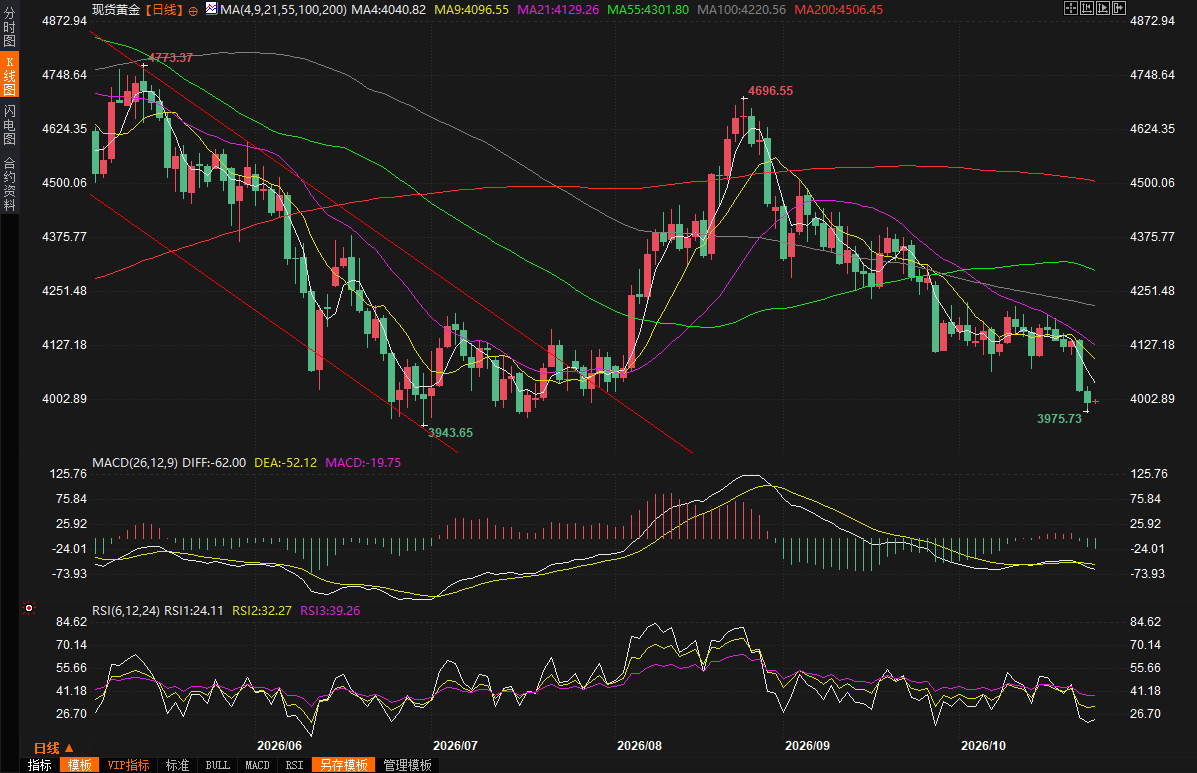 (Spot gold daily chart, source: EasyTrade) At 07:37 Beijing time, spot gold is currently trading at $4001.07 per ounce.
Why did gold prices pull back sharply last week?
Looking back at last week's performance, spot gold touched a low of around $3,975 before closing at around $3,996, a weekly drop of about 4%, marking its worst performance since June. US December gold futures also weakened. The core factor driving this decline was the sharp volatility in the energy market. Houthi attacks in Saudi Arabia reignited concerns about potential disruptions to Middle Eastern energy supplies, causing Brent crude oil to hit a more than five-month high and briefly reach significant levels. The rise in oil prices directly reinforced inflation expectations, prompting the market to reassess the pace of monetary easing by major central banks. Jim Wyckoff, a market analyst at the Gold Exchange, pointed out that rising inflation concerns mean that major central banks globally may be unable to proceed with easing at the originally planned pace, which is a significant negative factor for both gold and silver bulls. At the same time, the sharp correction in technology stocks, especially those related to artificial intelligence, also triggered some margin calls. Some stock traders and investors, facing margin calls, chose to sell their gold and silver positions to raise funds, further exacerbating the selling pressure on precious metals. Silver, palladium, and platinum prices also came under pressure last week, falling to relatively low levels, indicating that the entire precious metals sector was affected by both declining risk appetite and rising real interest rate expectations. The bond market's performance also provided corroborating evidence for gold's price movement. Although the 10-year US Treasury yield experienced its largest single-day drop in nearly four years last Thursday, it rebounded somewhat on Friday, remaining below 5%. Market concerns about the sustainability of the artificial intelligence rally initially drove funds into safe-haven assets such as government bonds, but stronger inflation data and high oil prices limited the downside potential for yields. The positive spread between the two-year and 10-year US Treasury yields reflects a relatively robust market expectation for the economic outlook, which suppresses the attractiveness of gold, a non-interest-bearing asset.Policy expectations and data windows become key focuses
This week, market attention quickly shifted to the Federal Reserve's policy meeting on October 27-28. Traders widely expect the Fed to keep interest rates unchanged at 3.75% to 4.00%, with the CME FedWatch tool showing a probability of over 90% at one point. However, the market has already largely priced in a December rate hike, with a probability approaching 80%. Stronger-than-expected consumer and producer inflation data have reinforced the narrative of "higher and longer" interest rates. The Personal Consumption Expenditures (PCE) price index, to be released later this week, will provide further clues as the Fed's preferred inflation indicator . If the PCE reading is high, coupled with still-high oil prices, market bets on further rate hikes may intensify, further suppressing gold's performance. In addition to the Fed, this week will also see interest rate decisions from the European Central Bank, the Bank of Japan, the Reserve Bank of New Zealand, and the Bank of Canada, making it a super central bank week. The European Central Bank is likely to keep interest rates unchanged, but political and fiscal concerns in France have already weighed on the euro. In Japan, core inflation exceeded the 2% target again in September for the first time in nine months, reinforcing the case for continued tightening in the short term and raising market expectations for a December rate hike by the Bank of Japan. These subtle changes in policy signals can all affect gold pricing through exchange rates and global liquidity channels.Geopolitical risks remain a potential support, but are unlikely to outweigh macroeconomic pressures in the short term.
Geopolitically, the situation in the Middle East has not completely cooled down. Trump has recently made several statements hinting at possible new US military action against Iran, while also not ruling out the possibility of an agreement. Rumors and denials regarding the Strait of Hormuz, and concerns about the Houthi rebels potentially expanding their attacks, continue to provide an upside risk premium for oil prices. Regarding Ukraine, Zelenskyy revealed that negotiators from Ukraine, Russia, and the US plan to hold a technical meeting in Abu Dhabi in the first half of November, indicating that diplomatic efforts are still underway, but their short-term impact on gold prices is limited. From a longer-term perspective, gold still possesses certain structural support. Uncertainty surrounding global geopolitical conflicts, the expansion of fiscal deficits in major economies, and demand for gold from some central banks all constitute medium- to long-term bullish factors. However, in the short term, real interest rates and the dollar's performance are the dominant variables. As long as the market continues to price in the possibility of further interest rate hikes by the Federal Reserve this year, the upside potential for gold will be limited.Market Outlook: The market is expected to fluctuate and search for a bottom; pay attention to key data and policy statements.
In summary, gold has entered a new trading range after breaking below $4,000. In the short term, the market will focus on the Federal Reserve's policy statement, the Chairman's press conference, and the specific readings of the PCE data. If inflation indicators remain strong and policy statements are hawkish, gold prices may further test the area near the June lows ($3,943); conversely, if the data is moderate and the Fed emphasizes data dependence and downplays the necessity of near-term rate hikes, gold is expected to find some support around $4,000 and stage a technical rebound. For investors, the current environment is more suitable for caution. The linkage between energy prices and inflation expectations, liquidity disturbances caused by technology stock volatility, and sudden geopolitical risks could all amplify gold's volatility in the short term. Rather than rushing to buy the dip or short, it is better to closely monitor central bank statements and key data this week and wait for clearer directional signals. As a traditional safe-haven asset, gold's long-term value has not disappeared due to short-term corrections, but in a "higher and longer" interest rate environment, patience and discipline are more important than emotions. This week's super central bank week may become an important window for observing the turning point in gold's short-term trend. Whether the bulls can hold their ground near the $4,000 mark will depend on the rebalancing of the inflation narrative and policy expectations. (Spot gold daily chart, source: EasyTrade) At 07:37 Beijing time, spot gold is currently trading at $4001.07 per ounce.
- Risk Warning and Disclaimer
- The market involves risk, and trading may not be suitable for all investors. This article is for reference only and does not constitute personal investment advice, nor does it take into account certain users’ specific investment objectives, financial situation, or other needs. Any investment decisions made based on this information are at your own risk.