Crude oil trading alert: With the US midterm elections approaching and supply-side uncertainties prevailing, US crude oil prices remain high.
2026-10-26 09:24:28
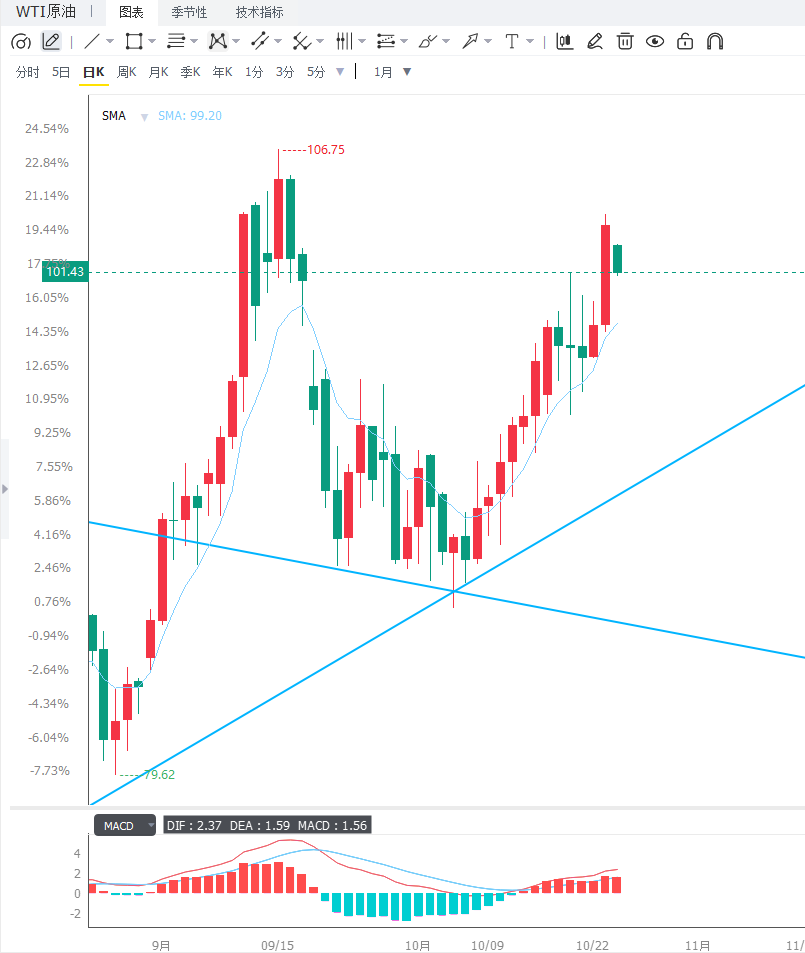
On Monday during Asian trading hours, WTI crude oil traded around $101.10, a significant pullback from the previous trading day's close, but still holding above the $100 mark. The core contradiction in current oil prices lies in this: Trump's statements removed the impulsive premium of "immediate strike," causing oil prices to retreat from sentiment-driven highs; however, the election cycle's timing and the Houthi's continued attacks have locked in an escalation risk of "restarting at any time." The combination of these two factors has resulted in a tug-of-war pattern in oil prices, with volatility significantly exceeding what fundamentals can explain.  From the perspective of suppressing factors, political statements directly altered short-term risk pricing. While ruling out launching an attack that day, Trump also hinted that Washington might need to "get the job done" or reach some kind of agreement with Tehran. This "closing the window with one hand and leaving the door open with the other" communication style is precisely the most difficult scenario to handle in the oil market: it is neither sufficient to disprove the risk of supply disruptions nor to provide a clear path to easing tensions. For oil prices, this means that any deep pullback is more likely to encounter buying support at relatively low levels—funds are betting not on the current conflict, but on the asymmetric increase in the probability of conflict within the election window; however, at the same time, due to the lack of immediate catalysts, the rebound in oil prices also lacks smoothness. This is the fundamental reason why this round of pullbacks is more persistent than previous rounds. Geopolitical uncertainties, on the other hand, provided support from the other side. The Houthi rebels announced on Sunday that they would continue to attack King Khalid Airport in Riyadh, the Saudi capital, just hours after Saudi officials said flights had resumed; over the weekend, the group claimed to have attacked Saudi airports and oil facilities on Saturday, and Saudi Arabia reported intercepting more drones on Sunday. The significance of these attacks has evolved from damage to a single facility to a challenge to the sustainability of the core hubs of the world's largest crude oil exporter. When targets expand from ports and oil fields to capital airports and energy infrastructure, market pricing of disruption risk is no longer limited to the toll fees of a single shipping route, but extends to a reassessment of logistics and insurance costs across the entire region. In the past two weeks, at least 18 attacks on merchant ships have occurred in the Strait of Hormuz, while Brent crude oil has remained above $109.55. High oil prices have pushed up global inflation through cost channels, reinforcing the rationale for central banks to maintain high interest rates, thereby raising the central level of real interest rates. For crude oil, this constitutes a self-reinforcing cycle: conflict drives up oil prices, oil prices drive up inflation, inflation forces central banks to maintain tightening, tightening suppresses demand expectations, and demand concerns, in turn, limit the upside potential of oil prices. It is worth noting that domestic political pressure in the United States is intervening in the oil price formation mechanism in unconventional ways. With the November midterm elections approaching, Trump is employing a series of costly and politically controversial measures to address the persistent diesel price problem: providing billions of dollars in subsidies to farmers, easing regulations on truck drivers, relaxing sanctions on Russian fuel, and pressuring European allies to release emergency oil reserves. These measures essentially aim to artificially lower end-user fuel costs through administrative means, rather than addressing structural supply-side tensions. In the short term, they may indeed alleviate upward pressure on diesel prices, indirectly weakening the demand-side narrative for crude oil; however, in the long term, easing sanctions on Russian fuel and pressuring allies to release reserves actually increase available supply in the market—opposite to the supply contraction caused by geopolitical conflicts, constituting the most easily underestimated downside variable for current oil prices. If these measures are implemented simultaneously, they could create a "policy pressure window" around the election, subjecting oil prices to an additional layer of selling pressure beyond the upgrade premium. Institutional views further confirm the current bullish bias. TD Securities points out, "We expect crude oil prices to remain biased towards rising in the short term, as the risk of escalation before the Israeli election and the US midterm elections remains high." The bank believes that this persistent geopolitical risk premium continues to provide constructive support for crude oil, despite ongoing uncertainty in the broader market. This assessment offers investors an important insight: current oil price support primarily stems from event-driven time windows rather than a substantial tightening of supply and demand fundamentals. In other words, once the election cycle ends and military options are effectively shelved, this premium may be retraced faster than it accumulated. Therefore, treating "escalation risk" as an upper limit constraint for position management rather than a trend confirmation signal is a more prudent approach. From a cross-asset perspective, the current volatility in crude oil is essentially a confluence of four factors: first, the immediate impulsive premium from Trump's statements has subsided; second, the asymmetric distribution of escalation probabilities within the election window provides bottom support; third, the revaluation of logistics and insurance costs triggered by the spread of the Houthi attacks; and fourth, the policy headwinds posed by US administrative measures to suppress prices. Furthermore, the high-level fluctuations in oil prices are indirectly shaping the rhythm of precious metals and foreign exchange: rising energy costs reinforce the central bank's rationale for maintaining high interest rates through inflation, explaining both why gold failed to benefit from this round of geopolitical escalation and weakened instead, and the logic behind the yen's interest rate hikes supported by imported inflation. Investors should not view the one-sided trend of crude oil in isolation, but should evaluate it in the transmission chain of "oil price - inflation - interest rate - exchange rate" - only when a link in this chain breaks will the pricing center of oil prices shift substantially. On the daily chart, WTI crude oil rose more than 4% in the previous trading day and then consolidated at a high level. The price is running near the dense area of key moving averages. In the short term, it is biased towards neutral to bullish, but the momentum is weakening. The RSI (14) has fallen back from the high of the previous trading day to around 62. It is in the positive range and has not yet entered the overbought state, indicating that the upward momentum is being released moderately. However, there is still room for fluctuation before the indicator is overextended. It is a typical "strong consolidation, waiting for confirmation" pattern. The resistance above should be focused on the previous platform of $102.50, $103.80 and the psychological level of $105.00. Only when the daily body effectively stands above $102.50 can the consolidation be confirmed to be over and space be opened for a higher attack. The first support level to watch is the psychological level of $100.00, followed by the previous support level of $99.80 and $98.50. $100.00 is a key psychological support level; a break below it could open up further downside potential towards $98.50 and even $97.20. On the 4-hour chart, oil prices have been consolidating slowly along short-term moving averages after falling from around $102.00. The MACD histogram is close to the zero line, with the fast and slow lines repeatedly intertwined, indicating neutral momentum. Currently, the price is oscillating narrowly between $100.90 and $101.40. If it finds support at $100.80-$101.00, there is still a chance for a short-term retest of $101.40-$102.00. However, a significant break below $100.00 could lead to a test of support at $99.80 and even $98.50. An upward breakout requires developments in the Middle East situation and confirmation from inventory data. Until then, a range-bound trading strategy is advisable, avoiding chasing highs and lows.
 The editor summarizes that the core contradiction in the short term for WTI crude oil lies in Trump's decision to rule out immediate strikes, which would drain the impulsive premium. Meanwhile, the risk of escalation during the election window and the potential spread of Houthi attacks maintain bottom support. This dual-pronged approach makes oil prices more likely to consolidate within the $99.80-$102.50 range, awaiting a resolution to the events. Three key variables need to be monitored: first, the progress of US-Israel plans regarding Iran following this week's Israeli election and next week's US midterm elections, as well as Iran's retaliatory actions against Israel and the UAE. Any substantial escalation could potentially inject a premium back into the market through supply disruptions; second, the operational status of King Khalid Airport and traffic data across the Strait of Hormuz, which directly determine the extent of the revaluation of logistics and insurance costs; and third, the pace of implementation of US administrative price-cutting measures and EIA and API inventory data. Policy-driven supply releases may be the most easily underestimated downside variable in this round.
From the perspective of suppressing factors, political statements directly altered short-term risk pricing. While ruling out launching an attack that day, Trump also hinted that Washington might need to "get the job done" or reach some kind of agreement with Tehran. This "closing the window with one hand and leaving the door open with the other" communication style is precisely the most difficult scenario to handle in the oil market: it is neither sufficient to disprove the risk of supply disruptions nor to provide a clear path to easing tensions. For oil prices, this means that any deep pullback is more likely to encounter buying support at relatively low levels—funds are betting not on the current conflict, but on the asymmetric increase in the probability of conflict within the election window; however, at the same time, due to the lack of immediate catalysts, the rebound in oil prices also lacks smoothness. This is the fundamental reason why this round of pullbacks is more persistent than previous rounds. Geopolitical uncertainties, on the other hand, provided support from the other side. The Houthi rebels announced on Sunday that they would continue to attack King Khalid Airport in Riyadh, the Saudi capital, just hours after Saudi officials said flights had resumed; over the weekend, the group claimed to have attacked Saudi airports and oil facilities on Saturday, and Saudi Arabia reported intercepting more drones on Sunday. The significance of these attacks has evolved from damage to a single facility to a challenge to the sustainability of the core hubs of the world's largest crude oil exporter. When targets expand from ports and oil fields to capital airports and energy infrastructure, market pricing of disruption risk is no longer limited to the toll fees of a single shipping route, but extends to a reassessment of logistics and insurance costs across the entire region. In the past two weeks, at least 18 attacks on merchant ships have occurred in the Strait of Hormuz, while Brent crude oil has remained above $109.55. High oil prices have pushed up global inflation through cost channels, reinforcing the rationale for central banks to maintain high interest rates, thereby raising the central level of real interest rates. For crude oil, this constitutes a self-reinforcing cycle: conflict drives up oil prices, oil prices drive up inflation, inflation forces central banks to maintain tightening, tightening suppresses demand expectations, and demand concerns, in turn, limit the upside potential of oil prices. It is worth noting that domestic political pressure in the United States is intervening in the oil price formation mechanism in unconventional ways. With the November midterm elections approaching, Trump is employing a series of costly and politically controversial measures to address the persistent diesel price problem: providing billions of dollars in subsidies to farmers, easing regulations on truck drivers, relaxing sanctions on Russian fuel, and pressuring European allies to release emergency oil reserves. These measures essentially aim to artificially lower end-user fuel costs through administrative means, rather than addressing structural supply-side tensions. In the short term, they may indeed alleviate upward pressure on diesel prices, indirectly weakening the demand-side narrative for crude oil; however, in the long term, easing sanctions on Russian fuel and pressuring allies to release reserves actually increase available supply in the market—opposite to the supply contraction caused by geopolitical conflicts, constituting the most easily underestimated downside variable for current oil prices. If these measures are implemented simultaneously, they could create a "policy pressure window" around the election, subjecting oil prices to an additional layer of selling pressure beyond the upgrade premium. Institutional views further confirm the current bullish bias. TD Securities points out, "We expect crude oil prices to remain biased towards rising in the short term, as the risk of escalation before the Israeli election and the US midterm elections remains high." The bank believes that this persistent geopolitical risk premium continues to provide constructive support for crude oil, despite ongoing uncertainty in the broader market. This assessment offers investors an important insight: current oil price support primarily stems from event-driven time windows rather than a substantial tightening of supply and demand fundamentals. In other words, once the election cycle ends and military options are effectively shelved, this premium may be retraced faster than it accumulated. Therefore, treating "escalation risk" as an upper limit constraint for position management rather than a trend confirmation signal is a more prudent approach. From a cross-asset perspective, the current volatility in crude oil is essentially a confluence of four factors: first, the immediate impulsive premium from Trump's statements has subsided; second, the asymmetric distribution of escalation probabilities within the election window provides bottom support; third, the revaluation of logistics and insurance costs triggered by the spread of the Houthi attacks; and fourth, the policy headwinds posed by US administrative measures to suppress prices. Furthermore, the high-level fluctuations in oil prices are indirectly shaping the rhythm of precious metals and foreign exchange: rising energy costs reinforce the central bank's rationale for maintaining high interest rates through inflation, explaining both why gold failed to benefit from this round of geopolitical escalation and weakened instead, and the logic behind the yen's interest rate hikes supported by imported inflation. Investors should not view the one-sided trend of crude oil in isolation, but should evaluate it in the transmission chain of "oil price - inflation - interest rate - exchange rate" - only when a link in this chain breaks will the pricing center of oil prices shift substantially. On the daily chart, WTI crude oil rose more than 4% in the previous trading day and then consolidated at a high level. The price is running near the dense area of key moving averages. In the short term, it is biased towards neutral to bullish, but the momentum is weakening. The RSI (14) has fallen back from the high of the previous trading day to around 62. It is in the positive range and has not yet entered the overbought state, indicating that the upward momentum is being released moderately. However, there is still room for fluctuation before the indicator is overextended. It is a typical "strong consolidation, waiting for confirmation" pattern. The resistance above should be focused on the previous platform of $102.50, $103.80 and the psychological level of $105.00. Only when the daily body effectively stands above $102.50 can the consolidation be confirmed to be over and space be opened for a higher attack. The first support level to watch is the psychological level of $100.00, followed by the previous support level of $99.80 and $98.50. $100.00 is a key psychological support level; a break below it could open up further downside potential towards $98.50 and even $97.20. On the 4-hour chart, oil prices have been consolidating slowly along short-term moving averages after falling from around $102.00. The MACD histogram is close to the zero line, with the fast and slow lines repeatedly intertwined, indicating neutral momentum. Currently, the price is oscillating narrowly between $100.90 and $101.40. If it finds support at $100.80-$101.00, there is still a chance for a short-term retest of $101.40-$102.00. However, a significant break below $100.00 could lead to a test of support at $99.80 and even $98.50. An upward breakout requires developments in the Middle East situation and confirmation from inventory data. Until then, a range-bound trading strategy is advisable, avoiding chasing highs and lows. The editor summarizes that the core contradiction in the short term for WTI crude oil lies in Trump's decision to rule out immediate strikes, which would drain the impulsive premium. Meanwhile, the risk of escalation during the election window and the potential spread of Houthi attacks maintain bottom support. This dual-pronged approach makes oil prices more likely to consolidate within the $99.80-$102.50 range, awaiting a resolution to the events. Three key variables need to be monitored: first, the progress of US-Israel plans regarding Iran following this week's Israeli election and next week's US midterm elections, as well as Iran's retaliatory actions against Israel and the UAE. Any substantial escalation could potentially inject a premium back into the market through supply disruptions; second, the operational status of King Khalid Airport and traffic data across the Strait of Hormuz, which directly determine the extent of the revaluation of logistics and insurance costs; and third, the pace of implementation of US administrative price-cutting measures and EIA and API inventory data. Policy-driven supply releases may be the most easily underestimated downside variable in this round.
- Risk Warning and Disclaimer
- The market involves risk, and trading may not be suitable for all investors. This article is for reference only and does not constitute personal investment advice, nor does it take into account certain users’ specific investment objectives, financial situation, or other needs. Any investment decisions made based on this information are at your own risk.