The combination of the Federal Reserve's policy decision and the Bank of Japan's meeting this week has put pressure on the USD/JPY pair, causing it to fluctuate below the 157 level.
2026-10-26 15:44:22
On Monday morning in Asia, the USD/JPY pair traded around 156.60, continuing its correction after falling from above 160. The core contradiction in the current exchange rate lies in the tug-of-war between expectations of a Bank of Japan rate hike and the undisproven year-end path of the Federal Reserve. The dense schedule of macroeconomic events this week makes it difficult for either side to establish dominance before the data is released. This environment, with both a ceiling and a floor, suggests that the exchange rate is more likely to consolidate within a range rather than embark on a smooth, one-sided trend.  From the perspective of the yen, Kazuo Ueda's statements constitute the main driving force behind this round of strengthening. Last week, he pointed out that underlying inflation is approaching the 2% target, providing a basis for a near-term interest rate hike and further strengthening market expectations that the Bank of Japan will continue to normalize its policy. The key to this logic is that the Bank of Japan's motivation for raising interest rates stems partly from "preventing excessive yen depreciation"—as long as the Federal Reserve maintains a restrictive stance for longer than expected, the Bank of Japan has the incentive to gradually tighten interest rate differentials and reduce the risk of further yen weakness. This means that the yen's upside potential is always constrained by the actual trend of the US-Japan interest rate differential, rather than simply by its own inflation readings. This is also the structural reason why this round of yen strengthening has lacked smoothness: each surge is more likely to encounter resistance from carry trade cover-ups, while each decline can find support at relatively low levels based on expectations of interest rate hikes. The dollar, on the other hand, provides the opposite constraint. Recent statements from Federal Reserve officials indicate that there is almost no need to rush to accelerate policy tightening; at the same time, the decline in US Treasury yields from multi-year highs has also limited the dollar's attempt to rebound from a three-week low. However, traders are still pricing in an approximately 80% probability of a Fed rate hike in December, making the dollar's pullback more of a technical correction than a trend reversal. For USD/JPY, this presents a "short-term dovish, medium-term hawkish" combination: Wednesday's inaction was widely expected, offering little additional negative news; however, the year-end tightening path remains unproven, making any yen breakout likely to encounter selling pressure at relatively high levels. Furthermore, continued geopolitical uncertainty may limit the depth of the safe-haven dollar's decline—a substantial escalation in the Middle East could cause capital flows to the yen and dollar to overlap, weakening the yen's relative advantage. This is particularly noteworthy at the current level and is an area prone to misjudgment. This week's event distribution suggests a short-term strategy of "wait and see, then choose a side." Wednesday's Fed decision and Warsh press conference are the first key events—given that holding rates steady is already fully anticipated, the real factor triggering repricing will be the wording of the statement and the chairman's comments on the December path. Thursday's preliminary US Q3 GDP figures and PCE price index will be direct evidence of the US economic resilience and inflation stickiness; stronger-than-expected data could weaken the narrative of "no rush to raise rates," leading to short-term profit-taking in the yen. Friday's Bank of Japan meeting is the final variable; even if rates remain unchanged, any changes in forward guidance regarding "when to raise rates" could repric the exchange rate through interest rate differentials. For investors, this means that before these three major events are resolved, a range-bound approach is more prudent than a trend-following approach, significantly reducing the success rate of chasing highs and lows. Geopolitical factors provide another layer of complexity. Trump has ruled out immediate military action against Iran, but the Iranian-backed Houthi rebels in Yemen threatened on Sunday to continue attacks on King Khalid Airport in Riyadh, Saudi Arabia. Coupled with the stalled US-Iran negotiations, geopolitical risk premiums remain firmly in place. This intermediate state of "leaving room for negotiation while holding military options" has a multi-directional impact on the USD/JPY exchange rate: on the one hand, escalating tensions in the Middle East boost safe-haven demand, theoretically benefiting the yen; on the other hand, high oil prices worsen Japan's trade balance and imported inflation, strengthening the Bank of Japan's rationale for raising interest rates (beneficial to the yen) while also suppressing its growth prospects (negative to the yen). After offsetting these factors, the yen's net direction depends more on changes in interest rate expectations than on simple geopolitical narratives. This also explains why the yen's volatility has not significantly exceeded its trading range during this round of tensions. From a cross-asset perspective, the current USD/JPY volatility is essentially a confluence of four factors: first, proactive interest rate support provided by Ueda's hawkish statements; second, a passive pullback in the dollar due to the Fed's "no rush to raise rates but uncertainties at year-end"; third, valuation pressure from the decline in US Treasury yields from multi-year highs; and fourth, two-way disturbances caused by high oil price volatility and geopolitical risk premiums. It's worth noting that the same round of oil price increases simultaneously impacted three transmission chains: it boosted Japan's imported inflation (supporting the Bank of Japan's interest rate hikes), worsened trade conditions (suppressing risk appetite for the yen), and strengthened the Federal Reserve's rationale for maintaining high interest rates through global inflation (supporting the dollar). The offsetting effect of these three forces is the fundamental reason why the exchange rate has been fluctuating within a narrow range of 156-157. Investors should not view individual data points or statements in isolation, but rather assess them within the transmission chain of "oil price—inflation—interest rate differential—exchange rate." On the 4-hour chart, USD/JPY is trading below the 200-period simple moving average, indicating a short-term bearish bias. Above this resistance level is the 23.6% Fibonacci retracement level at 157.58; only a sustained break above this resistance zone can reopen the path to recent cycle highs. On the downside, the first support level to watch is the 38.2% retracement level at 156.69, with deeper Fibonacci clusters at 155.98 and 155.26, where buyers may attempt to stabilize the pullback. On the daily chart, the exchange rate has been in a correction phase since topping above 160. The price is trading below the lower, middle, and upper Bollinger Bands (20-day moving average) and is constrained by the 100-day simple moving average, with rebounds consistently suppressed. The medium-term bearish structure remains unresolved. The RSI is at 38.20, having fallen below the 50 neutral line, indicating that downward pressure still dominates, despite some overbought conditions. This is a typical "weak consolidation, nearing support" pattern. Key resistance levels to watch are the lower Bollinger Band (20-day) around 156.75, the 200-period moving average on the 4-hour chart at 157.14, the 23.6% Fibonacci retracement level at 157.58, and the middle Bollinger Band around 157.85. Only a decisive break above 157.14-157.58 on the daily chart would alleviate the current bearish bias and open up space for an upward move towards 157.85. The first support level to watch is 156.69, followed by the psychological level of 156.00 and 155.98. Since the current data is concentrated below 156.38 and there is a lack of near-term technical support, if the price breaks below 156.00, it may enter a downward phase without clear technical references, and we need to wait for a new demand zone to emerge.
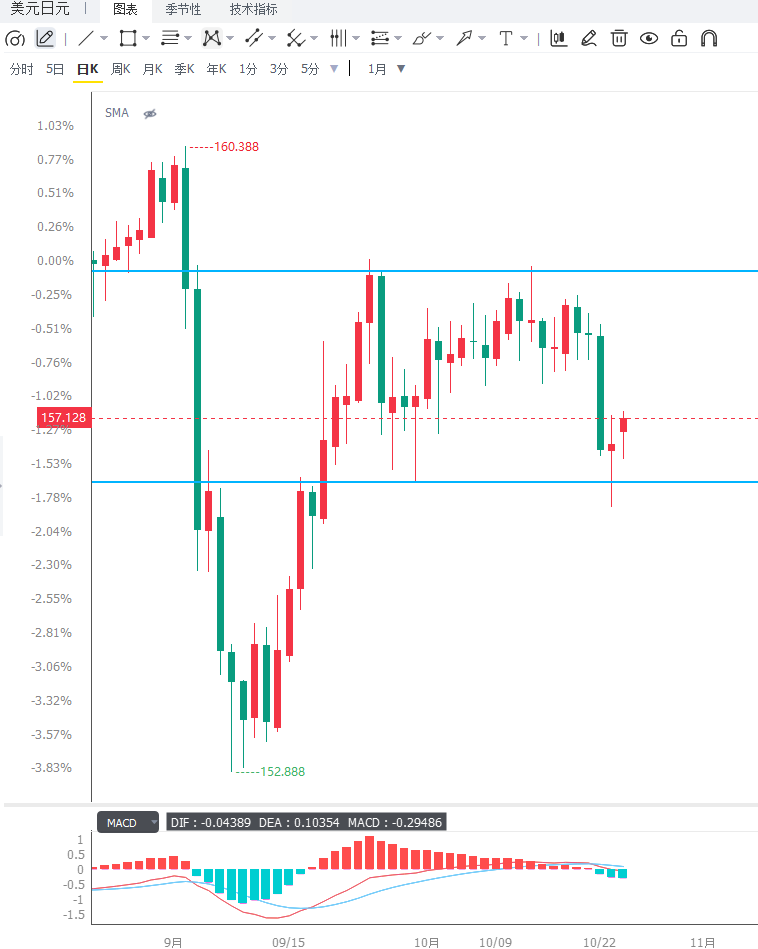 Editor's Summary: The core contradiction in the USD/JPY exchange rate in the short term lies in the fact that Ueda's hawkish remarks have strengthened expectations of a Bank of Japan rate hike, while the undisproven tightening path of the Federal Reserve at the end of the year and geopolitical uncertainties have limited the yen's upside potential. This two-way dynamic makes the exchange rate more likely to consolidate within the 156.00-157.00 range, awaiting a breakthrough in the event. Three variables need to be closely watched going forward: first, the Fed's decision, interest rate statement, and Warsh press conference on Wednesday, which are the primary indicators of the tightness or looseness of the dollar's interest rate floor; second, the preliminary US Q3 GDP and PCE price index on Thursday, directly verifying the resilience of the US economy and the stickiness of inflation; and third, the Bank of Japan's policy update and forward guidance on Friday. Even if it holds rates steady, changes in the wording regarding "when to raise rates" will repric the exchange rate through interest rate differentials. In addition, the situation of passage through the Strait of Hormuz and oil price trends, as dual sources of imported inflation and terms of trade, also need to be monitored.
From the perspective of the yen, Kazuo Ueda's statements constitute the main driving force behind this round of strengthening. Last week, he pointed out that underlying inflation is approaching the 2% target, providing a basis for a near-term interest rate hike and further strengthening market expectations that the Bank of Japan will continue to normalize its policy. The key to this logic is that the Bank of Japan's motivation for raising interest rates stems partly from "preventing excessive yen depreciation"—as long as the Federal Reserve maintains a restrictive stance for longer than expected, the Bank of Japan has the incentive to gradually tighten interest rate differentials and reduce the risk of further yen weakness. This means that the yen's upside potential is always constrained by the actual trend of the US-Japan interest rate differential, rather than simply by its own inflation readings. This is also the structural reason why this round of yen strengthening has lacked smoothness: each surge is more likely to encounter resistance from carry trade cover-ups, while each decline can find support at relatively low levels based on expectations of interest rate hikes. The dollar, on the other hand, provides the opposite constraint. Recent statements from Federal Reserve officials indicate that there is almost no need to rush to accelerate policy tightening; at the same time, the decline in US Treasury yields from multi-year highs has also limited the dollar's attempt to rebound from a three-week low. However, traders are still pricing in an approximately 80% probability of a Fed rate hike in December, making the dollar's pullback more of a technical correction than a trend reversal. For USD/JPY, this presents a "short-term dovish, medium-term hawkish" combination: Wednesday's inaction was widely expected, offering little additional negative news; however, the year-end tightening path remains unproven, making any yen breakout likely to encounter selling pressure at relatively high levels. Furthermore, continued geopolitical uncertainty may limit the depth of the safe-haven dollar's decline—a substantial escalation in the Middle East could cause capital flows to the yen and dollar to overlap, weakening the yen's relative advantage. This is particularly noteworthy at the current level and is an area prone to misjudgment. This week's event distribution suggests a short-term strategy of "wait and see, then choose a side." Wednesday's Fed decision and Warsh press conference are the first key events—given that holding rates steady is already fully anticipated, the real factor triggering repricing will be the wording of the statement and the chairman's comments on the December path. Thursday's preliminary US Q3 GDP figures and PCE price index will be direct evidence of the US economic resilience and inflation stickiness; stronger-than-expected data could weaken the narrative of "no rush to raise rates," leading to short-term profit-taking in the yen. Friday's Bank of Japan meeting is the final variable; even if rates remain unchanged, any changes in forward guidance regarding "when to raise rates" could repric the exchange rate through interest rate differentials. For investors, this means that before these three major events are resolved, a range-bound approach is more prudent than a trend-following approach, significantly reducing the success rate of chasing highs and lows. Geopolitical factors provide another layer of complexity. Trump has ruled out immediate military action against Iran, but the Iranian-backed Houthi rebels in Yemen threatened on Sunday to continue attacks on King Khalid Airport in Riyadh, Saudi Arabia. Coupled with the stalled US-Iran negotiations, geopolitical risk premiums remain firmly in place. This intermediate state of "leaving room for negotiation while holding military options" has a multi-directional impact on the USD/JPY exchange rate: on the one hand, escalating tensions in the Middle East boost safe-haven demand, theoretically benefiting the yen; on the other hand, high oil prices worsen Japan's trade balance and imported inflation, strengthening the Bank of Japan's rationale for raising interest rates (beneficial to the yen) while also suppressing its growth prospects (negative to the yen). After offsetting these factors, the yen's net direction depends more on changes in interest rate expectations than on simple geopolitical narratives. This also explains why the yen's volatility has not significantly exceeded its trading range during this round of tensions. From a cross-asset perspective, the current USD/JPY volatility is essentially a confluence of four factors: first, proactive interest rate support provided by Ueda's hawkish statements; second, a passive pullback in the dollar due to the Fed's "no rush to raise rates but uncertainties at year-end"; third, valuation pressure from the decline in US Treasury yields from multi-year highs; and fourth, two-way disturbances caused by high oil price volatility and geopolitical risk premiums. It's worth noting that the same round of oil price increases simultaneously impacted three transmission chains: it boosted Japan's imported inflation (supporting the Bank of Japan's interest rate hikes), worsened trade conditions (suppressing risk appetite for the yen), and strengthened the Federal Reserve's rationale for maintaining high interest rates through global inflation (supporting the dollar). The offsetting effect of these three forces is the fundamental reason why the exchange rate has been fluctuating within a narrow range of 156-157. Investors should not view individual data points or statements in isolation, but rather assess them within the transmission chain of "oil price—inflation—interest rate differential—exchange rate." On the 4-hour chart, USD/JPY is trading below the 200-period simple moving average, indicating a short-term bearish bias. Above this resistance level is the 23.6% Fibonacci retracement level at 157.58; only a sustained break above this resistance zone can reopen the path to recent cycle highs. On the downside, the first support level to watch is the 38.2% retracement level at 156.69, with deeper Fibonacci clusters at 155.98 and 155.26, where buyers may attempt to stabilize the pullback. On the daily chart, the exchange rate has been in a correction phase since topping above 160. The price is trading below the lower, middle, and upper Bollinger Bands (20-day moving average) and is constrained by the 100-day simple moving average, with rebounds consistently suppressed. The medium-term bearish structure remains unresolved. The RSI is at 38.20, having fallen below the 50 neutral line, indicating that downward pressure still dominates, despite some overbought conditions. This is a typical "weak consolidation, nearing support" pattern. Key resistance levels to watch are the lower Bollinger Band (20-day) around 156.75, the 200-period moving average on the 4-hour chart at 157.14, the 23.6% Fibonacci retracement level at 157.58, and the middle Bollinger Band around 157.85. Only a decisive break above 157.14-157.58 on the daily chart would alleviate the current bearish bias and open up space for an upward move towards 157.85. The first support level to watch is 156.69, followed by the psychological level of 156.00 and 155.98. Since the current data is concentrated below 156.38 and there is a lack of near-term technical support, if the price breaks below 156.00, it may enter a downward phase without clear technical references, and we need to wait for a new demand zone to emerge. Editor's Summary: The core contradiction in the USD/JPY exchange rate in the short term lies in the fact that Ueda's hawkish remarks have strengthened expectations of a Bank of Japan rate hike, while the undisproven tightening path of the Federal Reserve at the end of the year and geopolitical uncertainties have limited the yen's upside potential. This two-way dynamic makes the exchange rate more likely to consolidate within the 156.00-157.00 range, awaiting a breakthrough in the event. Three variables need to be closely watched going forward: first, the Fed's decision, interest rate statement, and Warsh press conference on Wednesday, which are the primary indicators of the tightness or looseness of the dollar's interest rate floor; second, the preliminary US Q3 GDP and PCE price index on Thursday, directly verifying the resilience of the US economy and the stickiness of inflation; and third, the Bank of Japan's policy update and forward guidance on Friday. Even if it holds rates steady, changes in the wording regarding "when to raise rates" will repric the exchange rate through interest rate differentials. In addition, the situation of passage through the Strait of Hormuz and oil price trends, as dual sources of imported inflation and terms of trade, also need to be monitored.
- Risk Warning and Disclaimer
- The market involves risk, and trading may not be suitable for all investors. This article is for reference only and does not constitute personal investment advice, nor does it take into account certain users’ specific investment objectives, financial situation, or other needs. Any investment decisions made based on this information are at your own risk.