Even with rising US stocks, consumer confidence is unlikely to improve; gold is poised for a turnaround.
2026-10-26 18:04:22
Spot gold has been consolidating near three-month lows recently, recording its biggest weekly drop since June last week. Rising oil prices and hawkish global concerns have severely limited upside potential. A Michigan consumer confidence survey revealed a peculiar contrast in the current US macroeconomic landscape: during the survey period, US stocks experienced a V-shaped recovery, followed by a sharp drop and then a strong rebound. Theoretically, this wealth effect should have boosted consumer sentiment, but confidence improved only slightly. The reality of inflation eroding purchasing power and weakening consumer spending continues to weigh heavily on US household expectations, laying the groundwork for future bullish and bearish battles in the gold market.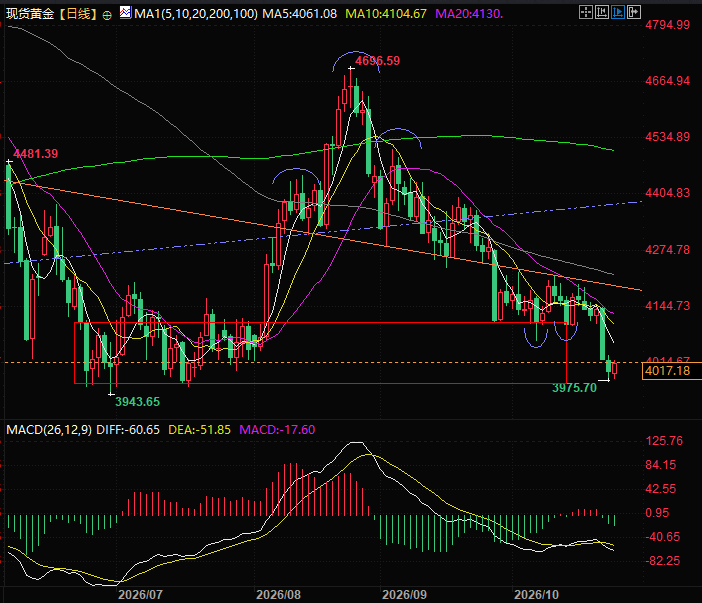 (Spot gold daily chart, source: EasyTrade) At 17:59 Beijing time, spot gold is currently trading at $4016 per ounce.
Michigan confidence data reveals contradictions: the wealth effect of the stock market is weak.
Spot gold has been fluctuating near three-month lows recently, falling 4% last week, its biggest weekly drop since June, with the market consistently suppressed by expectations of high interest rates. The October University of Michigan consumer sentiment data reveals a crucial contradiction in the current US macroeconomic environment: During the survey period, US stocks experienced a sharp rise and fall followed by a significant rebound. The wealth effect should theoretically boost consumer sentiment, but the final confidence reading showed limited improvement. Inflation, purchasing power pressures, and weakening consumer willingness remain the core constraints weighing on US consumer expectations. The final Michigan consumer sentiment reading for October was 48.0, slightly lower than September's 48.1, remaining in historically low territory, only higher than the previous low of 44.8 reached in May. While this reading exceeded market expectations of 46.3, it did not escape the low and sluggish trend. The accompanying inflation expectations component is even more alarming: residents' one-year inflation expectations rose to 4.7%, and 5-10 year long-term inflation expectations rose to 3.5%, both hitting new highs since May. Joanne Hsu, the survey's lead researcher, pointed out that purchasing power continues to dominate public opinion on the economy, with respondents across all political stances agreeing that inflation poses a far greater threat to the economy than unemployment in the coming year. This also confirms that the optimism stemming from the recovery of stock market accounts has limited reach and cannot offset the price pressures faced by the entire population. With the US midterm elections approaching, the cost of living has become a core campaign issue. Polls and early voting data show a slight recovery in the Democratic Party's momentum, and the race for Senate seats is intensifying. This political environment has amplified market uncertainty about the economic outlook.The Federal Reserve is taking a wait-and-see approach, leaving global central banks in a dilemma regarding interest rate hikes.
Although inflation stickiness persists, the Federal Reserve remains cautious about raising interest rates, as evidenced by its decision to pause rate hikes at its October meeting. CME Group's FedWatch data shows that the market is pricing in only a 9% probability of a rate hike at this meeting, but expectations for a December hike remain near 80%, indicating that the Fed has not completely closed the door to rate hikes, but rather prefers to wait for more evidence on prices and demand. Globally, with high oil prices causing volatility, other economies are also facing difficult choices: whether to further tighten monetary policy and sacrifice domestic economic growth to suppress inflation transmitted from energy sources has become a dilemma for central banks worldwide. The spillover effects of energy inflation have led to a significant divergence in global monetary policy paths and continue to disrupt asset pricing.Oil prices briefly retreated, but persistent supply concerns continued to weigh on gold prices.
Oil prices are a crucial variable in the current macroeconomic chain. Recently, oil prices have fallen, driven by Qatar's mediation and expectations of easing tensions between the US and Iran. This has temporarily alleviated market anxieties about inflation and also led to a slight rebound in gold prices, with spot gold briefly touching $4019.36 per ounce. However, it's important to recognize that this easing is only a temporary signal. The Houthi rebels in Yemen continue to attack Saudi facilities, and the risk to oil supply has not truly been eliminated. The fragility of energy prices makes it difficult for the narrative of "maintaining high interest rates for a longer period" to completely dissipate, continuously raising the opportunity cost of holding gold and constituting the most direct downward pressure on gold prices. US corporate data also harbors hidden risks: while business activity slowed slightly in October, strong demand supported companies continuing to raise prices for goods and services, suggesting that the upside risk of inflation has not completely subsided.With the sell-off nearing its end, low gold prices present a window for speculation.
From a trading perspective, after a significant decline in the previous period, the concentrated sell-off in gold accompanying the US stock market correction is nearing its end, and the current level is gradually showing its cost-effectiveness. Gold's pricing strategy continues to follow interest rate expectations and liquidity changes: if signs of a US economic slowdown continue to materialize, inflation expectations will decline accordingly, and the market will further lower its pricing of future interest rate hikes, driving a rebound in gold prices. Alternatively, if risk sentiment improves and US stocks recover, market liquidity conditions will also improve, potentially providing room for valuation repair for gold, a non-interest-bearing asset. Of course, risks remain. The volatile situation in the Middle East and a renewed surge in oil prices could reignite tightening expectations, continuing to limit the upside potential of gold prices. Trading should closely monitor this week's FOMC decision and subsequent PCE price indicators. Technically, spot gold has found support at the bottom of its trading range and is expected to rebound, but the overall bearish alignment of moving averages may limit the magnitude and duration of the rebound. (Spot gold daily chart, source: EasyTrade) At 17:59 Beijing time, spot gold is currently trading at $4016 per ounce.- Risk Warning and Disclaimer
- The market involves risk, and trading may not be suitable for all investors. This article is for reference only and does not constitute personal investment advice, nor does it take into account certain users’ specific investment objectives, financial situation, or other needs. Any investment decisions made based on this information are at your own risk.