Strategist: Gold prices are facing resistance near the $4,000 level; technical indicators suggest a potential rebound, but macroeconomic headwinds persist.
2026-10-27 11:34:22
Gold is struggling to defend the key $4,000 per ounce level. Despite the US 10-year Treasury yield falling below 5% earlier this week, it has offered little respite to the already pressured gold market. The market is caught in a tug-of-war: technical indicators suggest a rebound is imminent, but the economic fundamentals still hang heavy on the market.
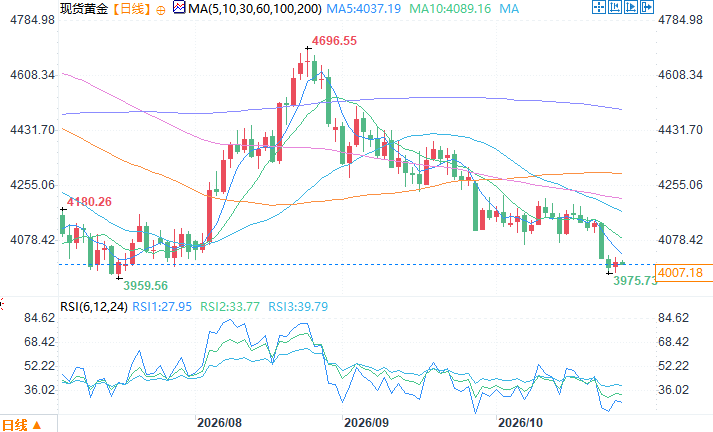 Spot gold daily chart source: FX678. At 11:32 AM Beijing time on October 27th, spot gold was trading at $4012.18 per ounce.
The $4,000 mark is in danger; a tug-of-war between technical and fundamental factors.
Gold is currently struggling around the $4,000 mark, a key turning point for the precious metal. Behind this disappointing price performance lies the continued pressure from the macroeconomic environment. Roukaya Ibrahim, chief commodities strategist at BCA Research, believes the recent sell-off may have been somewhat excessive, but any potential rebound is expected to be merely a consolidation phase rather than the start of another significant downtrend. Ibrahim stated that gold remains caught between bullish technical indicators and bearish economic fundamentals. She added that persistent inflation and the possibility of a stronger dollar may prevent gold from building meaningful bullish momentum before the end of the year. She said, "My technical indicators suggest a rebound is imminent, but macroeconomic variables indicate headwinds remain, so I tend to think that gold will consolidate in this environment. We won't see a meaningful surge due to technicals, but similarly, those technical indicators also suggest that even with macroeconomic drags, we may not see further selling."Technical indicators are oversold, but macro headwinds remain.
Ibrahim explained that gold's deviation from its 200-day moving average has returned to levels seen in late July, when prices established a short-term bottom and subsequently experienced a significant recovery. This technical indicator suggests that the recent sell-off has overextended downwards and may provide some support for gold prices in the coming weeks. However, she also cautioned that $4,000 remains a key support level, and a sustained break below this threshold could signal further weakness. While the technical picture suggests gold prices may be nearing a bottom, she noted that the fundamental outlook remains challenging, particularly persistent inflationary pressures that are forcing the Federal Reserve to maintain a restrictive monetary policy stance.The US dollar has become the dominant variable, limiting its upside potential in the short term.
Ibrahim pointed out that in recent months, the relationship between gold and the US dollar has become more important than its relationship with real interest rates. Given that the dollar is expected to remain relatively strong until the end of the year, she believes there is limited room for gold to generate a sustainable upward trend. She said, "I will remain cautious about the outlook for gold prices. Because of this risk, I am not overly bullish in the short term." She added that although US Treasury yields have retreated from recent highs, lower yields alone may not be enough to support gold if the dollar remains strong and investors remain focused on inflation risks. She also mentioned that the ongoing conflict in the Middle East complicates the monetary policy outlook, as high energy prices exacerbate inflationary pressures, making it more difficult for the Federal Reserve to consider easing interest rates. She said, "In the short term, the risks are skewed towards greater inflationary pressures." She warned that the conflict could escalate further after the US midterm elections, exacerbating energy-driven inflation and reinforcing market expectations that the Federal Reserve will need to maintain a tightening stance.The sell-off may be a liquidity event, but long-term support remains.
Despite these challenges, Ibrahim stated that the recent sharp drop in gold prices should not be interpreted as evidence of a fundamental deterioration in the gold investment outlook. She described last week's sell-off as an unusual, likely liquidity-driven event, where gold prices fell instead of providing support from the dollar and Treasury yields. She believes this reflects broader cross-asset liquidity pressures rather than a structural breakdown in the relationship between gold and traditional financial markets. Ibrahim also pointed out that gold has shown considerable resilience in recent months, even as rising bond yields and a stronger dollar have created an increasingly challenging environment for the non-interest-bearing asset. Beyond short-term weakness, long-term investment demand remains a significant support for the precious metal. While central bank purchases are unlikely to accelerate significantly from already high levels, she expects official sector demand to remain a supporting factor, and major Asian countries are likely to continue taking advantage of lower prices to increase their gold reserves.Key factors to watch for in the market outlook: private demand and a turning point in 2027.
According to Ibrahim, another significant catalyst for a sustained rebound could come from private investment demand, especially as market concerns intensify regarding the sustainability of US fiscal policy. Growing unease about government debt and the fiscal deficit could prompt investors to increase their holdings of gold ETFs and other investment products to diversify portfolio risk. For now, she expects gold to be caught between these long-term supporting factors and short-term challenges posed by monetary policy and the US dollar. She believes the macroeconomic environment may become more favorable for gold in early 2027, particularly when the dollar begins to weaken and inflationary pressures eventually ease.Conclusion
Above the $4,000 mark, gold is caught in a tug-of-war between technical, fundamental, and geopolitical factors. In the short term, the US dollar and inflation remain the main downward pressures; while longer-term support hinges on the return of private investment demand and a loosening of the macroeconomic environment. Whether 2027 will be a turning point remains to be seen. Spot gold daily chart source: FX678. At 11:32 AM Beijing time on October 27th, spot gold was trading at $4012.18 per ounce.
- Risk Warning and Disclaimer
- The market involves risk, and trading may not be suitable for all investors. This article is for reference only and does not constitute personal investment advice, nor does it take into account certain users’ specific investment objectives, financial situation, or other needs. Any investment decisions made based on this information are at your own risk.