The dollar fell against the Brazilian real after fluctuating by more than 10% overnight, with Lula's victory and election fraud controversies dominating sentiment.
2026-10-27 11:58:24
On Tuesday (October 27) during Asian trading hours, the US dollar fell slightly against the Brazilian real, currently trading around 5.3715. Overnight, the exchange rate rose by more than 10% to 5.6053, hitting its highest level since late December 2025. The direct driver of this sharp fluctuation was the political shock of the Brazilian presidential election results. Brazilian President Lula da Silva, trailing in the first round and virtually eliminated politically, won a fourth term in Sunday's (October 25) runoff with over 64 million votes, setting a record for the most votes won by a Brazilian presidential candidate. This reversal, adding 10.4 million votes in three weeks, stemmed from grassroots mobilization, fear narratives, and adjustments in the opponent's strategies. On Monday morning, the Brazilian currency plummeted, and the stock market plunged nearly 20%. Bolsonaro refused to concede defeat and vowed to challenge the results; Washington has not yet recognized the election results. 
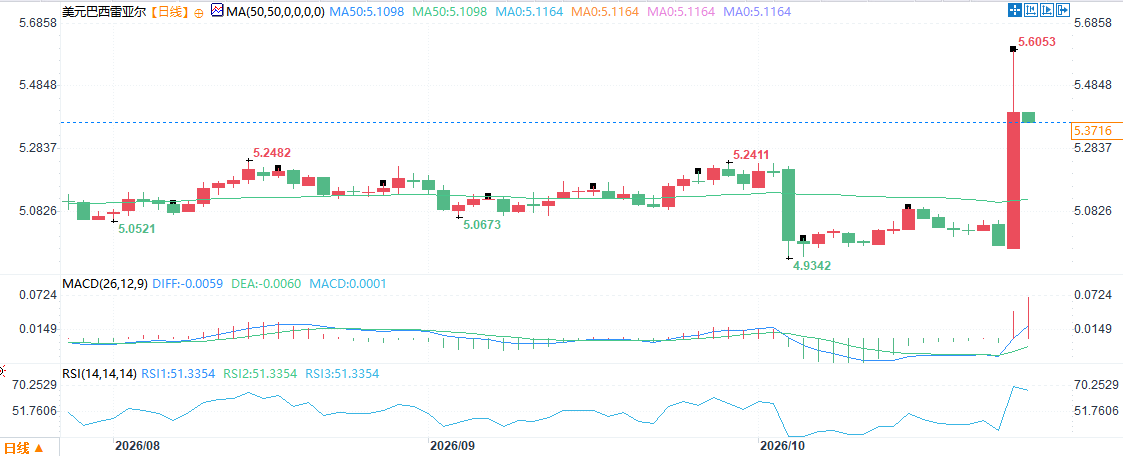 (USD/BRL daily chart, source: FX678) At 11:56 Beijing time, the USD/BRL exchange rate was 5.3716/23.
A dramatic turnaround: trailing in the first round, the team staged a comeback in the final election, garnering a record-breaking 64 million votes.
Brazilian President Luiz Inácio Lula da Silva, whose parents were illiterate and who worked as a shoeshine boy in his early years, has repeatedly defied expectations throughout his life. His unexpected victory on Sunday secured his fourth term, making him one of the world's longest-serving elected leaders, a result that even his own party members were caught off guard. Just three weeks earlier, da Silva lost the first round of voting to Flavio Bolsonaro with 45% to 47%, effectively ending his political chances. Flavio is the son of his formidable rival, former President Jair Bolsonaro. In Brazil's democratic history, there has never been a precedent of a presidential candidate overturning a first-round defeat in a runoff election. The abstention rate was the highest since 1998, and polls that historically overestimated da Silva's support showed him slightly behind Bolsonaro. The right wing has even begun selecting ministerial candidates for the new government. However, in what is considered one of the most dramatic election reversals in Brazilian history, da Silva won a fourth term with over 64 million votes, setting a new record for the most votes won by a Brazilian presidential candidate. Da Silva will turn 81 on Tuesday, and he is now poised to serve a total of 16 years in office.Market reaction: Brazilian currency plummeted, and the stock market plunged nearly 20%.
On Monday morning, the Brazilian currency plummeted and the stock market plunged nearly 20% as investors reacted to da Silva's unexpected turnaround and the prospect of a left-wing government remaining in power. Pollsters scrambled to explain how da Silva had revitalized the left in just three weeks; in Latin America, all major countries except Mexico are now under conservative rule.Controversy over election fraud: Bolsonaro refuses to concede defeat and vows to challenge the results.
Bolsonaro and his supporters have only one explanation: fraud. As conspiracy theories circulated online, Bolsonaro refused to concede defeat on Sunday and vowed to seek an invalidation of the election results in response to the Supreme Court's last-minute two-hour extension of voting time. Bolsonaro is under investigation for alleged money laundering and attempting to raise funds for a film about his father from a banker embroiled in a fraud scandal. He stated that police, fearing he might flee Brazil after the defeat, had ordered him to surrender his passport on Monday. World leaders congratulated da Silva on his victory, and Washington has not yet recognized the results. US President Trump told reporters on Monday that the election "looks like another rigged election."Reasons for the reversal: A mix of hope and fear, with fear mobilizing impoverished voters.
But according to political scientists, pollsters, and da Silva himself, his seemingly miraculous comeback was due to the powerful interplay of hope and fear, with fear being the dominant factor. Strong grassroots mobilization brought young and older voters to the polls, many of whom hadn't left their homes for the first round of voting. Fear-mongering propaganda exacerbated anxieties among Brazil's poorer citizens who feared losing government benefits if a right-wing government came to power. This last-minute mobilization was largely driven by André Jañones, a former bus conductor and now a hardline congressman allied with da Silva's Workers' Party. He brought his aggressive social media strategy to da Silva's struggling campaign. Jañones is far from a clean-cut hero: he has faced corruption charges and allegations of threatening to release private photos of his ex-girlfriend; she has obtained a restraining order against him. He denies these allegations. But his series of viral videos and personal attacks on the Bolsonaro family injected energy into the campaign. Within three weeks of the first round of voting, his supporters' social media following for da Silva surged from 50,000 to nearly 11 million. The 80-year-old da Silva only recently got his first smartphone. On Sunday evening, he praised Janones as his "general," saying he kept the campaign team in high spirits "morning, afternoon, and evening."Strategic shift: Removing the straw hat, donning the national flag colors, and shifting the criminal stance to the right.
After losing in the first round of voting, da Silva quickly adjusted his strategy. He removed his iconic Panama hat and the Workers' Party's signature red, replacing it with the iconic colors of the Brazilian flag—green and yellow—long associated with the Bolsonaro movement. He also changed his long-standing stance on crime, supporting a proposal to try 16-year-olds convicted of serious crimes such as murder and rape as adults. "His re-election tonight wasn't because he became more committed to left-wing ideology," said Kevin Ivers of the political analysis newsletter StratComms. "In the end, da Silva rushed to do, or promised to do, things he failed to deliver on during his term, almost as if he were playing himself against his opponent."Voting Analysis: 10.4 Million New Votes, Increased Turnout and the Shift Towards Blank Votes
Da Silva gained 10.4 million votes between the two rounds of voting. Rising voter turnout contributed significantly: despite torrential rains and flooding in parts of Brazil on Sunday, nearly 3 million more people participated in the runoff than in the first round. While most citizens are obligated to vote, the penalty for not voting is less than $1, and about one-fifth of adults did not participate in the October 4th first round. Another 1.8 million voters cast blank or invalid ballots in the first round but selected a candidate in the runoff. Brazilians often use blank or invalid ballots to express dissatisfaction with candidates. However, even if all these additional votes went to Da Silva, he still has an increase of over 5.5 million votes that cannot be explained by these reasons. These changes suggest that Da Silva also gained support from voters who previously supported less well-known candidates who were eliminated in the first round, including right-wing candidates. Political scientists suggest that some voters may have switched from supporting Bolsonaro to supporting Da Silva; in Brazil, voters' positions are often more influenced by practical issues than ideology. “The most compelling explanation is that da Silva successfully built a coalition that was more about opposition to Bolsonaroism than about endorsement of the president himself,” said Leandro Gabbiati, a political scientist and director of Dominium Public Affairs. In Minas Gerais, the home state of his online ally Janones, da Silva reversed a first-round defeat to win the state, a bellwether for every presidential election since 1989. He also won the metropolitan areas of São Paulo and Rio de Janeiro, although Bolsonaro won the states where those cities are located.Election Day Chaos: Heavy Rain, Public Transport Shortages, and Controversy Over Judicial Intervention
However, for Bolsonaro and his supporters, this reversal was unbelievable, with many seizing on the chaos of election day to accuse others of fraud. Torrential rains brought nearly five inches of rain to some towns, flooding roads, disrupting public transportation, and forcing several polling stations to be temporarily relocated. In Paraná state, local authorities deployed boats and tractors to help voters reach polling stations. Meanwhile, da Silva's allies accused pro-Bolsonaro local officials of deliberately cutting public transport services to impoverished communities. In El Salvador, authorities found hundreds of buses idle. An election judge ordered the arrest of the city's transportation director. The city government denied attempting to obstruct the vote. Both campaigns petitioned the Brazilian Electoral Court to extend voting hours by two hours; Bolsonaro's team cited the torrential rains, while da Silva's team cited a shortage of buses. With no ruling in sight, da Silva's coalition also appealed to the Supreme Court. The case was randomly assigned to Justice Cristiano Zanin, da Silva's former personal lawyer who defended him in his corruption case. Just after 5 p.m., Zanin ordered the nationwide voting period extended to 7 p.m. This unprecedented intervention caused chaos as many electronic voting machines were shut down and could not be restarted. Constitutional lawyers and the Electoral Court itself stated that the decision was legal and refuted Bolsonaro's claims that the move was biased towards Da Silva. The Electoral Court is currently led by a justice appointed by Bolsonaro. But years of controversial rulings and allegations of judicial overreach have eroded public trust in Brazil's highest judicial body. Ivar Hartman, an associate professor at the Innsper Business School in São Paulo, said that judicial intervention has exacerbated political turmoil at a time when the country needs certainty from the judiciary. "For years, it is the Supreme Court justices themselves who have created this distrust," he said. He stated that democracies need public trust to function, and the Brazilian judiciary has lost that trust.Real Outlook: Two Key Variables to Determine if Rebound Can Continue
In the short term, two variables will determine whether the Real can hold its current position. First, whether the Central Bank of Brazil will intervene. The Finance Minister has stated that it will intervene in the foreign exchange market "if necessary" and plans to raise its primary fiscal surplus forecast for next year. The effectiveness of verbal intervention depends on whether there are subsequent concrete actions; if it remains merely a statement, the sustainability of the Real's rebound is questionable. Second, the credibility of fiscal commitments. Lula's campaign spending promises included actual increases in the minimum wage, expanded education subsidies, and household debt relief. The market is highly sensitive to the deficit path in the 2027 budget. Brazil's public debt already exceeds 82% of GDP; any expansion of spending without hedging measures will directly push up the fiscal premium in long-term interest rates.Summarize
Despite trailing in the first round and being virtually politically out of contention, Lula won a fourth term in the runoff with over 64 million votes, setting a new record for the most votes won by a Brazilian presidential candidate. The reversal stemmed from grassroots mobilization, fear narratives, a social media offensive, and a strategic shift towards the centrist. An additional 10.4 million votes were won between the two rounds, with over 5.5 million of those votes defying explanations of increased voter turnout and blank ballots being cast. On Monday morning, the Brazilian currency plummeted and the stock market plunged nearly 20%. Bolsonaro refused to concede defeat and vowed to challenge the results, which Washington has not yet recognized. Heavy rains on election day, public transportation shortages, and the Supreme Court's intervention to extend voting hours exacerbated allegations of fraud and a crisis of confidence in the judiciary. (USD/BRL daily chart, source: FX678) At 11:56 Beijing time, the USD/BRL exchange rate was 5.3716/23.
- Risk Warning and Disclaimer
- The market involves risk, and trading may not be suitable for all investors. This article is for reference only and does not constitute personal investment advice, nor does it take into account certain users’ specific investment objectives, financial situation, or other needs. Any investment decisions made based on this information are at your own risk.