Strategist: Gold prices lack upward momentum in the short term, but long-term value remains.
2026-10-27 10:58:22
At the beginning of this year, continued gold purchases by central banks around the world drove spot gold prices close to $5,600 per ounce, making gold a mainstream investment theme. However, in the second half of 2026, the situation in the Middle East remained unresolved, and the market's attitude towards gold clearly shifted to caution. Rob Haworth, senior investment strategist at Bank of America Wealth Management, analyzed the multiple factors currently suppressing gold and the prerequisites for a future recovery.
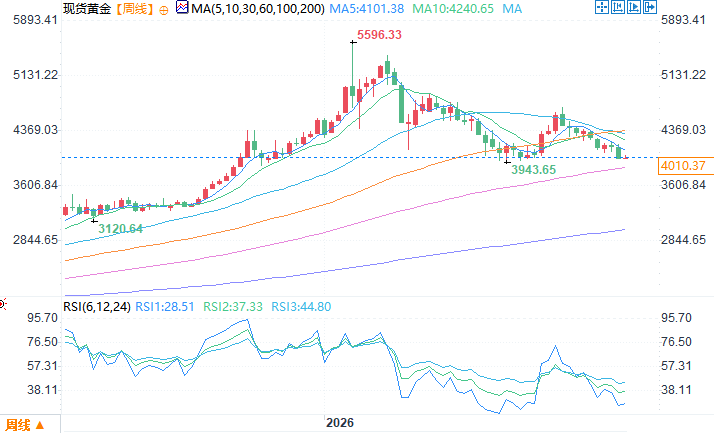 Spot gold weekly chart source: FX678. At 10:56 AM Beijing time on October 27th, spot gold was trading at $4009.32 per ounce.
Central banks shift their focus, and gold loses its core buying support.
Haworth stated that for gold to return above $5,000 per ounce, the conflict with Iran must end and the global energy market return to normal, at which point central banks will refocus on diversifying their reserves. While gold's long-term investment value hasn't disappeared, central banks are currently prioritizing economic stability and energy security, and are no longer continuously increasing their gold holdings. He said, "As long as the conflict continues, the gold market will likely remain under pressure." The central bank gold-buying spree that previously drove up prices has subsided. Countries are impacted by high energy and food prices, diverting funds to address energy supply risks, and forcing the pace of reserve diversification to be put on hold. As early as the end of March, he pointed out that increasing gold holdings by central banks is no longer a priority for many countries.Traditional negative factors continue to exert downward pressure, leading to a shift in the logic of risk aversion.
Gold prices are now primarily driven by traditional fundamentals such as real interest rates and the US dollar. Rising US Treasury yields, a stronger dollar, and market demand for liquidity are continuously eroding gold's traditional safe-haven appeal. According to his assessment, the Federal Reserve's gradual tightening cycle is highly detrimental to gold, a non-interest-bearing asset. While the Fed remains firm in its fight against inflation, it will not resort to aggressive rate hikes. Institutional economists predict another rate hike in December and possibly again in March next year. This moderate tightening path is sufficient to support a strong dollar, continuously suppressing gold prices. Even with US Treasury yields falling from their highs, there has been no large-scale buying of gold; funds are more inclined towards technology growth stocks and the energy sector, which benefits from supply disruptions.Physical demand struggles to keep pace, Asian consumer spending remains weak.
Asia's two largest economies are the world's two largest physical gold consumer markets, but Haworth believes it's unlikely that physical demand will rebound significantly in either region in the short term. Both countries face pressure on their domestic economies, limiting residents' purchasing power and hindering gold consumption. Slower central bank gold purchases, weak physical demand, and constraints imposed by the Federal Reserve's policies make it difficult for any catalysts to drive gold prices significantly higher in the short term. He noted an anomaly: while geopolitical instability should be beneficial for gold, the current conflicts have pushed up energy prices and exacerbated inflation, with funds prioritized for addressing immediate economic risks, and traditional safe-haven buying has not materialized. He said, "There is currently no bullish logic for gold, which is particularly noteworthy in an environment full of conflict and uncertainty."The long-term value has not disappeared; it awaits the resonance of multiple signals.
While adopting a cautious short-term view, Haworth does not believe that gold's significance as a strategic reserve asset has disappeared. The long-term desire of countries to reduce reliance on single currencies and diversify their reserves remains unchanged, and the resumption of central bank gold purchases remains a key variable for long-term gold price increases. For example, major Asian countries continue to reduce their dependence on the US dollar and the euro. However, the trade landscape and economic outlook are fraught with uncertainty, making it difficult to predict when central banks will resume increasing their gold holdings. For gold prices to experience a strong upward trend, the situation in the Middle East needs clarification, the global trade environment needs stability, and a clear signal of the return of central bank gold purchases.Conclusion
Gold is currently in a unique and contradictory environment. Geopolitical conflicts have not brought safe-haven buying; instead, they have generated negative factors such as inflation and high interest rates. Gold's long-term reserve value remains, but for the short-term market to reverse, it needs to wait for the energy crisis to ease and for central bank funds to flow back into gold reserves. Spot gold weekly chart source: FX678. At 10:56 AM Beijing time on October 27th, spot gold was trading at $4009.32 per ounce.
- Risk Warning and Disclaimer
- The market involves risk, and trading may not be suitable for all investors. This article is for reference only and does not constitute personal investment advice, nor does it take into account certain users’ specific investment objectives, financial situation, or other needs. Any investment decisions made based on this information are at your own risk.