Ahead of the Federal Reserve decision, safe-haven buying surged, pushing the dollar index to its third consecutive day above the 102.00 mark.
2026-10-27 15:34:24
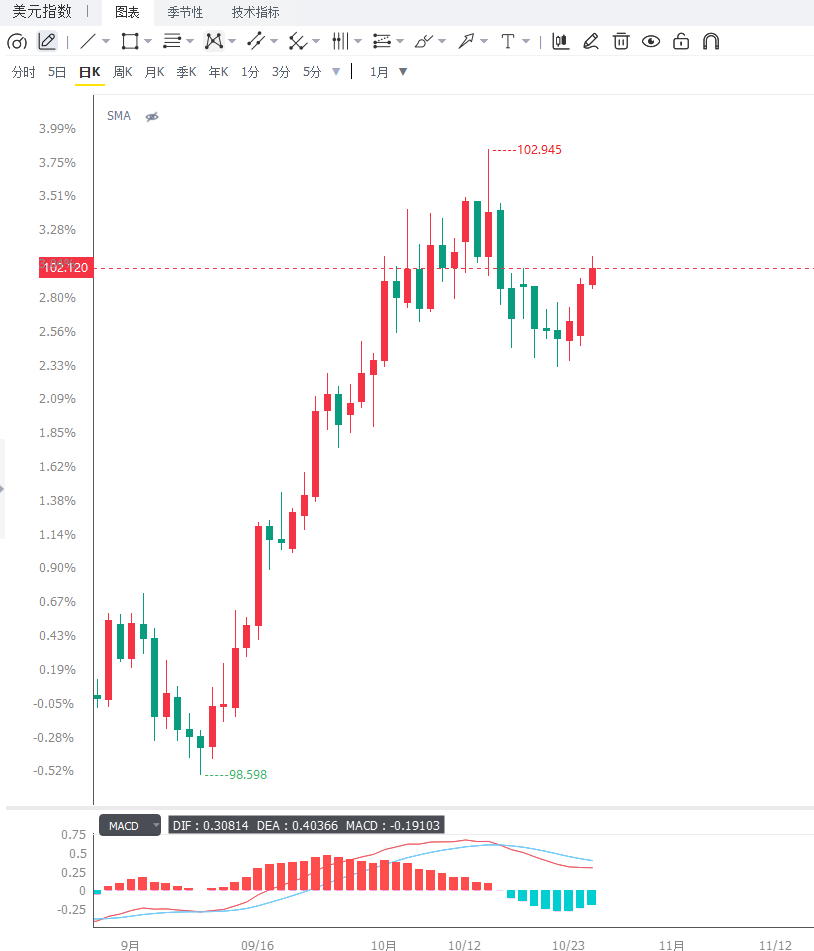
The US dollar index is trading around 102.00, having briefly touched a near two-week high before giving back some of its gains. The core contradiction in the current index lies in two aspects: on the one hand, high energy prices are pushing up inflation expectations, US Treasury yields are rebounding from three-week lows, and geopolitical uncertainties are all providing tailwinds; on the other hand, recent signals from Federal Reserve officials that there is "no rush to raise interest rates," and the fact that Wednesday's rate hold was already fully priced in, means that the upward movement lacks a smooth catalyst. This combination of "clear direction but sluggish pace" suggests that this rebound is more of a combination of technical correction and risk aversion than the start of a trend breakout.  From the perspective of supporting factors, energy prices are the most direct transmission channel. Rising oil prices have pushed up inflation readings on the cost side, thereby strengthening the Federal Reserve's case for maintaining or even further tightening its policy. The significance of this chain for the US dollar is that it keeps the year-end interest rate hike expectation in the pricing—despite officials' dovish statements, the market still assigns about an 80% probability to December. This divergence between "dovish statements and hawkish pricing" is precisely the key to the US dollar index's ability to strengthen for three consecutive days but struggle to break through smoothly: funds are betting that inflation stickiness has not been disproven, rather than that central banks are about to take action. At the same time, US Treasury yields rebounded slightly after falling to a three-week low, providing additional interest rate differential support for the dollar; the continued geopolitical risk premium in the Middle East further activated the dollar's safe-haven attributes. These two forces, acting in the same direction, constitute the main driving force of this rebound. However, the fragility of this support structure is also worth noting. First, the logic on the energy front is two-way – if diplomatic efforts such as the Tehran talks make substantial progress, the fading oil price premium will simultaneously remove the two pillars of inflation expectations and safe-haven demand, and the tailwind for the dollar could quickly turn into a headwind. Second, there is a significant discrepancy between the official statement that "there is no need to rush to raise interest rates" and the market's 80% probability of a rate hike. This means that if Thursday's PCE data is lower than expected or Warsh reiterates a cautious stance at the press conference, this crowded pricing will face the risk of a rapid correction. Third, the current rebound occurred in the pre-meeting window of thin liquidity, with traders generally choosing to wait and see, resulting in a lack of confirmation from incremental funds for the index's rise. Historically, the credibility of highs formed under such thin market conditions often needs to wait for secondary verification after liquidity returns. Policy expectations set the framework for this week's pace. With no updated economic forecasts, the policy statement and Warsh's post-meeting press conference become the sole basis for judging the future path. This information environment amplifies the impact of a single word – the same statement about inflation stickiness, without a dot plot reference, may be interpreted by the market as a stronger hawkish signal. Thursday's release of the preliminary US Q3 GDP and PCE price index will directly validate economic resilience and inflation sustainability: if the data is stronger than expected, the rebound in US Treasury yields will be supported, pushing the dollar index towards 102.95; if the data is weaker, it may undermine the legitimacy of tightening expectations, causing the index to retest the support zone below 101.92. This tight schedule means that directional market movements this week are more likely to unfold after the data releases, with the previous narrow-range fluctuations being a normal consolidation phase. From a cross-currency perspective, the dollar index's rebound also benefits from the relative weakness of non-US currencies. The euro, dragged down by stagflation pressures from European natural gas prices rising by more than a third this month and reaching 90 euros/megawatt-hour, has become the worst-performing G10 currency this month; the pound is under pressure ahead of the fiscal credibility test of the autumn budget; the yen is continuously suppressed by active carry trades, and its safe-haven attributes have failed to be effectively activated in this round of geopolitical tensions. This divergence indicates that the current strength of the dollar stems more from the weaknesses of its counterparts than from an absolute improvement in its own fundamentals. This distinction has significant implications for subsequent price movements: when the driving factors are primarily external, the dollar's rise often exhibits a "step-like" rather than a "trend-like" pattern—it rises a step each time negative news about non-dollar currencies is priced in, then consolidates until the next catalyst appears. This also explains why, although this rebound has seen three consecutive days of gains, the daily increases have remained limited. On the 4-hour chart, the dollar index has stabilized above the 200-period simple moving average and broken through the 23.6% Fibonacci retracement level of 101.92, maintaining a constructive bullish bias and strengthening the short-term upward momentum; however, the overall gains are still constrained by the cycle anchor at 102.95, which constitutes the primary resistance level in the near term. The next resistance levels to watch are the psychological zones of 102.20 and 102.50, as well as 102.95. The first support level to watch is the recovered 23.6% Fibonacci retracement at 101.92, followed by the bottom of a dense structure formed by the 38.2% Fibonacci retracement at 101.28 and the 200-period SMA around 101.26. A deeper retracement would expose the 50.0% Fibonacci retracement at 100.77 and the 61.8% Fibonacci retracement at 100.26. If the current bullish structure fails, the 78.6% Fibonacci retracement levels at 99.52 and 98.59 represent further downside targets. On the daily chart, the index has been slowly moving upwards along short-term moving averages since rebounding from a three-week low. The RSI has moved away from its lows but remains in the neutral zone, indicating that momentum is recovering but has not yet entered overbought territory, leaving room for further fluctuations.
 Editor's Summary: The core contradiction for the US dollar index in the short term lies in the combined tailwinds provided by inflation concerns triggered by energy prices, the rebound in US Treasury yields, and geopolitical safe-haven demand. However, the Fed's "no rush to raise interest rates" stance and pre-meeting wait-and-see sentiment limit upward momentum. This two-way driving force makes the index more likely to consolidate within the 101.92-102.50 range, awaiting a breakthrough in policy and data. Three key variables need to be monitored: First, the Fed's decision, policy statement, and Warsh press conference on Wednesday. Without updated economic forecasts, their statements on inflationary pressures will be the primary basis for judging the policy path. Second, the preliminary US Q3 GDP and PCE price index on Thursday, directly verifying economic resilience and inflation stickiness, determining whether the rebound in US Treasury yields can continue. Third, the trends of Brent and WTI crude oil and developments in the Middle East, which are prerequisites for the transmission chains of inflation expectations and safe-haven demand. In addition, non-US variables such as Eurozone natural gas prices and PMI, the UK autumn budget, and the Bank of Japan's policy updates also need to be monitored, as their relative weakness is also an important source of this round of dollar strength.
From the perspective of supporting factors, energy prices are the most direct transmission channel. Rising oil prices have pushed up inflation readings on the cost side, thereby strengthening the Federal Reserve's case for maintaining or even further tightening its policy. The significance of this chain for the US dollar is that it keeps the year-end interest rate hike expectation in the pricing—despite officials' dovish statements, the market still assigns about an 80% probability to December. This divergence between "dovish statements and hawkish pricing" is precisely the key to the US dollar index's ability to strengthen for three consecutive days but struggle to break through smoothly: funds are betting that inflation stickiness has not been disproven, rather than that central banks are about to take action. At the same time, US Treasury yields rebounded slightly after falling to a three-week low, providing additional interest rate differential support for the dollar; the continued geopolitical risk premium in the Middle East further activated the dollar's safe-haven attributes. These two forces, acting in the same direction, constitute the main driving force of this rebound. However, the fragility of this support structure is also worth noting. First, the logic on the energy front is two-way – if diplomatic efforts such as the Tehran talks make substantial progress, the fading oil price premium will simultaneously remove the two pillars of inflation expectations and safe-haven demand, and the tailwind for the dollar could quickly turn into a headwind. Second, there is a significant discrepancy between the official statement that "there is no need to rush to raise interest rates" and the market's 80% probability of a rate hike. This means that if Thursday's PCE data is lower than expected or Warsh reiterates a cautious stance at the press conference, this crowded pricing will face the risk of a rapid correction. Third, the current rebound occurred in the pre-meeting window of thin liquidity, with traders generally choosing to wait and see, resulting in a lack of confirmation from incremental funds for the index's rise. Historically, the credibility of highs formed under such thin market conditions often needs to wait for secondary verification after liquidity returns. Policy expectations set the framework for this week's pace. With no updated economic forecasts, the policy statement and Warsh's post-meeting press conference become the sole basis for judging the future path. This information environment amplifies the impact of a single word – the same statement about inflation stickiness, without a dot plot reference, may be interpreted by the market as a stronger hawkish signal. Thursday's release of the preliminary US Q3 GDP and PCE price index will directly validate economic resilience and inflation sustainability: if the data is stronger than expected, the rebound in US Treasury yields will be supported, pushing the dollar index towards 102.95; if the data is weaker, it may undermine the legitimacy of tightening expectations, causing the index to retest the support zone below 101.92. This tight schedule means that directional market movements this week are more likely to unfold after the data releases, with the previous narrow-range fluctuations being a normal consolidation phase. From a cross-currency perspective, the dollar index's rebound also benefits from the relative weakness of non-US currencies. The euro, dragged down by stagflation pressures from European natural gas prices rising by more than a third this month and reaching 90 euros/megawatt-hour, has become the worst-performing G10 currency this month; the pound is under pressure ahead of the fiscal credibility test of the autumn budget; the yen is continuously suppressed by active carry trades, and its safe-haven attributes have failed to be effectively activated in this round of geopolitical tensions. This divergence indicates that the current strength of the dollar stems more from the weaknesses of its counterparts than from an absolute improvement in its own fundamentals. This distinction has significant implications for subsequent price movements: when the driving factors are primarily external, the dollar's rise often exhibits a "step-like" rather than a "trend-like" pattern—it rises a step each time negative news about non-dollar currencies is priced in, then consolidates until the next catalyst appears. This also explains why, although this rebound has seen three consecutive days of gains, the daily increases have remained limited. On the 4-hour chart, the dollar index has stabilized above the 200-period simple moving average and broken through the 23.6% Fibonacci retracement level of 101.92, maintaining a constructive bullish bias and strengthening the short-term upward momentum; however, the overall gains are still constrained by the cycle anchor at 102.95, which constitutes the primary resistance level in the near term. The next resistance levels to watch are the psychological zones of 102.20 and 102.50, as well as 102.95. The first support level to watch is the recovered 23.6% Fibonacci retracement at 101.92, followed by the bottom of a dense structure formed by the 38.2% Fibonacci retracement at 101.28 and the 200-period SMA around 101.26. A deeper retracement would expose the 50.0% Fibonacci retracement at 100.77 and the 61.8% Fibonacci retracement at 100.26. If the current bullish structure fails, the 78.6% Fibonacci retracement levels at 99.52 and 98.59 represent further downside targets. On the daily chart, the index has been slowly moving upwards along short-term moving averages since rebounding from a three-week low. The RSI has moved away from its lows but remains in the neutral zone, indicating that momentum is recovering but has not yet entered overbought territory, leaving room for further fluctuations. Editor's Summary: The core contradiction for the US dollar index in the short term lies in the combined tailwinds provided by inflation concerns triggered by energy prices, the rebound in US Treasury yields, and geopolitical safe-haven demand. However, the Fed's "no rush to raise interest rates" stance and pre-meeting wait-and-see sentiment limit upward momentum. This two-way driving force makes the index more likely to consolidate within the 101.92-102.50 range, awaiting a breakthrough in policy and data. Three key variables need to be monitored: First, the Fed's decision, policy statement, and Warsh press conference on Wednesday. Without updated economic forecasts, their statements on inflationary pressures will be the primary basis for judging the policy path. Second, the preliminary US Q3 GDP and PCE price index on Thursday, directly verifying economic resilience and inflation stickiness, determining whether the rebound in US Treasury yields can continue. Third, the trends of Brent and WTI crude oil and developments in the Middle East, which are prerequisites for the transmission chains of inflation expectations and safe-haven demand. In addition, non-US variables such as Eurozone natural gas prices and PMI, the UK autumn budget, and the Bank of Japan's policy updates also need to be monitored, as their relative weakness is also an important source of this round of dollar strength.
- Risk Warning and Disclaimer
- The market involves risk, and trading may not be suitable for all investors. This article is for reference only and does not constitute personal investment advice, nor does it take into account certain users’ specific investment objectives, financial situation, or other needs. Any investment decisions made based on this information are at your own risk.