The decline in oil prices is unlikely to change the bearish structure of silver. A short-term break below the 11-month low warrants caution against a potential acceleration of the downward trend.
2026-10-27 15:44:24
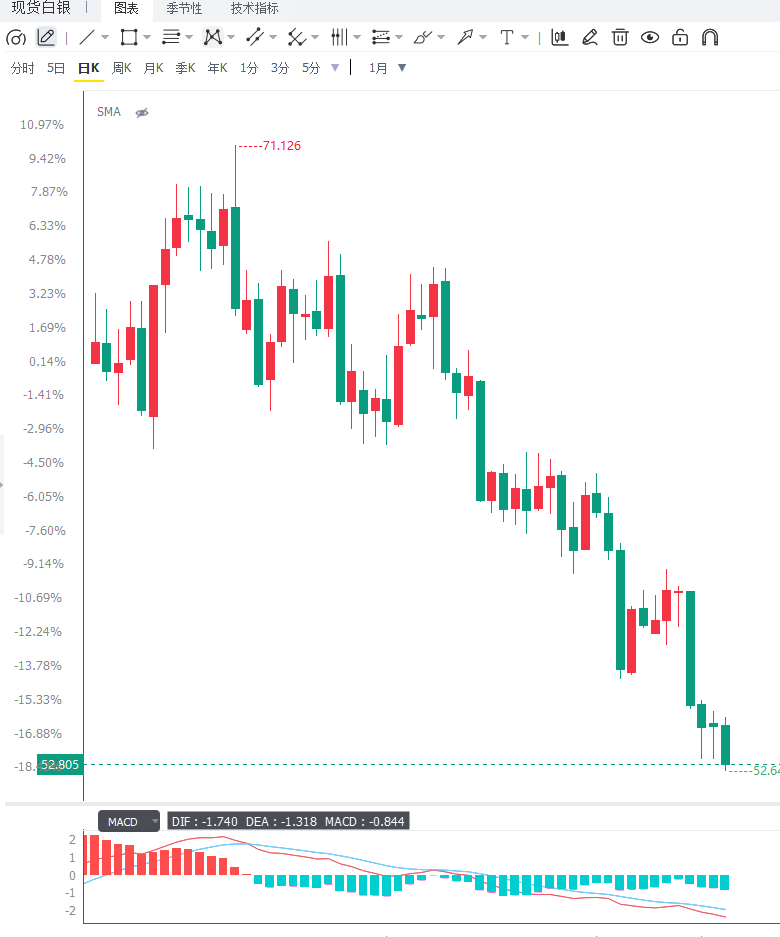
On Tuesday during Asian trading hours, silver traded around $52.80, failing to sustain the previous day's slight rebound. The core contradiction in silver prices currently lies in the fact that while the decline in oil prices has removed some of the driving force from the "inflation-deflation" headwind chain, the bearish alignment of the moving average system and the high probability of a year-end interest rate hike still create layers of resistance above. This combination of "weakening headwinds but unchanged structure" suggests that this rebound is more of a technical correction than the start of a trend reversal.  From the perspective of suppressing factors, energy prices remain the key variable dominating silver pricing. Silver does not generate interest, and its holding cost is directly influenced by the central level of real interest rates. When oil prices push up inflation readings on the cost side, the rationale for central banks to maintain tightening is strengthened, thereby raising real interest rates and suppressing precious metal valuations. Compared to gold, silver is more sensitive to interest rates—it has a heavier speculative position and a shallower market depth, so the same capital outflow will cause a greater price shock. This is the fundamental reason why silver prices fell below $53.01, hitting an 11-month low: it is simultaneously suffering from the double blow of interest rate headwinds and the drag from its industrial attributes. Geopolitical escalation should have been a boon for precious metals, but this round of conflict primarily impacted the energy sector, and the resulting tightening expectations instead constituted a headwind for silver; at the same time, pressured growth expectations weakened its industrial demand narrative, leading to a significantly larger decline than gold, and a passive increase in the gold-silver ratio. However, the drop in oil prices following the Tehran talks provided the first substantial easing signal in this chain. Iran, Saudi Arabia, Pakistan, and Turkey agreed to continue security dialogue and strengthen regional cooperation. A joint statement following the meeting emphasized that the four countries would maintain consultations on regional peace, security, and stability. While such procedural developments are more likely to trigger short-term profit-taking than to reshape the supply and demand narrative, for silver, their significance lies in breaking the one-sided expectation that "inflation can only rise." Institutions such as StoneX had previously pointed out that "a certain degree of pullback in crude oil is beneficial to gold, while some bargain hunters are also entering the market," and predicted that the market would hover around key psychological levels awaiting the Fed's statement. This judgment also applies to silver: the rebound in a thin market lacks incremental capital driving it, and is more of a combination of short covering and bargain hunting, fast but weak in sustainability. Policy expectations set a ceiling from another perspective. Although the October rate freeze has been fully priced in, the probability of at least one rate hike before the end of the year remains as high as 82.3%, and the year-end holding cost pressure has not been relieved. The FXS Fed Sentiment Index remains unchanged at a high level of 127.51, indicating that the overall policy narrative remains firmly in the hawkish range. For silver, this is an environment of "no short-term catalysts and headwinds in the medium term": the meeting itself is unlikely to provide incremental positive factors, but the statement that inflationary pressures remain high has not been disproven, making any rebound likely to encounter selling pressure at relatively low levels. Comparing the actions of other central banks, the European Central Bank and the Bank of Japan are expected to hold rates steady, while the Bank of Canada is expected to raise rates by 25 basis points—this divergence means that the strength of the US dollar stems more from the relative weakness of non-US currencies, thus indirectly strengthening the upward resistance of dollar-denominated silver through the exchange rate channel. What can truly change this situation is not the outcome of a single meeting, but whether there is a substantial easing of the real interest rate center. From the perspective of cross-asset correlation, the current fluctuations in silver are essentially a superposition of four factors: first, the proactive pressure reduction exerted by the decline in oil prices through inflation and interest rate channels; second, the passive drag from industrial attributes under growth concerns; third, the valuation ceiling created by the Fed's year-end path not being disproven; and fourth, the pricing failure due to the failure of geopolitical situations to translate into effective safe-haven buying. The same round of Middle East diplomatic progress simultaneously affected crude oil, the US dollar, and precious metals: it lowered oil prices but also weakened safe-haven demand, while also creating pricing pressure through the strengthening of the US dollar index. After the three phases offset each other, the net direction of silver depends more on real interest rates than on geopolitical narratives. Investors should not view the daily rise and fall of silver prices in isolation, but should evaluate them in the transmission chain of "oil price - inflation - real interest rate - exchange rate": only when the interest rate end of this chain loosens can the stage bottom of silver be credible. On the daily chart, spot silver is trading at $52.80, running below the 9-day EMA and 50-day EMA, with a short-term bias towards the downside. The moving average structure indicates that the rebound is likely to be constrained by the above level; RSI (14) is at 31.06, close to the oversold area, indicating that the downward momentum has been stretched but has not yet reversed, which is a typical "bearish trend, indicator waiting to be repaired" pattern. The next resistance levels to watch are the 9-day EMA at approximately $55.74 and the stronger barrier of the 50-day EMA at approximately $60.74 – only a decisive break above these levels can ease the current bearish sentiment. On the downside, the current data does not indicate clear technical support below the current price. A break below $53.01 could lead to a downward move without clear technical references, followed by a wait for new demand zones to emerge around the $52.00 and $50.00 psychological levels. On the 4-hour chart, silver prices are slowly moving downwards along short-term moving averages, with the MACD histogram close to the zero line and the fast and slow lines repeatedly intertwined, indicating weak momentum. If a rebound to $53.30-$53.60 holds, a further downward acceleration cannot be ruled out.
 Editor's Summary: The core contradiction for silver in the short term lies in the easing of inflation and tightening headwinds due to falling oil prices, with bargain hunters providing marginal support. However, the breach of the key $53.01 level, the bearish alignment of moving averages, the high probability of a year-end rate hike, and the persistently high FXS sentiment index exert downward pressure. These two factors suggest that silver prices are more likely to consolidate within the $52.50-$53.40 range, awaiting a breakthrough from the Fed's decision. Three key variables need to be monitored: first, the Fed's decision, policy statement, and Warsh press conference on Wednesday, as their description of inflationary pressures will directly determine the year-end holding cost; second, the trends of Brent and WTI crude oil and the progress of Middle East diplomatic negotiations, which are prerequisites for inflation expectations and real interest rates; and third, whether $53.01 can be recaptured, which is the primary technical basis for determining whether the breakout is valid and whether the support below is sustainable. In addition, whether gold can stabilize and recover $4000, the trend of the gold-silver ratio, and Thursday's US PCE price index and preliminary Q3 GDP figures also need to be monitored.
From the perspective of suppressing factors, energy prices remain the key variable dominating silver pricing. Silver does not generate interest, and its holding cost is directly influenced by the central level of real interest rates. When oil prices push up inflation readings on the cost side, the rationale for central banks to maintain tightening is strengthened, thereby raising real interest rates and suppressing precious metal valuations. Compared to gold, silver is more sensitive to interest rates—it has a heavier speculative position and a shallower market depth, so the same capital outflow will cause a greater price shock. This is the fundamental reason why silver prices fell below $53.01, hitting an 11-month low: it is simultaneously suffering from the double blow of interest rate headwinds and the drag from its industrial attributes. Geopolitical escalation should have been a boon for precious metals, but this round of conflict primarily impacted the energy sector, and the resulting tightening expectations instead constituted a headwind for silver; at the same time, pressured growth expectations weakened its industrial demand narrative, leading to a significantly larger decline than gold, and a passive increase in the gold-silver ratio. However, the drop in oil prices following the Tehran talks provided the first substantial easing signal in this chain. Iran, Saudi Arabia, Pakistan, and Turkey agreed to continue security dialogue and strengthen regional cooperation. A joint statement following the meeting emphasized that the four countries would maintain consultations on regional peace, security, and stability. While such procedural developments are more likely to trigger short-term profit-taking than to reshape the supply and demand narrative, for silver, their significance lies in breaking the one-sided expectation that "inflation can only rise." Institutions such as StoneX had previously pointed out that "a certain degree of pullback in crude oil is beneficial to gold, while some bargain hunters are also entering the market," and predicted that the market would hover around key psychological levels awaiting the Fed's statement. This judgment also applies to silver: the rebound in a thin market lacks incremental capital driving it, and is more of a combination of short covering and bargain hunting, fast but weak in sustainability. Policy expectations set a ceiling from another perspective. Although the October rate freeze has been fully priced in, the probability of at least one rate hike before the end of the year remains as high as 82.3%, and the year-end holding cost pressure has not been relieved. The FXS Fed Sentiment Index remains unchanged at a high level of 127.51, indicating that the overall policy narrative remains firmly in the hawkish range. For silver, this is an environment of "no short-term catalysts and headwinds in the medium term": the meeting itself is unlikely to provide incremental positive factors, but the statement that inflationary pressures remain high has not been disproven, making any rebound likely to encounter selling pressure at relatively low levels. Comparing the actions of other central banks, the European Central Bank and the Bank of Japan are expected to hold rates steady, while the Bank of Canada is expected to raise rates by 25 basis points—this divergence means that the strength of the US dollar stems more from the relative weakness of non-US currencies, thus indirectly strengthening the upward resistance of dollar-denominated silver through the exchange rate channel. What can truly change this situation is not the outcome of a single meeting, but whether there is a substantial easing of the real interest rate center. From the perspective of cross-asset correlation, the current fluctuations in silver are essentially a superposition of four factors: first, the proactive pressure reduction exerted by the decline in oil prices through inflation and interest rate channels; second, the passive drag from industrial attributes under growth concerns; third, the valuation ceiling created by the Fed's year-end path not being disproven; and fourth, the pricing failure due to the failure of geopolitical situations to translate into effective safe-haven buying. The same round of Middle East diplomatic progress simultaneously affected crude oil, the US dollar, and precious metals: it lowered oil prices but also weakened safe-haven demand, while also creating pricing pressure through the strengthening of the US dollar index. After the three phases offset each other, the net direction of silver depends more on real interest rates than on geopolitical narratives. Investors should not view the daily rise and fall of silver prices in isolation, but should evaluate them in the transmission chain of "oil price - inflation - real interest rate - exchange rate": only when the interest rate end of this chain loosens can the stage bottom of silver be credible. On the daily chart, spot silver is trading at $52.80, running below the 9-day EMA and 50-day EMA, with a short-term bias towards the downside. The moving average structure indicates that the rebound is likely to be constrained by the above level; RSI (14) is at 31.06, close to the oversold area, indicating that the downward momentum has been stretched but has not yet reversed, which is a typical "bearish trend, indicator waiting to be repaired" pattern. The next resistance levels to watch are the 9-day EMA at approximately $55.74 and the stronger barrier of the 50-day EMA at approximately $60.74 – only a decisive break above these levels can ease the current bearish sentiment. On the downside, the current data does not indicate clear technical support below the current price. A break below $53.01 could lead to a downward move without clear technical references, followed by a wait for new demand zones to emerge around the $52.00 and $50.00 psychological levels. On the 4-hour chart, silver prices are slowly moving downwards along short-term moving averages, with the MACD histogram close to the zero line and the fast and slow lines repeatedly intertwined, indicating weak momentum. If a rebound to $53.30-$53.60 holds, a further downward acceleration cannot be ruled out. Editor's Summary: The core contradiction for silver in the short term lies in the easing of inflation and tightening headwinds due to falling oil prices, with bargain hunters providing marginal support. However, the breach of the key $53.01 level, the bearish alignment of moving averages, the high probability of a year-end rate hike, and the persistently high FXS sentiment index exert downward pressure. These two factors suggest that silver prices are more likely to consolidate within the $52.50-$53.40 range, awaiting a breakthrough from the Fed's decision. Three key variables need to be monitored: first, the Fed's decision, policy statement, and Warsh press conference on Wednesday, as their description of inflationary pressures will directly determine the year-end holding cost; second, the trends of Brent and WTI crude oil and the progress of Middle East diplomatic negotiations, which are prerequisites for inflation expectations and real interest rates; and third, whether $53.01 can be recaptured, which is the primary technical basis for determining whether the breakout is valid and whether the support below is sustainable. In addition, whether gold can stabilize and recover $4000, the trend of the gold-silver ratio, and Thursday's US PCE price index and preliminary Q3 GDP figures also need to be monitored.
- Risk Warning and Disclaimer
- The market involves risk, and trading may not be suitable for all investors. This article is for reference only and does not constitute personal investment advice, nor does it take into account certain users’ specific investment objectives, financial situation, or other needs. Any investment decisions made based on this information are at your own risk.