The Tehran talks were defensive diplomatic, and the risk premium for crude oil in the Straits of Hormuz has not yet been cleared.
2026-10-27 16:14:22
Stimulated by news of high-ranking officials from Saudi Arabia, Turkey, and Pakistan visiting Tehran for mediation, coupled with profit-taking, international oil prices fell on Tuesday. However, the overall situation did not show significant easing. On Wednesday, geopolitical disturbances by the Houthis and Saudi Arabia ignited a rebound in oil prices. Although Saudi officials claimed the alert had been lifted, multiple explosions did occur at the Prince Sultan Air Base in the Halaj region south of Riyadh, the Saudi capital. Analyst Sugandha Sachdeva commented that oil prices surged to multi-month highs before profit-taking occurred. The new round of diplomatic contacts has created room for speculation about a breakthrough in US-Iran negotiations, but the core conflict constraints have not disappeared. This Tehran meeting was mediation in nature, aimed at avoiding isolation by Middle Eastern countries and increasing resilience in military confrontation, not at forming an anti-US military alliance. The decline in oil prices is more of a sentiment correction and does not indicate that the tail risk of a supply disruption in the Strait of Hormuz has been eliminated. 
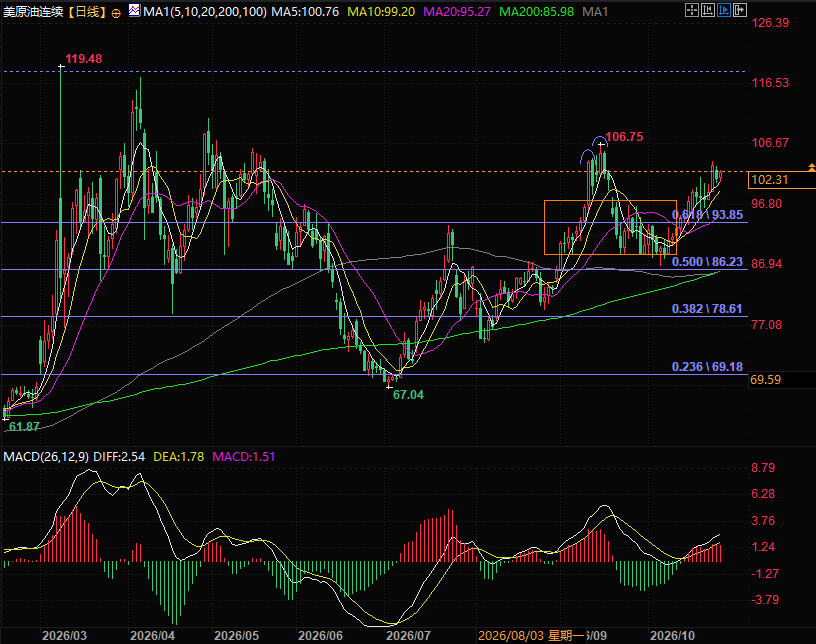 (WTI crude oil futures daily chart, source: EasyTrade) At 16:07 Beijing time, WTI crude oil futures are currently trading at $102.33 per barrel.
Clarifying the nature of the talks: the primary focus was on de-escalation, not on forming a military alliance.
Saudi Arabia, Turkey, and Pakistan are all signatories to the Mecca Mutual Defense Agreement, leading to market speculation that the three parties would form a united front with Iran. DBS Energy Research notes that the Mecca Agreement is a regional collective defense framework, and this meeting was positioned as crisis mediation, not a shift in military alliances. The market tends to overemphasize alliance narratives, ignoring the long-standing security reality of Gulf states' ties to the United States. Domestic scholars also point out that this defense agreement is more symbolic than in terms of immediate combat capabilities, and regional countries' pursuit of strategic autonomy does not equate to siding with the anti-American camp. Multiple sources corroborate that the talks followed the mediation efforts of Qatar and Pakistan, aiming to persuade Iran to exercise more flexibility in negotiations and prevent the escalation of conflict. Saudi Arabia's official statements also clearly state that the trip aimed to promote dialogue and risk control, without any arrangements for military ties or the establishment of supply lines with Iran. The Iranian president's call for consensus among Islamic countries is a diplomatic statement, not a substantive military commitment, but it could indeed enhance Iran's resilience in military confrontation.Iran's core strategy: to gain leverage in negotiations and delay to avoid a full-scale war.
The benefits Iran gained from the meeting were concentrated on the strategic diplomatic level, conveying a more favorable negotiating position in the face of high oil prices during the crucial period of the US midterm elections. Against the backdrop of the US naval blockade suppressing oil exports and putting pressure on the economy, Iran used this opportunity to break its diplomatic isolation, gain the endorsement of a regional power for mediation, and not rule out the possibility of further negotiations. After all, domestic price issues and stockpiled oil are issues that Iran hopes to resolve through negotiations to open the Strait of Hormuz. Homayoun Falakshahi, head of crude oil analysis at Kpler, analyzed that Iran's optimal strategy at present is to dynamically adjust crude oil production based on export and storage capacity; control of the Strait of Hormuz is its core bargaining chip in the long-term game, and actively provoking a full-scale war is not in Iran's economic interests related to oil. Currently, the Qatari mediator is pushing a five-day concession agreement: Iran opens the Strait of Hormuz for navigation, and the US lifts the blockade on Iranian ports. The mediation by Saudi Arabia and other countries is essentially sending a signal to Iran that regional countries generally hope for a peace and compromise. Iran's strategy is to negotiate while maneuvering: on the one hand, it strives to lift the blockade and resume crude oil exports; on the other hand, the Revolutionary Guard Navy maintains strict control of the strait and keeps it on high alert, but actively avoids a large-scale conflict that it cannot afford.Significant obstacles lie ahead in the negotiations, and ongoing localized attacks in the Gulf continue to disrupt shipping.
Goldman Sachs' commodities team believes the biggest sticking point in US-Iran negotiations lies in the difficulty of synchronizing the timing of concessions made by both sides. A temporary easing of tensions is unlikely to eliminate the lingering risk of attacks on shipping through the Straits, and sporadic attacks will continue to undermine oil prices, making it difficult to quickly clear geopolitical premiums. Iranian officials have clearly drawn a bottom line: the US must first meet seven preconditions before Iran will begin negotiations, and the nuclear issue will not be included on the agenda until the US fulfills these conditions—a significant difference from US expectations. Meanwhile, tensions continue: Houthi attacks continue in eastern Saudi Arabia, with multiple missile and drone strikes intercepted by air defense systems; explosion alarms were reported at Prince Sultan Air Base, and Dammam Airport was temporarily closed; a tanker fire occurred in the northern Persian Gulf, and flights between Iran and the UAE remain suspended, as do codeshare flights between the UAE and Tel Aviv. Oman has proposed a non-aggression pact among the eight Gulf states (including Iran), but its implementation in the short term is extremely difficult.Global energy buffer stocks are low, and multiple hidden supply risks lurk.
The US strategic petroleum reserve has fallen to 282.6 million barrels, a new low since October 1982. Conventional emergency buffers have been exhausted, and if the Strait of Hormuz remains blocked, the US will lack the reserve means to quickly stabilize oil prices. Kpler and Vortexa shipping monitoring shows that Iran's previously traceable floating storage in Southeast Asia was emptied in mid-October; remaining inventory is concentrated in domestic tanks and unverified floating vessels in the Persian Gulf, making high-frequency data verification difficult. This theme has temporarily faded from mainstream trading narratives, but Iran's overall storage and transportation safety margin has significantly deteriorated compared to before. Saudi Aramco CEO Amin Nasser warned that global crude oil inventories are already low, and even with a de-escalation of the conflict, rebuilding inventories will take nearly two years. Furthermore, the US Democratic Party's demand that banks and ports retain records of Russian diesel transactions raises the risk of further tightening of Russian oil trade policies should the partisan landscape change, further compressing global supply elasticity. The risk of Iran's oil storage becoming saturated and being forced to cut production remains, but there is a lack of high-frequency data to support speculation. Meanwhile, the International Energy Agency (IEA) also warned that the likelihood of reaching a peace agreement in the short term is very low, and the disruption to global energy supply caused by the conflict will continue into next year.Trading Summary: The easing of tensions reflects short-term sentiment; tail risks have not yet been fully priced in.
Two main themes are clearly defined in the market: diplomatic easing is a rapid change that could easily trigger profit-taking; the supply disruption in the Strait of Hormuz, insufficient Iranian storage and transportation buffers, and low SPR levels are latent tail risks that have not yet been fully priced in. Morgan Stanley's geopolitical scenario report believes that the current pullback caused by the mediation news is merely a temporary retracement of the risk premium, not a trend reversal; as long as the Strait of Hormuz does not stably return to normal navigation, the Brent benchmark will remain high, with ample upside potential in the event of escalating conflict. The Tehran talks are merely defensive diplomacy to gain breathing room, not the end of the conflict, and traders should not assume that the geopolitical risks have been resolved. Two key signals to watch go forward: first, whether the US and Iran can finalize the order of concessions and achieve substantial navigation in the Strait; second, the frequency of Houthi and Iranian attacks on Saudi energy facilities and Gulf merchant ships. Once mediation stalls and the conflict escalates, the narrative of the Strait of Hormuz supply crisis will quickly re-emerge in the market, driving a rebound in oil prices. However, it's important to note that a significant rise in oil prices during the US midterm elections could be interpreted by the market as a sign of the US's inability to control geopolitical and oil price movements. Therefore, while a bullish outlook remains, caution is advised regarding the risk of a rapid pullback following news. Trump has also stated that positive news will be released later. From a technical perspective: International oil prices are near previous highs and have consistently closed above the 5-day moving average, indicating a strong bullish trend. The probability of a breakout remains high, which will directly suppress other asset classes. (WTI crude oil futures daily chart, source: EasyTrade) At 16:07 Beijing time, WTI crude oil futures are currently trading at $102.33 per barrel.
- Risk Warning and Disclaimer
- The market involves risk, and trading may not be suitable for all investors. This article is for reference only and does not constitute personal investment advice, nor does it take into account certain users’ specific investment objectives, financial situation, or other needs. Any investment decisions made based on this information are at your own risk.