Oil prices remained firm, the equity rebound fell short of expectations, and gold continued to suffer from a lack of liquidity.
2026-10-27 17:50:28
International gold prices have been declining from their year-to-date highs, with spot gold falling to around 3996, below 4000 points, a drop of more than 20% from its historical peak. The short-term weakness in gold prices stems from the combined negative factors of energy inflation, high interest rates, and liquidity contraction. A longer-term upward trend requires patience, awaiting a de-escalation of geopolitical tensions and a global resumption of monetary easing before further upward movement can resume.  The core negative factor is that high oil prices push up capital and corporate costs, damage asset valuations, and cause a contraction in global liquidity, triggering a passive sell-off of gold.
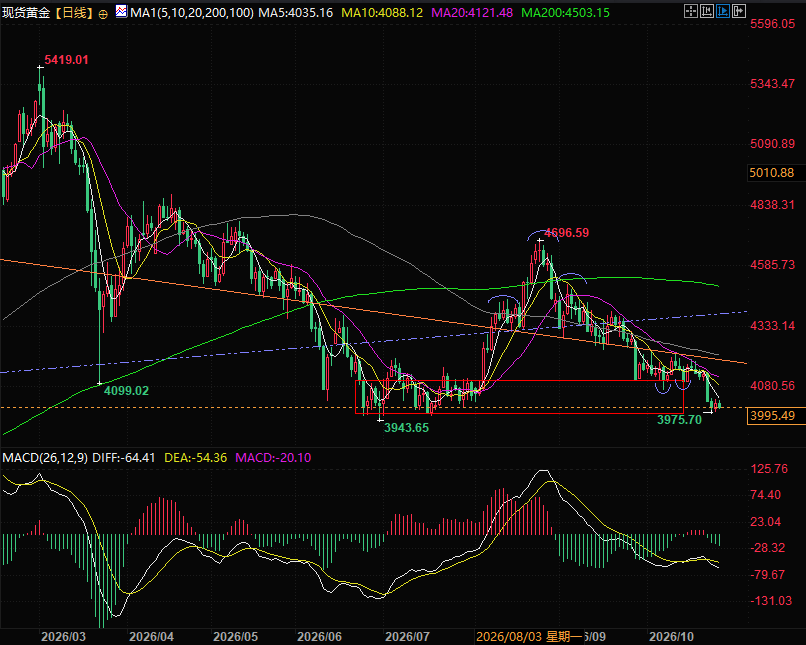 (Spot gold daily chart, source: EasyTrade) At 17:40 Beijing time, spot gold is currently trading at $3996 per ounce.
The core negative factor is that high oil prices push up capital and corporate costs, damage asset valuations, and cause a contraction in global liquidity, triggering a passive sell-off of gold.The energy crisis has driven up the dollar and real interest rates, significantly increasing the cost of holding gold.
Currently, international oil prices remain high and strong, coupled with energy shortages in Europe and political turmoil in France, leading to persistently high global energy inflation. On the one hand, oil trade is settled in US dollars, and strong oil prices support a continued rise in the US dollar index, directly suppressing the price of gold, which is denominated in US dollars. On the other hand, the stickiness of energy inflation is forcing major central banks around the world to extend the period of high interest rates, making it difficult for the Federal Reserve to cut interest rates in the short term. Gold is a non-interest-bearing asset, and with the continuous rise in US Treasury yields, the opportunity cost of holding gold has increased significantly, leading to a continuous flow of funds into interest-bearing assets such as US Treasuries, firmly suppressing gold prices. Although the yield on 10-year US Treasury bonds has slightly fallen below 5%, it is still at a historically high level. As long as the inflationary pressure from high oil prices does not ease, the high-interest-rate environment will be difficult to reverse quickly, and it will be difficult for gold prices to experience a trend rebound.A weaker-than-expected rebound in the equity market triggered a liquidity crisis, turning gold into a target for margin selling.
In this round of market activity, gold's safe-haven appeal has temporarily failed, and it has instead weakened in tandem with the stock market. The core reason is the continued correction in global equity markets, a rapid decline in market risk appetite, coupled with a sustained tightening of cross-market liquidity. With equity rebounds falling short of expectations and widespread asset declines, coupled with tight liquidity, gold, with its extremely high liquidity, has become the preferred asset for institutions to sell for cash and replenish futures margin, leading to a "the more it falls, the more it sells" panic selling, further amplifying short-term selling pressure. Simply put, the current market trend is not driven by geopolitical risk aversion, but by liquidity shortages. As long as global stock markets continue to weaken and markets continue deleveraging, gold will be sold as a liquid asset, with the safe-haven logic temporarily giving way to the logic of margin calls.Focus on the combination of liquidity clearing and policy shift, awaiting a window for gold price recovery.
The recovery in gold prices will not happen overnight; it will most likely only occur after a significant asset adjustment and a complete depletion of market liquidity. Once the equity market completes a deep correction and deleveraging is nearing its end, the pressure from margin selling will naturally subside, freeing gold from the predicament of passive selling. Simultaneously, as geopolitical conflicts in the Middle East ease and oil supply recovers, oil prices will fall from their highs, rapidly easing inflationary pressures from energy and removing constraints on monetary policy from central banks worldwide. At that point, the Federal Reserve will end its tightening cycle and gradually begin cutting interest rates, leading to a continued decline in the real yield of US Treasury bonds and a gradual weakening of the dollar's strength. Once the interest rate cycle reaches its turning point, the dollar's suppressive effect on gold prices will significantly weaken, and gold pricing will return to the main theme of monetary easing.Will gold prices be able to break new historical highs in the future?
From a medium- to long-term perspective, the fundamental logic supporting the rise in gold prices is solid, and some institutions believe that gold prices have the potential to hit a new historical high in 2027. The reasons are twofold: First, the current gold price surge began with the continued global trend of "de-dollarization," with many central banks continuously increasing their gold reserves, making gold a core choice for diversifying their foreign exchange reserves. Even if gold prices experience a short-term correction, central banks maintain a buy-on-dips strategy, and this sustained official buying can offset short-term outflows of speculative funds, providing long-term support for gold prices and significantly reducing the downside potential. Second, the outcome of the 2026 US midterm elections will be a crucial variable: if the ruling party loses control of Congress, increased uncertainty in US domestic policies and downside risks to the global economy will rapidly fuel safe-haven buying of gold. Even if the Republicans win, escalating geopolitical tensions in the Middle East and disruptions to oil supply could further push up inflation, similarly attracting hedging funds into the gold market. Furthermore, long-term geopolitical conflicts such as the Russia-Ukraine conflict and the Middle East shipping lane disputes will ensure that gold's safe-haven value remains intact in the long term. Finally, once the energy crisis subsides and global inflation steadily declines, major economies will enter a full-scale interest rate cut cycle, and market liquidity will ease again. JPMorgan Chase predicts that international gold prices could reach $6,300 per ounce by the end of 2027. Of course, for this to happen, the shipping issue in the Strait of Hormuz needs to be resolved stably to completely stabilize global energy supply and inflation expectations.Summary and Technical Analysis:
In the short term, gold prices remain in a bottoming-out phase under the dual pressure of interest rates and liquidity. The risk of a volatile pullback has not yet been fully cleared, making it unsuitable for heavy buying at higher prices. Medium- to long-term investors can patiently wait for two signals: a peak and decline in US Treasury real interest rates, and a clearing of liquidity in equity assets. This, coupled with expectations of a shift in monetary policy, will likely reverse the downward trend in gold prices. After all, global businesses are suffering from the energy shock, and economic stimulus from various countries will be essential for their recovery. Technically, spot gold is currently exhibiting a three-methods bearish candlestick pattern after a previous downtrend, suggesting further lows. The moving averages are also in a bearish alignment, which is unfavorable for bullish momentum. It is necessary to wait for the moving averages to flatten out and for the price to consolidate, thus alleviating the bearish pressure. (Spot gold daily chart, source: EasyTrade) At 17:40 Beijing time, spot gold is currently trading at $3996 per ounce.
- Risk Warning and Disclaimer
- The market involves risk, and trading may not be suitable for all investors. This article is for reference only and does not constitute personal investment advice, nor does it take into account certain users’ specific investment objectives, financial situation, or other needs. Any investment decisions made based on this information are at your own risk.