How will the market interpret the Fed's policy?
2026-10-27 18:10:24
At its last policy meeting, the Federal Reserve chose to hold rates steady, triggering a period of significant market volatility. The US yield curve steepened, and various voices emerged, discussing the Fed's loss of credibility in the fight against inflation. This market reaction triggered a policy response, directly prompting the US Treasury to release an unexpected announcement on August 19th. It also led Kevin Warsh to deliver hawkish remarks at the Jackson Hole Economic Symposium, foreshadowing the rate hike on September 16th.  This summer, the market fiercely criticized Warsh's views; in contrast, the market's reaction now is unusually mild, which surprises me. It's worth noting that on the eve of the July 29th policy meeting, despite the core Consumer Price Index (CPI) data being flat two weeks prior, the market still priced in a 10 basis point rate hike. Conversely, now, although the CPI data exceeded expectations two weeks ago, and the midterm elections are just around the corner, as shown by the orange curve in the chart below, the market's expectation for a rate hike at this policy meeting is only 3 basis points. If the market is truly worried that the Fed will be swayed by political factors, then this meeting should have been a crucial test of Warsh's stance.
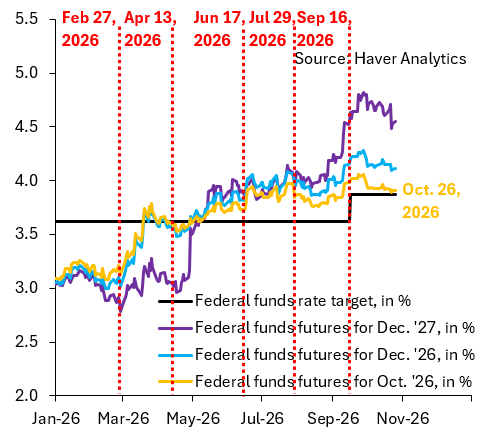 The core question is: how fragile is this temporary "peaceful coexistence" between the market and the Federal Reserve? Will Wednesday's interest rate meeting introduce any variables that could disrupt the current situation? The following analysis will address this question.
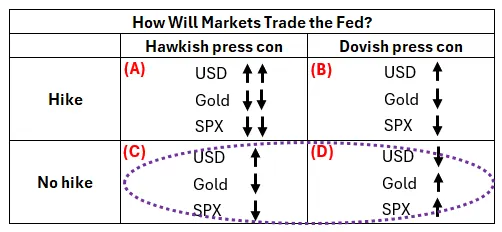 The table above is a 2x2 analysis matrix I used to predict the direction of this Federal Reserve meeting. The Fed will release its policy statement and interest rate decision at 2 PM Eastern Time (2 AM Beijing Time), followed by a press conference at 2:30 PM. These are two independent events, and the tone of the press conference will ultimately have a much greater impact on the market than the interest rate decision itself. So, how should we predict Wednesday's press conference? First, based on current market pricing expectations, the Fed is unlikely to raise interest rates, which naturally limits the hawkishness it can project at the press conference. Imagine if Warsh released a hawkish signal at the press conference; he would inevitably be pressed by reporters: why not just implement a rate hike this week? Warsh would certainly deliberately avoid such questions. Second, at the September press conference, Warsh clearly explained the three main reasons why the Fed turned hawkish since July: ① economic growth was stronger than expected; ② inflation was falling slower than expected; ③ oil prices continued to rise (the Saudi East-West oil pipeline had just been attacked before the September policy meeting). The market is increasingly concerned that artificial intelligence constitutes an asset bubble, and the economic growth outlook has weakened compared to before; however, inflation remains stubborn, and oil prices are higher than before the September 16th rate hike. According to a two-by-two analysis matrix, the current situation falls in the lower quadrant, between quadrant C (lower left) and quadrant D (lower right), meaning that this press conference is likely to maintain a neutral stance on the market. In my judgment, with the midterm elections approaching, the Federal Reserve hopes to avoid public focus as much as possible at this meeting. The midterm elections themselves are already very tense, and it is not appropriate to release policy surprises at this stage; even the statements in the press conference will not create any surprises.
This summer, the market fiercely criticized Warsh's views; in contrast, the market's reaction now is unusually mild, which surprises me. It's worth noting that on the eve of the July 29th policy meeting, despite the core Consumer Price Index (CPI) data being flat two weeks prior, the market still priced in a 10 basis point rate hike. Conversely, now, although the CPI data exceeded expectations two weeks ago, and the midterm elections are just around the corner, as shown by the orange curve in the chart below, the market's expectation for a rate hike at this policy meeting is only 3 basis points. If the market is truly worried that the Fed will be swayed by political factors, then this meeting should have been a crucial test of Warsh's stance. The core question is: how fragile is this temporary "peaceful coexistence" between the market and the Federal Reserve? Will Wednesday's interest rate meeting introduce any variables that could disrupt the current situation? The following analysis will address this question. The table above is a 2x2 analysis matrix I used to predict the direction of this Federal Reserve meeting. The Fed will release its policy statement and interest rate decision at 2 PM Eastern Time (2 AM Beijing Time), followed by a press conference at 2:30 PM. These are two independent events, and the tone of the press conference will ultimately have a much greater impact on the market than the interest rate decision itself. So, how should we predict Wednesday's press conference? First, based on current market pricing expectations, the Fed is unlikely to raise interest rates, which naturally limits the hawkishness it can project at the press conference. Imagine if Warsh released a hawkish signal at the press conference; he would inevitably be pressed by reporters: why not just implement a rate hike this week? Warsh would certainly deliberately avoid such questions. Second, at the September press conference, Warsh clearly explained the three main reasons why the Fed turned hawkish since July: ① economic growth was stronger than expected; ② inflation was falling slower than expected; ③ oil prices continued to rise (the Saudi East-West oil pipeline had just been attacked before the September policy meeting). The market is increasingly concerned that artificial intelligence constitutes an asset bubble, and the economic growth outlook has weakened compared to before; however, inflation remains stubborn, and oil prices are higher than before the September 16th rate hike. According to a two-by-two analysis matrix, the current situation falls in the lower quadrant, between quadrant C (lower left) and quadrant D (lower right), meaning that this press conference is likely to maintain a neutral stance on the market. In my judgment, with the midterm elections approaching, the Federal Reserve hopes to avoid public focus as much as possible at this meeting. The midterm elections themselves are already very tense, and it is not appropriate to release policy surprises at this stage; even the statements in the press conference will not create any surprises.
- Risk Warning and Disclaimer
- The market involves risk, and trading may not be suitable for all investors. This article is for reference only and does not constitute personal investment advice, nor does it take into account certain users’ specific investment objectives, financial situation, or other needs. Any investment decisions made based on this information are at your own risk.