80% of pricing decisions were met with cautious responses; where does the pressure on the yen come from?
2026-10-27 19:14:22
On Tuesday, October 27th, the USD/JPY exchange rate was trading around 157.7, with intraday fluctuations between 157.4 and 157.9, a slight increase from the previous trading day's close. Market focus is on the upcoming policy communication from Bank of Japan Governor Kazuo Ueda and Finance Minister Katayama's continued warnings of "bold action." Mitsubishi UFJ Financial Group analysts point out that the yen's downward momentum has restarted, and despite increased verbal intervention, actual intervention is still considered a distant prospect. 
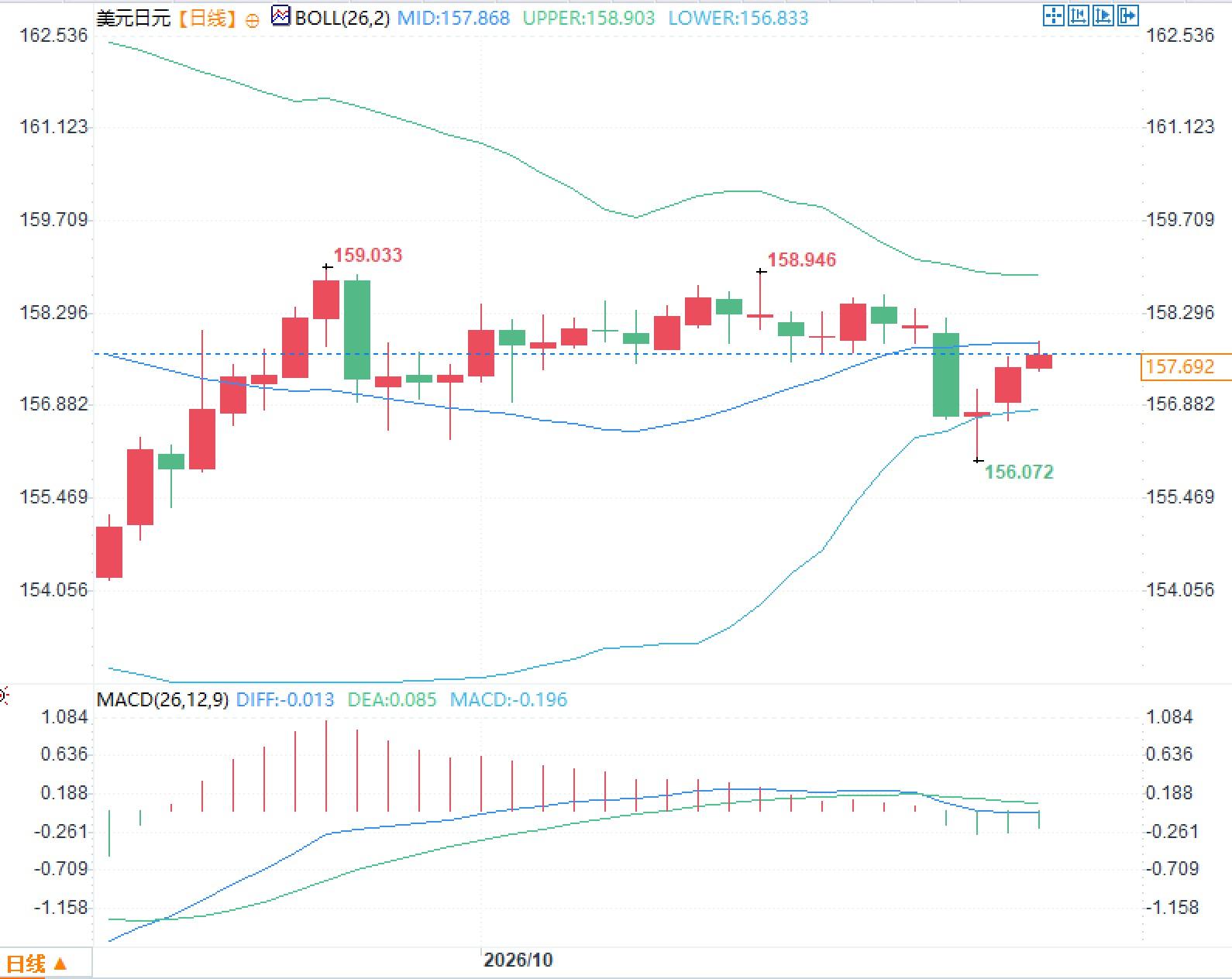
Current market structure and exchange rate dynamics
The USD/JPY pair is currently fluctuating around 157.7. The Bollinger Band middle line is around 157.868, the upper line is at 158.903, and the lower line is at 156.833; the current price is trading below the middle line. The MACD indicator shows a DIFF of -0.013, a DEA of 0.085, and a MACD histogram of -0.196, indicating weak short-term momentum. This configuration reflects price consolidation near the medium-term moving average, with relatively low volatility. Market expectations for the Bank of Japan's meeting at the end of October remain unchanged; the policy rate is currently at 1.25%, and most observers expect it to remain unchanged, with the focus shifting to subsequent communication.Policy communication style and interest rate pricing
Kazuo Ueda recently stated in Bangkok that core inflation is roughly close to the 2% target, and "further exceeding this level is intolerable." The central bank is in tightening mode, financial conditions remain loose, and policy rates will continue to be adjusted based on economic and price developments. He also emphasized the need to anchor inflation around 2%, mentioning that strong global AI demand is supporting capital expenditure and exports. The market has priced in an 80% chance of a December rate hike, but Ueda's consistently cautious approach has led investors to expect he will not provide a strong signal of December action this week. This communication style may cool market certainty regarding the pace of rate hikes, thus putting continued pressure on the yen. The Bank of Japan will release its new quarterly outlook on Friday, with the inflation path assessment being a key point of observation.The Reality of Intervention Threats
Finance Minister Katayama has repeatedly emphasized that if exchange rate fluctuations deviate from fundamentals, necessary measures, including bold action, will be taken, citing a joint statement with the US to reiterate the existence of room for action. However, analysts believe that the current exchange rate still has significant room to fall before reaching the 160 level, making verbal warnings less likely to translate into actual intervention. Historical experience shows that such threats are often more deterrent when the exchange rate is closer to sensitive areas. During the recent correction in AI-related markets, the yen briefly exhibited safe-haven characteristics; this support may weaken once related sentiment stabilizes. Intervention decisions typically require a comprehensive assessment of volatility and market function, rather than simply anchoring to a single level.Interaction between external factors and fundamentals
Global AI demand was cited by Ueda as one of the factors driving up prices, while related conflicts in the Middle East are having an imported impact on energy prices. A tight domestic job market and a moderate recovery in Japan are keeping underlying inflation close to target. If AI-related risk appetite stabilizes, it could put additional pressure on the exchange rate; conversely, a significant correction could re-emerge the yen's safe-haven appeal. Policymakers need to balance domestic inflation targeting with external variables to avoid overly rapid adjustments that could disrupt the market. Current pricing already fully reflects expectations of interest rate hikes; the actual path still depends on data verification and communication details.Frequently Asked Questions
Question 1: Why does market analysis suggest that intervention is less likely before reaching 160? Answer: The current price is around 157.7, still some room to move towards that level. Furthermore, verbal warnings have been issued multiple times without translating into action. The market believes that intervention needs to be closer to trigger actual measures. Question 2: How does Ueda's cautious communication affect the yen? Answer: His style may cool market expectations for a December rate hike. Even with higher pricing, the lack of strong signals may maintain pressure on the yen. Question 3: What is the relationship between AI sentiment changes and yen performance? Answer: The yen has shown safe-haven characteristics during recent AI adjustments. If sentiment stabilizes, this support may weaken. A comprehensive observation is needed, considering the inflation path.- Risk Warning and Disclaimer
- The market involves risk, and trading may not be suitable for all investors. This article is for reference only and does not constitute personal investment advice, nor does it take into account certain users’ specific investment objectives, financial situation, or other needs. Any investment decisions made based on this information are at your own risk.