Is the Federal Reserve holding rates steady to avoid any appearance of impropriety during the election, or are there other considerations?
2026-10-27 21:18:22
Despite the latest inflation data showing a relatively strong signal, the market is generally betting that the Federal Reserve will pause interest rate hikes this week, constrained by multiple factors including previous expectations, the election window, and financial market volatility. This pause merely delays the pace of tightening, not the end of the tightening cycle. The fluctuation in interest rate expectations will directly influence the direction of gold prices. 
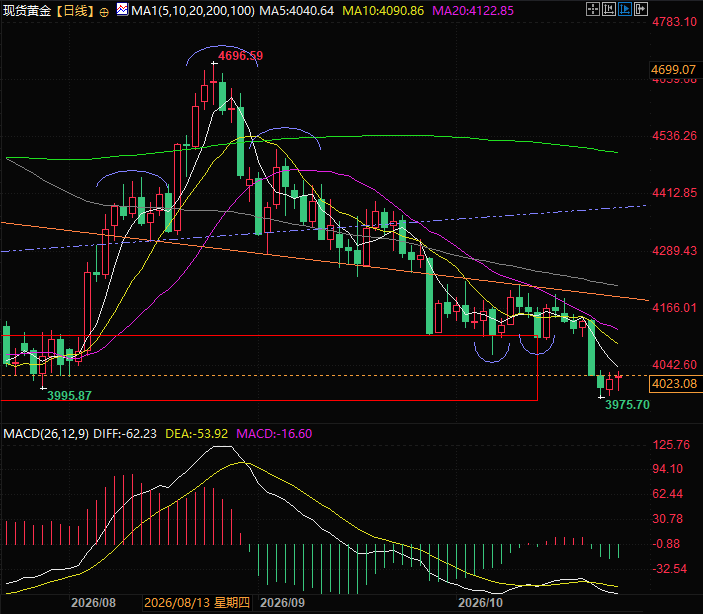 (Spot gold daily chart, source: EasyTrade) At 21:16 Beijing time, spot gold is currently trading at $4024 per ounce.
A dilemma: Inflation is rising, but the window for interest rate hikes has been locked by expectations.
This week's Federal Reserve meeting saw the market consensus expecting the benchmark interest rate to remain unchanged at 3.75%-4.00%. This outcome is not merely a product of economic data speculation, but also a result of the Fed's prior communication, expectation management, and external time constraints. Following last month's rate hike, several high-ranking officials signaled that further tightening was unnecessary, leading the market to lower its pricing for an October rate hike. However, September's CPI and PPI data were stronger than expected, and the Fed's preferred core inflation indicator has stagnated since early 2025, failing to approach the 2% target. Large-scale investment in the AI industry supports the resilience of the US economy, but rising tariffs and energy costs continue to push up production costs for businesses, stalling the decline in inflation. Surprisingly, Fed Chairman Warsh's remarks after the inflation data release did not reverse market expectations of a "pause in rate hikes." On October 16, the day before the policy silence, he did not mention the strong inflation report, only stating that the economy was broadly in line with the baseline assessment from the September meeting, causing the market probability of a rate hike to fall to approximately 15%. With only a few days left until the midterm elections on November 3, historical data shows that the probability of US stocks rising during the midterm elections is around 80%. At the same time, the Federal Reserve has historically tended to avoid raising interest rates in the last few days before the election to avoid getting involved in political disputes. Raising interest rates could indicate a discord between the Federal Reserve and the White House.Bulls and bears clash: Should we wait six weeks? Two policy approaches collide.
There is a clear divergence of opinion within academia and investment banks. Some economists hold a hawkish view: the market has already priced in a December rate hike, and waiting six weeks offers no real benefit; inflation risks persist, and delaying tightening could cause the Fed to fall behind the curve, forcing it to raise rates more quickly in the future. Conversely, those supporting a wait-and-see approach believe that waiting is a controllable tactical choice. Most officials' dot plot last month indicated only one more rate hike planned for the year. If a significant increase in the interest rate ceiling is not required, lengthening the interval between rate hikes has limited costs and allows time to track data changes. Former Dallas Fed President Kaplan commented that a six-week delay is a tactical risk and should not be confused with a directional strategic error. Two consecutive rate hikes could easily mislead the market, leading traders to believe the Fed is starting a faster tightening cycle. Current inflation is not as out of control as in 2022, but rather hovering around 3%. The recent sharp fluctuations in US Treasury bonds and tech stocks have also deepened the Fed's cautious stance. Following last month's interest rate hike, the 10-year US Treasury yield briefly broke through 5.3%, hitting a 24-year high. Last week, tech stocks were sold off, and funds flowed into the bond market for safety, causing the 10-year yield to plummet 19 basis points to 4.95% in a single day—the largest drop since the Silicon Valley Bank debacle. Policymakers are unwilling to further amplify financial market volatility due to a surprise interest rate hike.Internal divisions: Hawks may vote against the proposal, and a centrist approach becomes the current mainstream.
There is a division within the Federal Reserve regarding the ultimate peak of interest rates. New York Fed President Williams and San Francisco Fed President Daly belong to the more cautious camp, defining last month's rate hike as a risk-hedging measure aimed at preventing inflation from solidifying, and not indicating that current rates are significantly low. Daly's view fluctuates with inflation data, shifting from "it's possible there won't be any more rate hikes" to "the probability of further rate hikes is higher." The hardline hawks are advocating for higher rates. Dallas Fed President Logan proposed at least another 50 basis points; Cleveland Fed President Hammark advocated for small, rapid adjustments to avoid being forced to drastically correct policy later. Logan, Hammark, and Minneapolis Fed President Kashkari voted against the July rate-keeping decision, and if the Fed remains on hold this week, the probability of hawkish dissent is high. Waller represents a centrist position: continuous rate hikes are unnecessary, but the remaining rate hikes need to be implemented within a reasonable timeframe. If rates remain unchanged as expected on Wednesday, market focus will shift entirely to the wording of Warsh's press conference. Current trading has already bet on a renewed rate hike in December. Following the release of September inflation data, institutions such as Barclays have further raised their forecasts, factoring in a scenario of another rate hike early next year.The underlying problem: Supply-side disruptions mean that interest rate hikes are unlikely to directly cure this round of inflation.
The Federal Reserve now faces an even more intractable structural contradiction. The drivers of this round of price increases differ from the "overheated labor market, widespread wage increases" model-assumed pattern of a broad-based economic overheating. The AI capital expenditure boom, coupled with geopolitical supply shocks (recent tensions in Iran), are both supply-side constraints, and interest rate hikes are unlikely to directly resolve these issues. If AI investment remains high, continuing to consume resources and transmit inflation, the pressure on the Federal Reserve to further tighten monetary policy will continue to rise.Gold price correlation: Pause does not equal reversal; rebound potential is suppressed by long-term interest rate hike expectations.
As a non-interest-bearing asset, gold's pricing is primarily anchored to real interest rates and US Treasury yields. The expectation of a short-term "hold-back" will lower the opportunity cost of holding gold, providing a temporary respite for prices. However, it's important to note that this pause does not signify a shift towards monetary easing; it merely postpones the timing of rate hikes. Expectations of rate hikes in December and early next year remain high, continuing to suppress the upper limit of gold price rebounds. The key variable for the future market hinges on Warsh's statements: if the press conference is hawkish, maintaining the option of further rate hikes, US Treasury yields will face renewed upward pressure, putting downward pressure on gold prices; if he emphasizes patience and adopts a cautious tone regarding long-term rate hikes, expectations of declining real interest rates will rise, giving gold a chance for a stronger rebound. Meanwhile, safe-haven buying driven by the Iranian geopolitical conflict will interact with interest rate expectations, likely keeping gold prices in a highly volatile, volatile range in the short term. A clear trend will depend on the Fed releasing a clear signal regarding the end of interest rates. (Spot gold daily chart, source: EasyTrade) At 21:16 Beijing time, spot gold is currently trading at $4024 per ounce.
- Risk Warning and Disclaimer
- The market involves risk, and trading may not be suitable for all investors. This article is for reference only and does not constitute personal investment advice, nor does it take into account certain users’ specific investment objectives, financial situation, or other needs. Any investment decisions made based on this information are at your own risk.