Russia and Iran have signaled a willingness to ease tensions, but Middle Eastern resistance forces have launched simultaneous attacks, causing oil prices to surge and then fall back, reaching a delicate turning point.
2026-10-27 21:48:23
The previous article on crude oil pointed out the possibility of news intervention causing a rapid correction in oil prices, which was subsequently followed by a rapid reversal in the geopolitical narrative. During the European and American trading sessions, multiple conflict fronts around the world simultaneously released signs of easing tensions, briefly weakening oil prices. However, subsequent reports of escalating conflicts from major Middle Eastern powers created a sharp tug-of-war between bullish and bearish sentiment, bringing the situation to a turning point that requires close monitoring. Despite the initial drop, oil prices failed to rebound.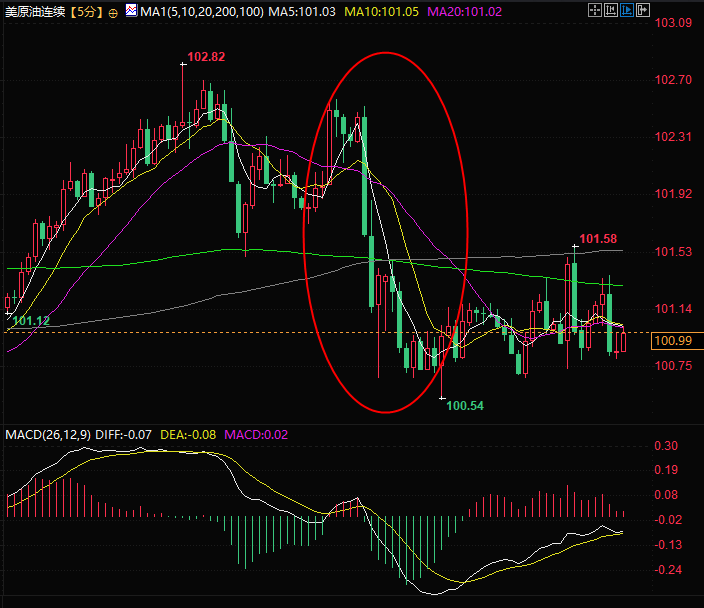 (WTI crude oil futures 5-minute chart, source: FX678)
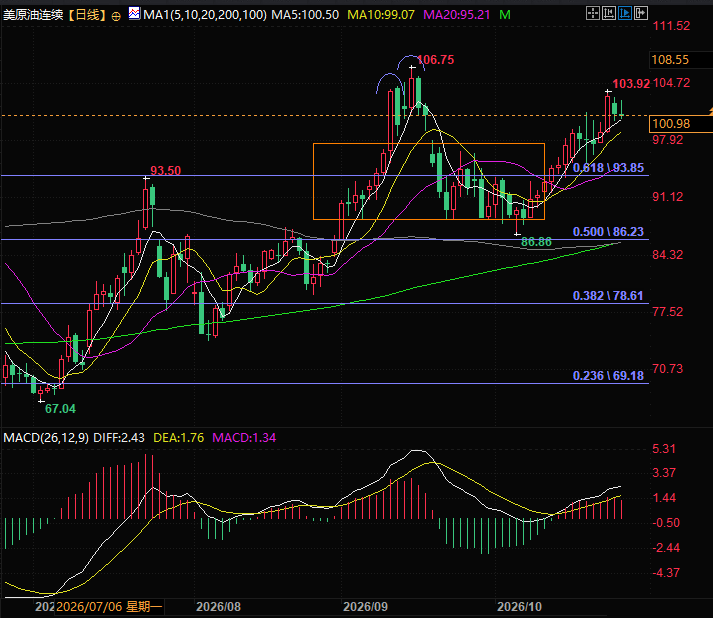 (WTI crude oil futures daily chart, source: EasyTrade) At 21:44 Beijing time, WTI crude oil futures are currently trading at $101 per barrel.
A summary of the positive impact of easing geopolitical tensions
First, Qatar, as the core party in this round of Middle East mediation, took the lead in stating that Iran needed to show goodwill, cease its threats against Gulf Arab states, and open the Strait of Hormuz for the mediation work to have a foundation to take place. At the same time, Qatar clarified that the goal of this round of mediation was to de-escalate tensions and open a channel for a peaceful resolution of the crisis between the US and Iran. Following Qatar's statement, Iranian officials released a corresponding stance. Iran's Supreme Leader met with Rezaei, Secretary of the Supreme National Security Council, to discuss ending the current conflict and moving beyond the stalemate that is "neither war nor peace," on the condition that Iran's proposed conditions be implemented and that the rights and interests of Iran and the resistance front be guaranteed. Iran also proposed creating a regional security order led by regional states, balancing its own security with regional security through the orderly management of the Strait of Hormuz. Qatar subsequently reiterated that keeping the Strait of Hormuz open is the foundation of prosperity and stability in the Gulf region, conveying its willingness to continue mediation efforts. The Middle East mediation framework thus established a foundation for two-way communication, and the market began to price in a decrease in shipping risks. While expectations of easing tensions in the Middle East rose, diplomatic mediation between Russia and Ukraine also progressed simultaneously. Zelenskyy spoke with the leaders of Finland and Norway, countries that had previously coordinated with the Russian leadership. This communication was a continuation of the Oslo consultations, with the Nordic countries acting as intermediaries to convey their demands to Russia, hoping for a reduction in its attacks on Ukraine's energy and infrastructure, and for all parties to jointly advance preparations for the trilateral talks between the US, Russia, and Ukraine in November. The simultaneous emergence of negotiation expectations on multiple geopolitical fronts further suppressed the risk premium for crude oil. Almost simultaneously, Putin's speech at the Gas Exporting Countries Forum reinforced expectations of easing tensions on the energy supply side. Putin pointed out that the forum's member countries collectively control 70% of global natural gas reserves and 40% of global natural gas exports, and that member countries should collaboratively assess market risks and optimize export routes. Russia is willing to cooperate with other countries in the natural gas sector. He also commented on Europe's choice to proactively cut off Russian energy supplies, believing that this move severely damaged European industries and people's livelihoods; Russia also expressed its desire to end the conflict and promote the lifting of sanctions. Following this series of relatively friendly statements, crude oil prices fell, and trading began to focus on the theme of "de-escalation of the conflict and reduction of supply risks." Amid a confluence of positive factors, oil prices fell rapidly. (WTI crude oil futures 5-minute chart, source: FX678)Just as the positive developments ended, the Middle East conflict began to dampen expectations.
Just as the market was pricing in a conciliatory narrative, a series of unexpected news events quickly disrupted the bullish trend. First, news broke of an explosion in Riyadh, Saudi Arabia, causing immediate market tension, although the official statement later confirmed the danger in the city had been lifted. Then, the Iranian Navy reported that an illegally operating oil tanker in the eastern Strait of Hormuz had struck a mine and caught fire. Adding insult to injury, the Houthi rebels subsequently announced attacks on Saudi military aircraft at Najran Airport and the Khamis Mushait airbase. Looking at the timeline, the market is currently in a highly contradictory state: diplomatically, Qatar's mediation, Russia-Ukraine talks, and Russia's signals of cooperation all point to positive developments across multiple global conflicts, clearly indicating a conciliatory narrative; however, Iran insists on setting its own conditions as the threshold for a ceasefire, the Houthi rebels continue to launch attacks in the Saudi direction, shipping in the Strait of Hormuz is again in danger, and the resistance front is escalating its actions during the negotiation window, essentially pouring cold water on expectations of de-escalation. Yet, oil prices have not rebounded as expected.The two opposing forces in the Middle East—those advocating peace and those advocating war—continue to fluctuate.
For crude oil traders, this is a typical delicate turning point. On one hand, diplomatic efforts are opening up room for de-escalation, which will continue to compress geopolitical premiums; on the other hand, the real risks of attacks on the Strait of Hormuz, Saudi facilities, and the Red Sea shipping lanes have not disappeared, and could quickly push up oil prices at any time. Going forward, it's crucial to closely monitor the two opposing voices in Iran. Substantial progress in the US-Iran mediation led by Qatar may only represent the pro-peace faction's view; the actual outcome depends on whether navigation conditions in the Strait of Hormuz improve. Second, whether the Houthi attacks escalate and whether they affect key Saudi oil and gas facilities; and third, whether the preparations for the November trilateral talks between the US, Russia, and Ukraine will change. Without a clear agreement, news of de-escalation and attacks will alternately impact the market, and crude oil is likely to maintain high volatility, making one-sided betting unsuitable. (WTI crude oil futures daily chart, source: EasyTrade) At 21:44 Beijing time, WTI crude oil futures are currently trading at $101 per barrel.
- Risk Warning and Disclaimer
- The market involves risk, and trading may not be suitable for all investors. This article is for reference only and does not constitute personal investment advice, nor does it take into account certain users’ specific investment objectives, financial situation, or other needs. Any investment decisions made based on this information are at your own risk.