What the European Central Bank doesn't say has a greater impact on euro interest rates than what it does say.
2026-10-28 20:02:26
On Wednesday (October 28), the market will see the European Central Bank's interest rate decision this Thursday. However, the market currently believes that the ECB will not take any action at this meeting, and the market has almost fully priced in another rate hike by the ECB on December 17. However, the ECB has reasons to cool down expectations, but may not want to say it explicitly.
Uncertainties surround the French budget, energy, the Iran war, and the US midterm elections; more importantly, a weaker euro and stronger stock markets are offsetting the tightening financial conditions resulting from rising sovereign bond yields. The ECB may welcome the market implementing some of the tightening for it. Traders are not looking for a rate hike, but rather for the FCI breakdown and the euro exchange rate response.
The European Central Bank faces an awkward situation: it has reasons to be dovish, but doesn't want to say it explicitly.
This week, all three major central banks are expected to keep interest rates unchanged, but the European Central Bank's communication is the most delicate. It has already raised rates twice this year due to the energy shock triggered by the Iran war, and now it is facing severe turmoil in the French debt market. The market has almost fully priced in another rate hike on December 17th, but according to this source, the ECB could actually provide sufficient reasons for the market to lower its bets.
The problem is that it may be unwilling to do so. Ahead of the December meeting, uncertainty surrounding the French budget could have a dual impact, compounded by uncertainties surrounding energy prices, the Iran war, and the US midterm elections. The ECB has so far skillfully avoided directly addressing the French debt crisis, publicly insisting that it should be handled by the Paris authorities. Lagarde stated that further tightening should be "restrained," not because of France, but because the overall surge in inflation has not yet produced a "second-round effect." This leaves the market with a vague but hawkish implicit space.
The financial conditions index indicates a tightening, but its breakdown is not so simple.
The European Central Bank's own Macro-Finance index showed a sharp tightening in September, reaching its tightest level this year, before stabilizing by the end of the month. Models from institutions like Goldman Sachs subsequently indicated that despite the escalating French crisis, financial conditions actually eased further at the beginning of the month. The tightening effect from rising sovereign debt costs was offset by a weaker euro and stronger stock markets.
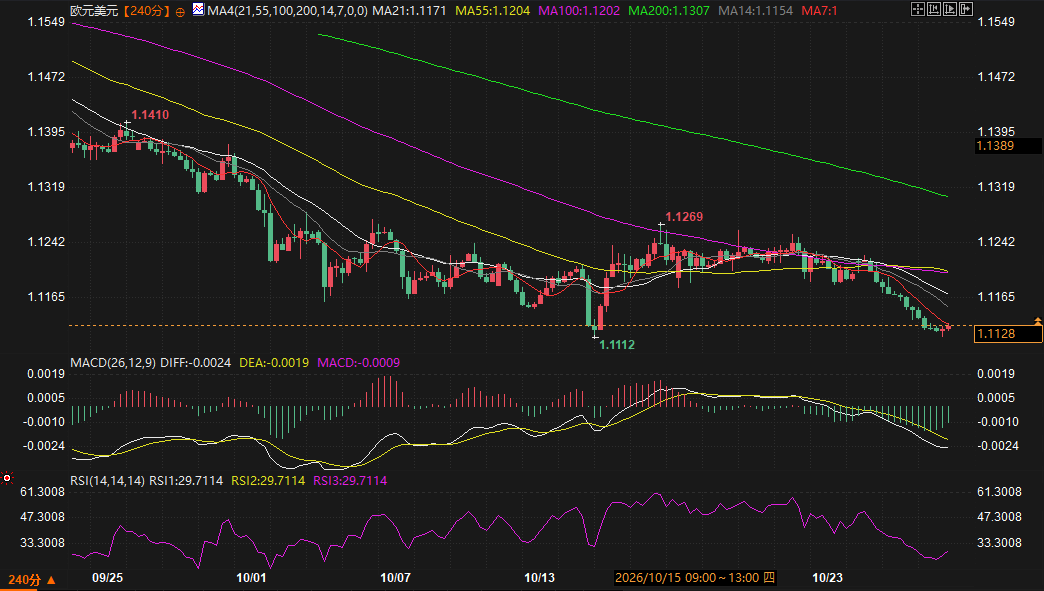
This is the key expectation gap: the market sees the widening French interest rate differential and assumes financial conditions are tightening; however, the ECB is looking at a basket of variables. In the chart, EUR/USD fell from 1.1410 to 1.1128; the weakening euro itself is an easing of financial conditions. The material states that since the ECB's last rate hike, EUR/USD has fallen by about 4.5%, partly because the market believes that the turmoil in France has lowered the "final rate" of the ECB's rate hike cycle. In other words, the more bearish the euro is on the market, the less the ECB needs to rush to suppress rate hike expectations.
Bank lending survey: Loans are tightening on the real economy, but France is the hardest hit.
The European Central Bank's September bank lending survey showed a sharp decline in mortgage demand in the eurozone in the three months to September, with increasingly stringent terms and standards for loans to businesses and consumers. France saw the largest drop in mortgage demand, with consumer confidence falling to a 13-year low.
This theoretically provides the European Central Bank with a basis to suggest that it may not raise interest rates again this year. However, the ECB may be reluctant to be too explicit, as the uncertainty surrounding the French budget could have a two-way impact: if the budget is compromised, interest rate spreads will narrow; if the deadlock worsens, the market may force the ECB to intervene. A premature commitment to a dovish stance could actually trigger unnecessary volatility.
The cyclical logic: Market pressure on the euro actually helps the European Central Bank to "tighten" monetary policy.
There is currently a self-balancing cycle: further market depreciation of the euro will ease tighter financial conditions, which could have prompted the ECB to cool its bets on interest rate hikes. Therefore, neither acquiescing to market expectations of a rate hike nor hinting that a rate hike this year is wise for the ECB.
For traders, this means an asymmetric risk in the ECB's communication. Hawks implicitly acknowledge a potential rise in euro interest rates, but the euro may not necessarily strengthen; dovish voices suggest a possible rate cut, but this could lead to an initial euro decline followed by a easing of financial conditions. On the charts, the EUR/USD RSI is nearing oversold territory, and the US Dollar Index MACD has formed a bearish crossover at a high level. A short-term rebound is not surprising, but the overall trend remains bearish. The real focus should be on the weekly FCI changes, the euro exchange rate response, and the progress of the French budget before the December 17th meeting.
If the market is urging the ECB to raise interest rates, the ECB would welcome it; if a falling euro is urging the ECB to ease financial conditions, the ECB has even less reason to be dovish. This is the core of the "can do it, but won't do it" principle.
- Risk Warning and Disclaimer
- The market involves risk, and trading may not be suitable for all investors. This article is for reference only and does not constitute personal investment advice, nor does it take into account certain users’ specific investment objectives, financial situation, or other needs. Any investment decisions made based on this information are at your own risk.