Will the dollar fall after oil prices recede?
2026-10-28 20:28:25
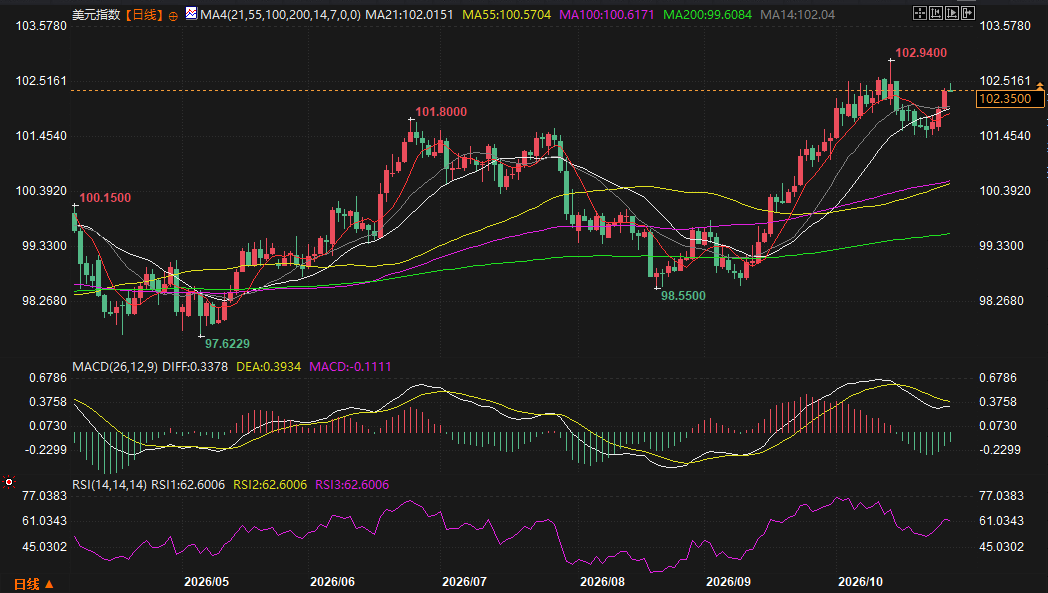
The US dollar index rose from an August low of 97.62 to 102.94, and is currently consolidating around 102.35. On the surface, this appears to be a typical strong market trend, but breaking down the driving factors reveals two completely different forces at play.
The first factor is oil prices. The trade-weighted dollar index closely correlates with the key events of the Iran-Iraq War: the start of the war on February 27, the blockade on April 13, the MoU on June 17, the renewed blockade on July 14, and the attack on the East-West pipeline on September 10. The recent surge began precisely with the pipeline attack, with Brent crude oil jumping from $100 to $115. The second factor is long-term yields. The 10-year US Treasury yield is 5.010%, and Treasury bond issuance, AI company borrowing, and declining demand for long-term US Treasuries are pushing up the term premium. Calling these two forces a "new dollar cycle" might overestimate its sustainability.
Oil prices are a mirror image: the tide will recede, but the timing is beyond your control.
One view holds that current Brent crude oil prices already factor in supply disruptions worse than those at the peak of the war in March and April, and that the risk premium is excessive. If the war de-escalates or ends, a decline in oil prices would drag down the dollar, and the current strength is merely temporary. The drop in oil prices and the surge in foreign investment in French bonds after the signing of the MoU in June can be seen as a prelude to a "de-escalation trade."
However, "the tide will recede" and "shorting now" are two different things. The timing of the receding oil price risk premium depends on the Hormuz shipping, pipeline attacks, and ceasefire signals, not on valuation. A high-level MACD death cross in the US dollar index only indicates weakening momentum, not that the mirror image has reversed. A more prudent framework is to treat the dollar bulls and oil bulls as expressions of the same risk factor; a drop in oil prices is the confirmation signal of the dollar's mirror image receding.
The Treasury and AI are providing the foundation: it won't disappear with the ceasefire.
Unlike oil prices, the rise in long-term yields is structurally supported. KBRA points out that large-scale borrowing by AI companies and large-scale debt issuance by the US Treasury are keeping yields high, "doing the Fed's job." Deutsche Bank's analysis is more specific: buy-and-hold portfolios are shrinking, investor preferences are shifting towards shorter durations, and demand for long-term US Treasuries is retreating; meanwhile, the Treasury's future borrowing needs are higher, giving it ample reason to proactively shorten issuance durations.
This means that even if the war ends and oil prices fall, the pressure of long-term term premiums will not disappear automatically. The Federal Reserve hasn't even raised interest rates yet, but the Treasury and AI have already done so for it. The dollar therefore has two layers of support: it will fall when the oil price mirror image recedes; but as long as the structural story of long-term yields remains, it will be difficult for the dollar to return to a simple weak cycle.
Gold's Position: No Longer Simply the Opposite of the Dollar
In the traditional framework, a strong dollar and high real interest rates put pressure on gold. However, the current rise in yields is partly driven by fiscal supply and term premiums, rather than purely by rising real interest rates. These two factors have different implications for gold: if driven by real interest rates, gold is under pressure; if driven by fiscal credit and term premiums, gold may actually benefit from the "fiscal-led" narrative.
Therefore, gold's current position is rather delicate. The receding oil price risk premium and the weakening dollar are bullish for gold; however, if long-term yields continue to rise due to fiscal supply, they may suppress gold prices. The key is not the direction of the dollar itself, but the nature of the rising yields. Gold may no longer be the simple opposite of "rising when the dollar falls," but rather an asset that "rises with the dollar when it falls, and its performance depends on the nature of yields when the dollar rises." Geopolitical risk premiums and fiscal credit risk provide two partially overlapping support lines for gold.
The US dollar should perhaps not be traded as a single direction, but rather broken down into the "oil price risk premium factor" and the "fiscal/duration supply factor".
Gold can serve as a cross-validation of these two factors: if oil prices fall, the dollar falls, and gold prices rise, it indicates that the market is trading on de-escalation of the economic war; if oil prices remain stable, long-term yields continue to rise, and gold prices also rise, it indicates that the market is trading on fiscal and credit risk. The dollar may weaken in both scenarios, but the reasons and their sustainability differ. This round of dollar strength is half driven by oil and half by bonds.
- Risk Warning and Disclaimer
- The market involves risk, and trading may not be suitable for all investors. This article is for reference only and does not constitute personal investment advice, nor does it take into account certain users’ specific investment objectives, financial situation, or other needs. Any investment decisions made based on this information are at your own risk.