Following the sharp drop in the New Zealand dollar, the Reserve Bank of New Zealand governor stated that a December rate hike is highly probable, but the timing remains uncertain.
2026-10-29 10:10:24
The New Zealand dollar traded in a narrow range against the US dollar during Asian trading hours on Thursday (October 29), currently hovering around 0.5625. Overnight, the New Zealand dollar fell by about 1% against the US dollar, hitting a low of 0.5575, its lowest level since October 14. Reserve Bank of New Zealand Governor Anna Brehman said on Thursday that the possibility of a December rate hike is high, a clearer indication than the central bank's guidance after unexpectedly keeping the official cash rate at 2.75% the previous day. In an interview with New Zealand media, Brehman said that every member of the Monetary Policy Committee agreed that the cash rate could be raised further, although the timing remains uncertain and will depend on the economic outlook and inflation developments. When directly asked about the possibility of action in December, she said it was very likely. 
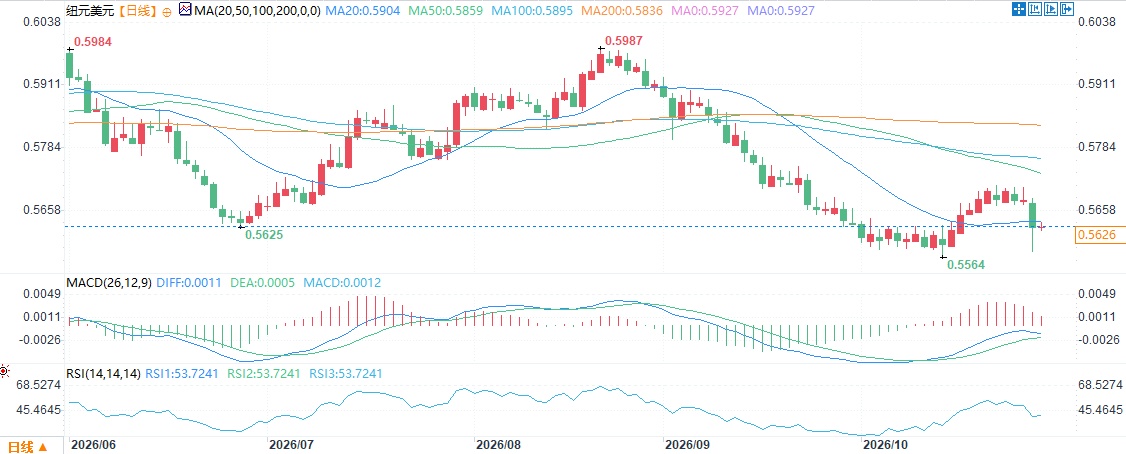 (NZD/USD daily chart, source: EasyForex) At 10:09 Beijing time, the NZD/USD exchange rate was 0.5625/26.
Differences from the policy guidance: From "further rate hikes are possible" to "high probability in December".
These remarks represent a significant step forward compared to the signals given by the Reserve Bank of New Zealand on Wednesday. At that time, the bank kept interest rates unchanged, only stating that "further rate hikes may be necessary," a decision that caught the market off guard. Prior to the statement, the market had almost priced in a rate hike, and the New Zealand dollar immediately plummeted after the central bank held rates steady. Currently, the market is pricing in a 77% probability of a rate hike in December. Brehman's statement clarified the vague "possible" to a "high probability," narrowing the market's divergence in expectations regarding the timing of the next action, reinforcing the hawkish tone, helping to stabilize exchange rate expectations and reduce ambiguity in policy communication.Inside story of the resolution: A close vote of 4 to 3, with Brehman in the majority.
Maintaining the interest rate was a close vote, with the committee split 4-3. Brehman, representing the majority, along with three other members, argued for more time to assess the effects of the last two rate hikes. The minority supported an immediate rate hike. In the press conference following the decision, Brehman stated that tightening might need to extend to a more restrictive area, noting concerns that a weaker New Zealand dollar could exacerbate imported inflation amid rising fuel costs. This split reflects disagreement within the committee on timing, but a consensus on the necessity of further tightening.Data supports this: The proportion of companies planning price increases has risen to its highest level since May.
New data has exacerbated concerns about imported inflation and price pressures. A business survey released on Thursday showed that the percentage of New Zealand businesses planning to raise prices rose to its highest level since May, with cost expectations remaining high. Brehman also attempted to reassure the public, emphasizing that despite the uncertain environment, the Reserve Bank of New Zealand will remain calm and focused on restoring inflation to its target. The increased willingness of businesses to raise prices, coupled with rising fuel prices and a depreciating currency, increases the risk of sticky inflation and also leaves room for further policy adjustments.Key to the market outlook: The December policy meeting and accompanying monetary policy statement; inflation, employment, and exchange rates are the determining factors.
The December decision will be released along with the monetary policy statement, which will include updated economic forecasts and a new projected path for the cash rate. Before that, inflation indicators, labor market data, and exchange rate movements will be key factors in determining whether a "high-probability rate hike" will materialize. If inflation continues to rise, employment remains resilient, or the New Zealand dollar weakens further, pushing up import costs, the probability of a rate hike will increase significantly; otherwise, the committee may continue to wait and see. The market will closely monitor the impact of these data on the committee's judgment.Summarize
Reserve Bank of New Zealand Governor Brehman said on Thursday that a December rate hike is highly likely, a clearer indication than the previous day's unexpected rate hold. She stated that the entire committee believes further rate hikes are possible, but the timing depends on the economic outlook and how inflation evolves. On Wednesday, the bank voted 4-3 to keep the official cash rate at 2.75%, catching the market off guard and causing the New Zealand dollar to plummet. Brehman, representing the majority, argued that the recent two rate hikes deserve time to assess their effects and expressed concern that a weaker New Zealand dollar could exacerbate imported inflation. The market is currently pricing in a 77% probability of a December rate hike. The latest business survey shows that the percentage of businesses planning price increases has risen to its highest level since May, indicating that cost expectations remain very high. Brehman's remarks countered dovish interpretations and aimed to stabilize the New Zealand dollar, but the uncertainty surrounding the timing leaves the risk of a second rate hold remaining, suggesting a potentially gradual recovery for the New Zealand dollar. The December decision will be accompanied by a monetary policy statement and updated forecasts, with inflation, employment, and the exchange rate being key determinants. (NZD/USD daily chart, source: EasyForex) At 10:09 Beijing time, the NZD/USD exchange rate was 0.5625/26.
- Risk Warning and Disclaimer
- The market involves risk, and trading may not be suitable for all investors. This article is for reference only and does not constitute personal investment advice, nor does it take into account certain users’ specific investment objectives, financial situation, or other needs. Any investment decisions made based on this information are at your own risk.