Gold Trading Alert: US Inflation Soars, Gold Prices Plunge Over 1%! But Two Underlying Factors Support the Price?
2026-10-30 07:42:23
On Thursday (October 29), the global gold market experienced significant selling pressure. Spot gold fell sharply by 1.2%, closing at $4,021.13 per ounce, after briefly dipping to $4,005.25 during the session; the December U.S. gold futures contract also settled down 0.5%, at $4,031.40. Gold prices are poised for their second consecutive monthly decline. On the surface, this appears to be a one-sided decline driven by inflation data, but the internal forces within the market are far more complex than they appear—persistent high U.S. inflation has strengthened expectations of a Federal Reserve rate hike, which is the core bearish logic dragging down gold prices; at the same time, the simultaneous decline in the dollar index and U.S. Treasury yields, along with the volatile lower close of international oil prices, has provided some buffer and support for gold. The battle between bulls and bears is becoming particularly clear at this crucial juncture. On Friday (October 30) in early Asian trading, spot gold traded weakly, currently hovering around $4,015 per ounce. 
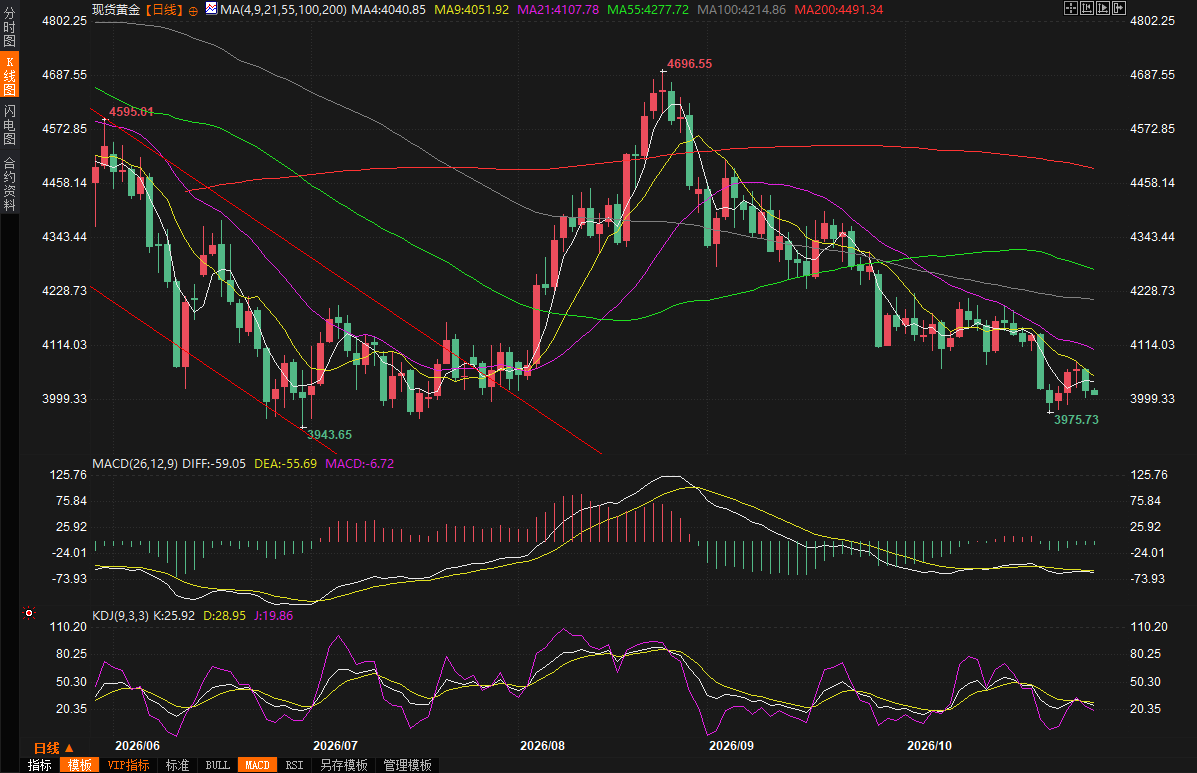 (Spot gold daily chart, source: FX678) At 07:39 Beijing time, spot gold is currently trading at $4013.75 per ounce.
Accelerating inflation and expectations of interest rate hikes: the most direct source of pressure on gold.
The Personal Consumption Expenditures (PCE) price index released on Thursday became a turning point for market sentiment. Data from the U.S. Commerce Department showed that the PCE rose 0.5% month-over-month in September, up from 0.3% in August; the year-over-year increase rose to 3.6% from 3.4%. As the Federal Reserve's most closely watched inflation indicator, this result clearly shows that price pressures intensified again at the end of the quarter, especially with rising gasoline and other commodity prices, directly pushing up the overall reading. The market reacted swiftly and directly. The Federal Reserve had just held interest rates steady the day before, maintaining them in the 3.75%-4.00% range and acknowledging that inflation "remains high," while postponing its next move until after the midterm elections. However, after the PCE data release, traders' bets on a December rate hike quickly intensified. According to the CME FedWatch tool, the market currently expects a 73% probability of a 25 basis point rate hike at the Fed's December meeting. While this probability has fallen from about 83% earlier in the day, it remains high enough to exert sustained downward pressure on gold, which does not generate interest. David Meger, head of metals trading at High Ridge Futures, pointed out that the persistently high inflation outlook above the Federal Reserve's target is currently the main factor dragging down gold prices, and the PCE report has done nothing to alleviate this concern. For gold, higher interest rates mean a higher opportunity cost of holding physical gold, and funds are more inclined to flow into assets that can generate returns. This logic was fully validated on Thursday, with gold prices falling rapidly after the data release and briefly testing support near the $4,000 mark.Strong economic growth: Further strengthening the case for interest rate hikes
If the PCE data was "adding fuel to the fire," then the third-quarter GDP data released at the same time further solidified the basis for possible action by the Federal Reserve. The US economy grew at an annualized rate of 3.4% in the third quarter, higher than the market expectation of 3.2% and the fastest growth in a year. Strong consumer spending and large-scale corporate investment in AI-related equipment were the two main engines of growth. Consumer spending, which accounts for more than two-thirds of US economic activity, grew at an annualized rate of 3.8% in the third quarter, the same as in the second quarter, mainly driven by service spending. Business equipment spending surged by 20.9%, the fastest since the third quarter of 2020, contributing 1.16 percentage points to GDP. The expansion of spending on information processing equipment (mainly computers and peripherals) and intellectual property products clearly reflects the real impact of the AI investment boom. Although a significant increase in imports dragged down GDP, private domestic final demand grew by 4.9%, indicating that endogenous momentum remained strong. With economic growth far exceeding the approximately 2% level that Federal Reserve officials believed would not stimulate inflation, coupled with a renewed acceleration in inflation data, the market naturally wonders: if the Fed wants to find more reasons why it should take action to restore price stability, these data have already provided the answer. The combination of strong growth and sticky inflation is the fundamental basis for maintaining expectations of interest rate hikes.Unexpected weakness in the US dollar and US Treasuries: Bulls gain breathing room
However, the market wasn't entirely bearish on gold. A notable phenomenon on Thursday was that the US dollar index and US Treasury yields actually declined after the release of inflation and GDP data. The dollar index fell 0.24% to close at 101.87, having briefly approached a near two-week high before quickly reversing course. The 10-year US Treasury yield fell 6.5 basis points to 4.98%, while the two-year yield fell even more sharply, by 8.7 basis points to 4.648%. This divergence between strong data and a weaker dollar and yields provided an important buffer for gold. Typically, strong data and expectations of interest rate hikes push up the dollar and US Treasury yields, thus doubly suppressing gold prices. But in this round of market activity, while digesting the data, investors also began to reassess the sustainability of economic growth and concerns about AI-related spending. Concerns about capital expenditures triggered by earnings reports from tech giants like Alphabet put pressure on the stock market, with some funds flowing into relatively safe government bonds, lowering yields. The decline in yields reduced the opportunity cost of holding gold, while the weakening dollar directly increased the attractiveness of gold priced in other currencies. The simultaneous weakening of the US dollar and US Treasury bonds was arguably one of the key supporting factors that prevented gold prices from falling further on Thursday, despite the decline. If these two factors continue to weaken, the probability of gold finding some respite around $4,000 will significantly increase.The dual impact of falling oil prices and geopolitical factors: repricing of risk premiums.
Energy prices remain a crucial variable in both inflation and gold price movements. On Thursday, international oil prices closed lower amid volatility, with Brent crude falling 0.38% to settle at $114.88 per barrel, and U.S. crude falling 0.76% to $102 per barrel. Both indices fell by more than $2 at one point during the session, erasing some of the previous day's gains. The immediate catalyst for the price decline was a resurgence of hopes on the diplomatic front. The Wall Street Journal reported that U.S. Vice President Vance sent a letter to Iran attempting to restart peace talks; the Iranian Foreign Minister also publicly stated that he was still consulting with mediators on a "seven-day plan" to reopen the Strait of Hormuz, emphasizing that he had not abandoned diplomatic channels. Meanwhile, news of a rebound in Russian refinery throughput also partially eased expectations of supply tightness. The drop in oil prices helps alleviate inflation concerns, indirectly benefiting gold—because energy costs are a significant source of inflation, and lower oil prices may reduce the urgency of interest rate hikes. However, the complexities of geopolitics are far from over. The delivery of air defense and interceptor missiles by US military transport planes to Israel, the briefing by the top Middle Eastern commander to Trump on military options against Iran, and the tensions surrounding Houthi attacks and the Strait of Hormuz all serve as reminders that market risk premiums could rise again at any time. If the situation in the Middle East escalates again and pushes up oil prices, inflation expectations and risk aversion could rise simultaneously, leaving gold facing a complex situation of "interest rate hike pressure and safe-haven buying." Currently, the decline in oil prices has provided temporary support for gold prices, but the sustainability of this support is highly dependent on the evolution of diplomatic and military developments.Midterm Elections and Subsequent Focus: New Variables in Market Sentiment
Investors are also closely watching the US midterm elections on November 3rd. The election results could have a profound impact on fiscal policy, government spending, and overall market sentiment. Meanwhile, the European Central Bank's decision to keep interest rates unchanged but warn of inflation risks from soaring energy costs foreshadows a divergence in global monetary policy. From a technical and sentiment perspective, gold prices have been under pressure for two consecutive months, and the $4,000 level will be psychologically significant. If this level can be held under the pressure of inflation and interest rate hike expectations, and if the price gradually stabilizes with the help of a weakening dollar, US Treasury bonds, and oil prices, the bulls still have a chance to regroup and launch a counterattack. Conversely, if the probability of an interest rate hike increases further and geopolitical risks ease, leading to a decline in safe-haven demand, gold prices may continue to test lower support levels. Overall, gold is currently in a typical phase of mixed bullish and bearish sentiment. High US inflation and strong economic growth support market bets on a December rate hike by the Federal Reserve, which is the core logic suppressing gold prices; however, the simultaneous decline in the dollar index and US Treasury yields, and the drop in international oil prices due to diplomatic hopes, provide a real buffer for gold prices. In the short term, gold prices will likely continue to fluctuate amid the tug-of-war between expectations of interest rate hikes and the actual interest rate environment. Investors need to closely monitor inflation data, Federal Reserve communications, the situation in the Middle East, and the movements of the US dollar and US Treasury bonds. A sudden shift in either direction could break the current fragile balance and trigger a new round of trend-driven market movements. (Spot gold daily chart, source: FX678) At 07:39 Beijing time, spot gold is currently trading at $4013.75 per ounce.
- Risk Warning and Disclaimer
- The market involves risk, and trading may not be suitable for all investors. This article is for reference only and does not constitute personal investment advice, nor does it take into account certain users’ specific investment objectives, financial situation, or other needs. Any investment decisions made based on this information are at your own risk.