The Bank of Japan is expected to hold rates steady; the USD/JPY exchange rate is focused on future interest rate path.
2026-10-30 08:34:29
On Friday (October 30) during the Asian session, the USD/JPY pair traded in a narrow range, currently hovering around 157.70, almost unchanged for the day, as the market awaits direction from the Bank of Japan (BOJ). The BOJ is scheduled to announce its monetary policy decision on Friday. Similar to the Federal Reserve, financial markets are confident that the BOJ will keep interest rates unchanged—after raising them by 25 basis points to 1.25% at its September meeting, the highest rate in Japan in 31 years. The BOJ has already implemented two 25-basis-point rate hikes this year. A report from Commerzbank noted that the market expects "overnight rates to remain unchanged, and none of the economists surveyed by Bloomberg expect a rate hike on Friday." This consensus has led investors to focus more on the monetary policy statement, the central bank's outlook report, and Governor Kazuo Ueda's press conference for clues about the policy outlook before the end of the year. 
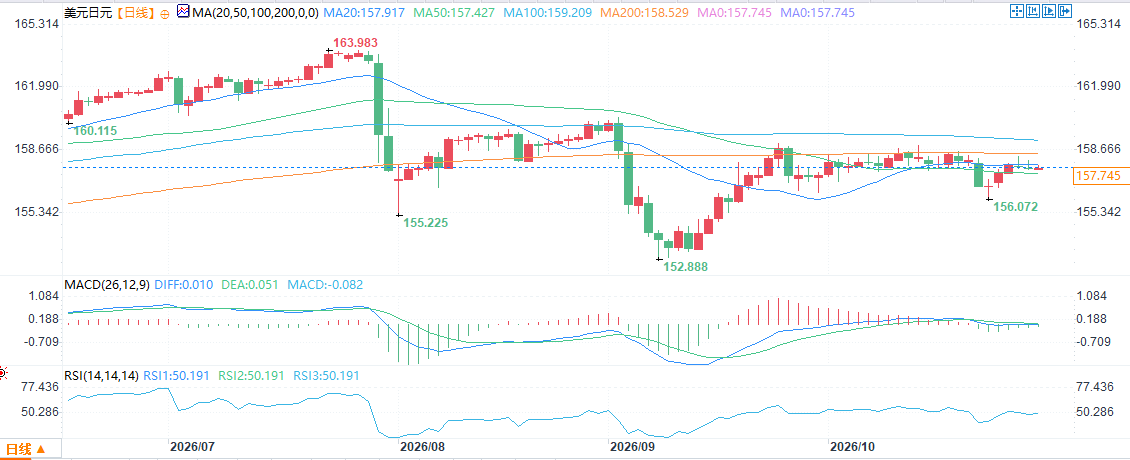 (USD/JPY daily chart, source: FX678) At 8:19 Beijing time, USD/JPY was trading at 157.73/74.
Tokyo's inflation remains resilient.
Tokyo's CPI growth remains well above the Bank of Japan's 2% target, highlighting persistent price pressures. Data released Friday showed that Tokyo's October CPI, excluding fresh food, rose 2.6% year-on-year, a slight slowdown from September's 2.7%; the overall inflation rate was 2.8%, and the price index excluding fresh food and energy rose 2.6%. Government subsidies in October to reduce summer electricity and city gas costs helped curb prices, but this effect is likely to fade in the coming months, so Friday's data is unlikely to prevent the Bank of Japan from raising interest rates in the coming months. Despite the subsidies, energy prices still contributed to the overall price increase, with electricity and natural gas prices rising by 1.7% and 4.9% respectively, both reversing the declines of the previous month. The Bank of Japan will announce its interest rate decision hours after the data release, and the market expects it to remain unchanged.Kazuo Ueda leans towards hawkish: AI demand and inflation are close to target.
Kazuo Ueda's remarks following the September policy meeting revealed his concern about the risks of energy-driven inflation. He also emphasized the importance of anchoring core inflation near the 2% target and repeatedly reiterated the central bank's commitment to a tight monetary policy path. Ueda stressed that underlying inflation was "quite close" to 2%, and that economic and price trends were broadly in line with forecasts. His commitment to "continue raising interest rates" while financial conditions remain accommodative, and his plan to discuss whether to adjust the assessment of inflation near 2%, reinforced the tendency towards gradual normalization and provided a more solid support for the yen. Ueda stated that there was "no major disagreement" between the Bank of Japan and global policymakers regarding AI-driven inflationary pressures, noting that some peers were more optimistic about AI demand—highlighting upside price risks and providing a justification for maintaining the tightening path. By explicitly linking the timing and pace of future interest rate hikes to exchange rates, AI demand, and the situation in the Middle East, the speech outlined a data- and risk-sensitive response function, providing marginal support for the yen, especially if AI-related demand and external shocks keep inflation near the 2% target. These statements indicate that Kazuo Ueda will continue to maintain a hawkish stance on the monetary policy outlook and emphasize the importance of anchoring price pressures near the central bank's 2% target.December meeting expectations: Nearly 70% of economists predict an interest rate hike to 1.5%.
According to a media survey of 78 economists conducted from October 13th to 19th, 54 (nearly 70%) expect the Bank of Japan to raise its policy rate from the current 1.25% to 1.5% this quarter (fourth quarter), almost double the percentage in the previous survey. Among respondents who specifically named the month of the rate hike, about 80% chose the December meeting, while only about 2% bet on the policy meeting ending on October 30th. This means that the market consensus has further solidified from "a possible one more rate hike before the end of the year" to "a high probability of action in December," continuing the quarterly rate hike rhythm established after the June and September rate hikes—while at the beginning of this tightening cycle, the Bank of Japan only raised rates once a year. Most analysts believe that the October meeting will remain unchanged in order to assess the impact of the previous two rate hikes on the financial environment and the real economy. At the same time, the weak yen, coupled with rising energy and import costs, is pushing up inflationary pressures. Policy board member Junko Koeda also emphasized last week that the upside risks to inflation are significant, and the central bank should not be overly cautious. Kazutaka Maeda, an economist at Meiji Yasuda Research Institute, pointed out that if the US and Europe raise interest rates before the end of the year while the Bank of Japan postpones it until the new year, the sell-off of the yen may accelerate. Takeshi Minami of Norinchukin Research Institute cautioned that the economy is not yet overheated to the point where consecutive interest rate hikes are necessary. Looking further ahead, about 60% of respondents expect interest rates to rise to 1.75% by the end of June next year, and the proportion who believe the final interest rate could reach 2% or higher has also increased significantly.How the USD/JPY exchange rate will react: The decision itself is unlikely to be the key factor; the tone will be crucial.
The Bank of Japan's interest rate decision itself appears to be a "non-event" for USD/JPY, as market participants are highly confident that the policy rate will remain unchanged. What truly matters is the tone of the Bank of Japan's monetary policy outlook and any clues about the level of the terminal interest rate. If the Bank of Japan signals that it may be approaching the terminal interest rate more quickly, it will be positive for the yen; conversely, if it indicates a pursuit of a gradual tightening path, the impact on the yen will be limited. Therefore, the risks for USD/JPY are moderately skewed to the downside.in conclusion
The Bank of Japan is highly likely to keep interest rates unchanged at 1.25% on Friday, and the decision itself is unlikely to cause any significant stir. The real variables lie in the policy statement, the outlook report, and Kazuo Ueda's press conference—nearly 70% of economists expect a rate hike to 1.5% in December, and Ueda's previous hawkish statements have also supported a gradual normalization. (USD/JPY daily chart, source: FX678) At 8:19 Beijing time, USD/JPY was trading at 157.73/74.- Risk Warning and Disclaimer
- The market involves risk, and trading may not be suitable for all investors. This article is for reference only and does not constitute personal investment advice, nor does it take into account certain users’ specific investment objectives, financial situation, or other needs. Any investment decisions made based on this information are at your own risk.