The US PCE data reinforced expectations of an interest rate hike, putting downward pressure on gold prices, which then fluctuated around the $4,000 mark.
2026-10-30 10:30:25
The core contradiction in the XAU/USD pair currently lies in the tug-of-war between "strengthened expectations of a Fed rate hike" and "geopolitical risk premium + central bank gold purchases." From the Fed's perspective, on Wednesday, the FOMC voted 10-2 to maintain interest rates at 3.75%-4.00%. Chairman Warsh declined to provide forward guidance but emphasized that "ensuring price stability is not about a fixed date on the calendar." The hawkish pause in rhetoric kept market pricing in a year-end rate hike at a high level. The US September core PCE rose 3.1% year-on-year, in line with expectations, and increased 0.5% month-on-month (previous value 0.3%), indicating that inflation stickiness remains unresolved. CME FedWatch shows a 74.9% probability of a 25 basis point rate hike in December, a slight decrease from 84.2% the previous day but still at a high level. The FXS Fed Sentiment Index jumped 14.39 points to 141.89, clearly in hawkish territory, reinforcing the "higher and longer" interest rate narrative.  From a geopolitical perspective, diplomatic contacts between the US and Iran have alleviated some risk aversion, but events such as the attack on oil tankers in the Strait of Hormuz and the continued attacks by the Houthis have not eliminated the tail risk pricing of supply disruptions in the Middle East. WTI crude oil has returned above $104, and inflation concerns are indirectly supporting gold. Furthermore, TD Securities points out that industrial precious metals (silver and platinum group metals) have significantly underperformed gold after the FOMC meeting. Macroeconomic headwinds and expectations of policy tightening have suppressed the outlook for industrial demand, highlighting gold's defensive attributes within the precious metals sector. In a horizontal comparison, gold's situation makes a range-bound trading strategy more suitable than a one-sided bet. From a cross-asset perspective, the current volatility is essentially a confluence of four factors: first, the data dependence on the Fed's year-end rate hike path; second, the impact of the evolving Middle East geopolitical situation on safe-haven capital flows; third, the sustainability of global central bank gold purchases; and fourth, the real-time changes in the US dollar index and real interest rates. Only when two or more of these factors resonate in the same direction can a trend-driven market be established. On the daily chart, XAU/USD is trading around $4015, with an overall bearish bias. The price is trading below the 100-day SMA around $4215 and the Bollinger Middle Band around $4115, indicating continued downward pressure in the medium term. The price is near the lower Bollinger Band around $3995, which forms the primary near-term support. The 14-day RSI is around 38.23, in the weak momentum zone but not oversold, suggesting downward pressure exists but the slope may slow. Resistance levels to watch are the Bollinger Middle Band around $4115 (the primary near-term level), the 100-day SMA around $4215, and the upper Bollinger Band around $4230 (a decisive break above this level is needed to reverse the bearish trend). Support is initially seen at the lower Bollinger Band around $3995; a break below this level could open up further downside potential, testing the psychological levels of $3950 and $3900. On the 4-hour chart, the price is moving along the short-term moving averages, and the MACD histogram is close to the zero line, indicating bearish momentum but no confirmed acceleration. The current price is oscillating narrowly between $4010 and $4030.
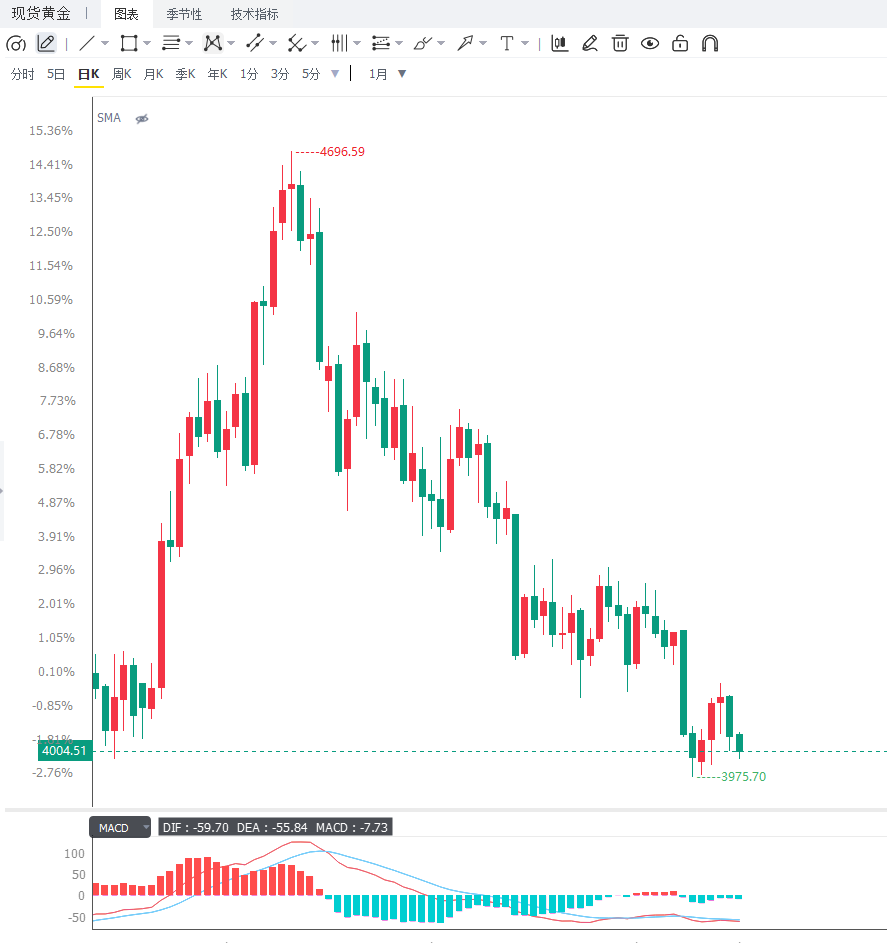 The editor summarizes that the core contradiction in the short term for XAU/USD lies in the strengthening expectation of a Fed rate hike, which is suppressing gold prices, while geopolitical risk premiums and central bank gold purchases provide a bottom-line support. This two-way driving force makes gold prices more likely to consolidate within the $3995-$4115 range, awaiting a breakthrough in US data and geopolitical developments. Going forward, three key variables need to be monitored: first, US PCE data and Fed officials' speeches, which are the primary indicators of whether the rate hike path will be further strengthened; second, whether XAU/USD can effectively break through and hold above $4115 (Bollinger Middle Band), which is the primary technical indicator of whether the bearish trend has reversed; and third, the trend of the US dollar index and US Treasury yields. If the dollar strengthens again, it will put pressure on gold. In addition, the evolution of the Middle East geopolitical situation, global central bank gold purchases, the performance of industrial precious metals such as silver, and policy signals before the December FOMC meeting also need to be monitored.
From a geopolitical perspective, diplomatic contacts between the US and Iran have alleviated some risk aversion, but events such as the attack on oil tankers in the Strait of Hormuz and the continued attacks by the Houthis have not eliminated the tail risk pricing of supply disruptions in the Middle East. WTI crude oil has returned above $104, and inflation concerns are indirectly supporting gold. Furthermore, TD Securities points out that industrial precious metals (silver and platinum group metals) have significantly underperformed gold after the FOMC meeting. Macroeconomic headwinds and expectations of policy tightening have suppressed the outlook for industrial demand, highlighting gold's defensive attributes within the precious metals sector. In a horizontal comparison, gold's situation makes a range-bound trading strategy more suitable than a one-sided bet. From a cross-asset perspective, the current volatility is essentially a confluence of four factors: first, the data dependence on the Fed's year-end rate hike path; second, the impact of the evolving Middle East geopolitical situation on safe-haven capital flows; third, the sustainability of global central bank gold purchases; and fourth, the real-time changes in the US dollar index and real interest rates. Only when two or more of these factors resonate in the same direction can a trend-driven market be established. On the daily chart, XAU/USD is trading around $4015, with an overall bearish bias. The price is trading below the 100-day SMA around $4215 and the Bollinger Middle Band around $4115, indicating continued downward pressure in the medium term. The price is near the lower Bollinger Band around $3995, which forms the primary near-term support. The 14-day RSI is around 38.23, in the weak momentum zone but not oversold, suggesting downward pressure exists but the slope may slow. Resistance levels to watch are the Bollinger Middle Band around $4115 (the primary near-term level), the 100-day SMA around $4215, and the upper Bollinger Band around $4230 (a decisive break above this level is needed to reverse the bearish trend). Support is initially seen at the lower Bollinger Band around $3995; a break below this level could open up further downside potential, testing the psychological levels of $3950 and $3900. On the 4-hour chart, the price is moving along the short-term moving averages, and the MACD histogram is close to the zero line, indicating bearish momentum but no confirmed acceleration. The current price is oscillating narrowly between $4010 and $4030. The editor summarizes that the core contradiction in the short term for XAU/USD lies in the strengthening expectation of a Fed rate hike, which is suppressing gold prices, while geopolitical risk premiums and central bank gold purchases provide a bottom-line support. This two-way driving force makes gold prices more likely to consolidate within the $3995-$4115 range, awaiting a breakthrough in US data and geopolitical developments. Going forward, three key variables need to be monitored: first, US PCE data and Fed officials' speeches, which are the primary indicators of whether the rate hike path will be further strengthened; second, whether XAU/USD can effectively break through and hold above $4115 (Bollinger Middle Band), which is the primary technical indicator of whether the bearish trend has reversed; and third, the trend of the US dollar index and US Treasury yields. If the dollar strengthens again, it will put pressure on gold. In addition, the evolution of the Middle East geopolitical situation, global central bank gold purchases, the performance of industrial precious metals such as silver, and policy signals before the December FOMC meeting also need to be monitored.
- Risk Warning and Disclaimer
- The market involves risk, and trading may not be suitable for all investors. This article is for reference only and does not constitute personal investment advice, nor does it take into account certain users’ specific investment objectives, financial situation, or other needs. Any investment decisions made based on this information are at your own risk.