The US-Iran peace talks aimed to depress the dollar, but why didn't the better-than-expected GDP growth support it?
2026-10-30 11:08:33
The US dollar index fell for the third consecutive day, trading around 101.70 in Asian trading on Friday (October 30). The immediate reason for the dollar's weakness was easing safe-haven demand. Hopes surrounding US-led diplomatic peace talks have led to signs of easing tensions in the Middle East, helping to offset concerns about oil supply and inflation, and lowering market expectations for a December rate hike by the Federal Reserve. The CME FedWatch tool shows traders are currently pricing in a 75% probability of a 25 basis point rate hike in December, down from 84.2% the previous day. Crude oil prices held steady following related reports. According to media reports, US Vice President JD Vance contacted Mohsen Rezaei, secretary of Iran's Supreme National Security Council, on Wednesday to push for the resumption of peace talks. US President Trump confirmed his approval of Vance's diplomatic contacts, stating that Iran needs assistance with medical supplies and other basic resources. 
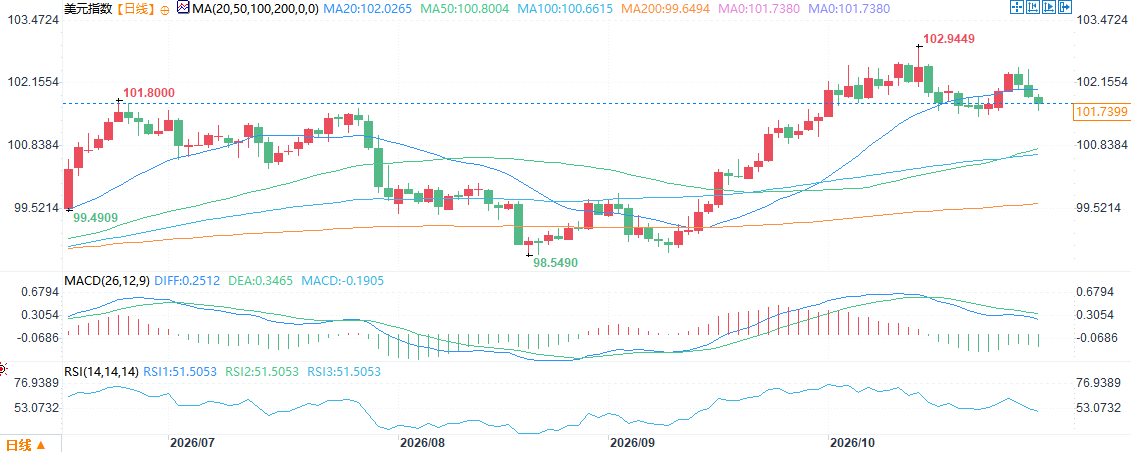 (US Dollar Index Daily Chart, Source: FX678) At 11:06 Beijing time, the US Dollar Index was at 101.69.
Safe-haven demand recedes: US-Iran talks weigh on dollar and interest rate hike expectations
Diplomatic engagement between the US and Iran was the core driver of the dollar's weakness this week. Easing tensions in the Middle East directly reduced the dollar's safe-haven premium, while stable oil prices eased immediate inflation concerns, thus reducing the urgency of a December rate hike by the Federal Reserve. This transmission chain is most clearly reflected in the interest rate market: the probability of a December rate hike fell from 84.2% to about 75%, a drop of nearly 10 percentage points in a single day, indicating that the market is reassessing the impact of geopolitical risks on the path of monetary policy. From a pricing perspective, the dollar is currently facing dual pressures from declining safe-haven demand and cooling expectations of rate hikes. The former directly reduces defensive allocations to dollar assets, while the latter diminishes the interest rate advantage of dollar assets. These two factors combined constitute the fundamental background for the dollar index's three consecutive days of decline.Resilience of economic data: Better-than-expected GDP and a tight labor market limited the dollar's decline.
However, the downside potential of the US dollar is clearly constrained by economic data. The preliminary estimate of US Q3 GDP growth was 3.4% year-on-year, exceeding the expected 3.2% and higher than Q2's 2.2%, mainly driven by a strong 3.8% year-on-year increase in consumer spending. The Fed's preferred inflation gauge—the core PCE price index—rose 3.1% year-on-year, in line with expectations. Initial jobless claims fell slightly to 194,000, further confirming the warming economy and tight labor market. This data has two implications. On the one hand, strong growth and a tight labor market reinforce the rationale for further Fed rate hikes, providing a floor for the dollar; on the other hand, the core PCE rising in line with expectations rather than exceeding them means that inflation data has not deteriorated to the point of forcing the Fed to accelerate its actions, which limits the room for further upward revisions in rate hike expectations.Market Outlook: The Dual Variables of US-Iran Negotiation Progress and the December Interest Rate Meeting
The short-term direction of the US dollar index depends on the relative strength of two variables. First, substantial progress in US-Iran negotiations: if diplomatic contact translates into a concrete peace agreement, the safe-haven premium will further diminish, and the dollar may test below 101.50; if negotiations stall or the situation fluctuates, safe-haven demand will return. Second, the data flow before the December interest rate meeting: with a December rate hike already priced in at approximately 75%, any marginal changes in inflation or employment data could trigger a repricing of expectations, thus amplifying the volatility of the dollar index. It is worth noting that oil prices play a bridging role between geopolitics and monetary policy in this combination. US-Iran contact has stabilized oil prices, easing inflation concerns and reducing the urgency of a rate hike—if this chain continues, the dollar will simultaneously lose both its safe-haven premium and interest rate differential support; however, if oil prices rise again due to other supply risks, renewed inflation concerns could reignite expectations of a rate hike, providing converse support for the dollar.in conclusion
The US dollar index fell for the third consecutive day, primarily driven by the reduced safe-haven demand due to diplomatic talks between the US and Iran, which led to a drop in expectations for a December rate hike from 84.2% to around 75%. However, better-than-expected Q3 GDP, in line with expectations for core PCE, and initial jobless claims falling to 194,000 provided economic resilience, limiting the dollar's decline. Short-term direction depends on substantial progress in US-Iran negotiations and the data releases ahead of the December FOMC meeting, with oil prices serving as a key bridge connecting geopolitical risks and monetary policy expectations. (US Dollar Index Daily Chart, Source: FX678) At 11:06 Beijing time, the US Dollar Index was at 101.69.
- Risk Warning and Disclaimer
- The market involves risk, and trading may not be suitable for all investors. This article is for reference only and does not constitute personal investment advice, nor does it take into account certain users’ specific investment objectives, financial situation, or other needs. Any investment decisions made based on this information are at your own risk.