With the US midterm elections approaching, a choice is being made for those holding $40 billion in bullish positions.
2026-10-30 19:52:23
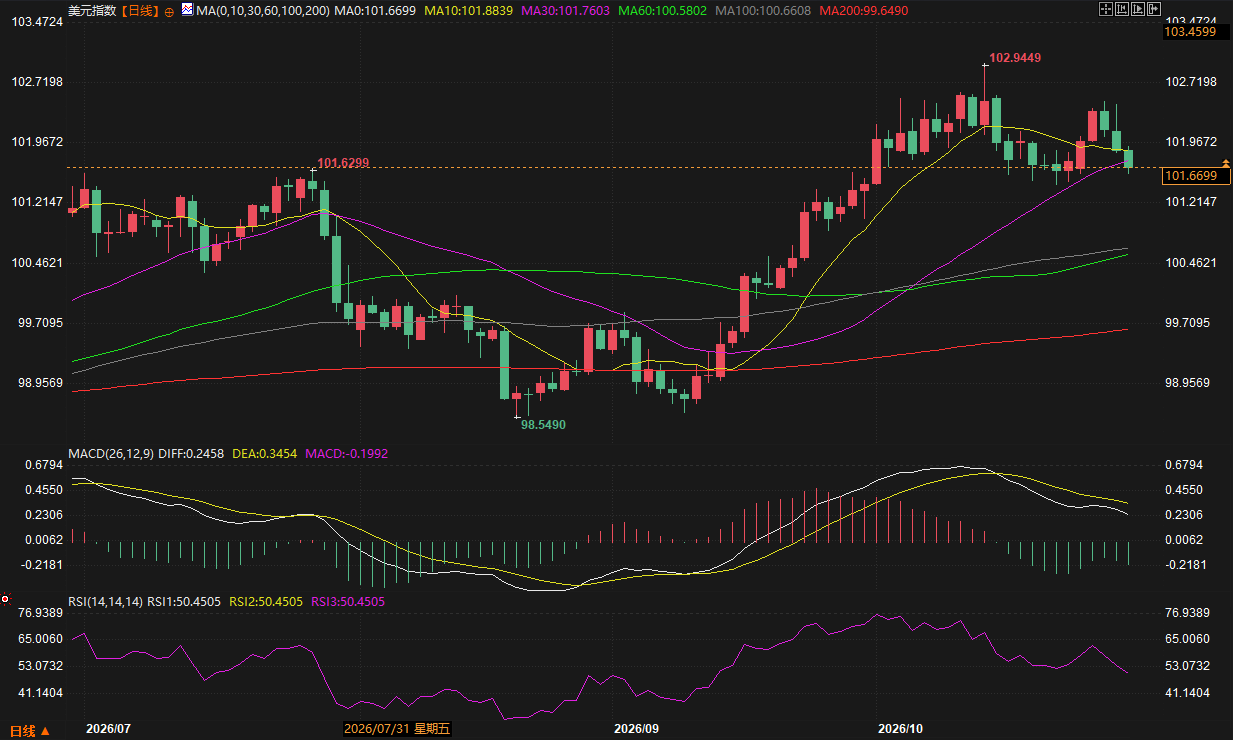
On Friday (October 30), the US dollar index was currently around 101.6659, with the early October high of 102.9449 remaining the most direct upper limit of the chart. The real force suppressing the market is not on the chart, but rather the ongoing position adjustments that are brewing ahead of Tuesday's voting day.  ING analyst Pessoll explicitly pointed out that the biggest risk facing the dollar on Friday was investors preemptively unwinding their net long positions ahead of the midterm elections, predicting the market would price in a Democratic sweep at approximately 68%. CFTC data as of October 20th showed that asset managers and non-commercial participants held slightly less than $40 billion in bets on a stronger dollar, a stance that has remained unchanged since mid-March. Any loosening of this existing position before the election window would explain a short-term dollar pullback more effectively than a moving average.
ING analyst Pessoll explicitly pointed out that the biggest risk facing the dollar on Friday was investors preemptively unwinding their net long positions ahead of the midterm elections, predicting the market would price in a Democratic sweep at approximately 68%. CFTC data as of October 20th showed that asset managers and non-commercial participants held slightly less than $40 billion in bets on a stronger dollar, a stance that has remained unchanged since mid-March. Any loosening of this existing position before the election window would explain a short-term dollar pullback more effectively than a moving average.Fundamentals: The divergence between election pricing and institutional judgment
The election situation is already quite clear. Polymarket's real-time odds show an implied probability of the Democrats winning the House of Representatives (approximately 91.5%) and the Senate (approximately 64.5%), with a 62.5% chance of a Democratic sweep of both houses. Decision Desk HQ's average polling rate gives Trump a 59.3% disapproval rating and predicts the Democrats will win 235 House seats, exceeding the 218 majority threshold. The market is pricing in a "blue wave," but the implications of this blue wave for the dollar are not one-sided. ING Bank analyzes the negative factors from three channels: the rising risk of a government shutdown, the deadlock in debt ceiling negotiations, and the potential further impact on already fragile AI sentiment. Another logic is equally significant. HSBC's review of 13 midterm elections since 1974 shows the dollar falling eight times, but rising in the last four (2010, 2014, 2018, and 2022), a contradictory trend, indicating that the election itself is not the directional driver for the dollar . Bank of America strategist Cohn's assessment is more direct: With a Democratic-led Congress pushing for AI regulatory legislation, Trump could veto it, preserving the main drivers of US stocks. "If AI trading falters due to the election and the dollar is sold off, we will buy on dips." Manulife's Tuft anchors the long term to relative growth, inflation, interest rates, and capital flows, rather than the election results. The divergence between short-term positions and medium-term fundamentals constitutes the core tension currently facing the dollar. Technical analysis is for reference only: the chart shows a short-term consolidation zone between 101.5 and 102.0, with the October high of 102.94 as an upper reference point; the medium-term moving averages still lean towards a bullish alignment.Future Trend Outlook
Before the election results are announced, adjustments in net long positions may continue to suppress the short-term performance of the US dollar. After the election results become clear, market attention will return to the Fed's policy path and AI capital flows. ING remains cautious about chasing the dollar higher, but the "buy on dips" stance of several institutions suggests that the depth of pullbacks may be limited. The range references are based solely on the visible positions on the chart and do not constitute investment guidance.Further Reading
Q: Why did the net long position in the US dollar loosen before the election? A: When uncertainty rises, some positions choose to reduce risk exposure. The $40 billion in existing bullish positions is a source of short-term pressure. Q: Is the blue wave necessarily bearish for the US dollar? A: ING lists three bearish channels: government shutdown, debt ceiling, and AI sentiment, but Citi believes any weakness is likely "temporary." Q: Are historical election patterns reliable? A: HSBC's review of 13 elections shows contradictory dollar directions; the election itself is insufficient as a directional indicator. Q: What to watch for the US dollar after the election? A: Whether the Fed resumes interest rate hikes after the election, and whether AI capital spending shows a substantial slowdown.- Risk Warning and Disclaimer
- The market involves risk, and trading may not be suitable for all investors. This article is for reference only and does not constitute personal investment advice, nor does it take into account certain users’ specific investment objectives, financial situation, or other needs. Any investment decisions made based on this information are at your own risk.