USD/JPY Analysis: The USD/JPY pair edged lower due to a hawkish stance and no change in policy.
2026-10-30 20:30:25
On Friday (October 30), the Bank of Japan kept its policy rate unchanged at 1.25% and, for the first time, signaled that its 2% inflation target had been achieved. In its policy statement and latest economic outlook report, the Bank of Japan identified three upside risks that could push up inflation: energy prices, demand related to artificial intelligence, and a weaker yen. The report maintained its economic growth forecast at 0.7%–0.8% (close to or above potential growth) while slightly raising its CPI inflation forecast.  The market is still debating whether the Bank of Japan's next interest rate hike will be in December or January, but the general expectation is that the policy rate will rise to around 2.00% next summer. The Bank of Japan is also paying attention to the interest rate hikes of overseas central banks, and it is likely aware that if it does not follow the Fed and ECB in raising rates in December, the yen may weaken further. We currently judge that the Bank of Japan will raise rates in December, and will most likely raise them again in March or April of the following year. ING believes that the USD/JPY pair fell slightly today due to the hawkish stance of holding rates steady, while the dollar as a whole generally weakened. We believe that the exchange rate will maintain buying support, fluctuating at the upper end of the wide range of 155-160, before turning downwards in the second quarter of next year. The Bank of Japan and its repeated intervention commitments Traders are not only worried about the impact of the Bank of Japan and the Fed (and the US Treasury) on USD/JPY, but the rising bond yields in both countries are also causing turmoil in the foreign exchange market. Furthermore, the current interest rate policies of the two central banks are also under scrutiny. While high inflation in the US is primarily driven by energy costs, Japan's inflation faces other factors—one of which is the persistent weakness of the yen. USD/JPY continues to trade in a highly risky area, a playground for both retail traders and large institutions seeking speculation. However, a major obstacle to USD/JPY trading remains the intervention threatened and actually implemented by the Bank of Japan (BOJ). The BOJ tends to keep the yen relatively weak against the dollar, but will decisively intervene when the exchange rate is deemed "unreasonably high." The dilemma for traders is that the BOJ keeps the threat of "intervention at any time" a real possibility, while never announcing the timing of its actions in advance. This can cause USD/JPY positions to suddenly turn from profitable to significantly loss, even wiping out trading accounts. Coordinated Action Against USD/JPY Upside Traders involved in USD/JPY trading must always be mindful of risk management. This currency pair is not suitable for inexperienced beginners to attempt or "practice" trading. Trading USD/JPY can be quite risky, especially given the current alignment between the Bank of Japan and the Federal Reserve/US Treasury in their public statements—similar to the coordinated intervention months ago by the US Treasury, the New York Fed, and the Bank of Japan to push USD/JPY lower. This currency pair is highly volatile, so setting appropriate stop-loss orders is crucial to prevent them from being triggered before the USD/JPY position truly takes effect. Patience is paramount in forex trading, but understanding the pair's inherent characteristics is equally essential. Large institutions and financial institutions continue to bet against the Bank of Japan, but even for them, such a bet could be costly should the Bank of Japan decide to intervene with large-scale yen purchases—which it certainly has the capacity to do if necessary. Technical Analysis
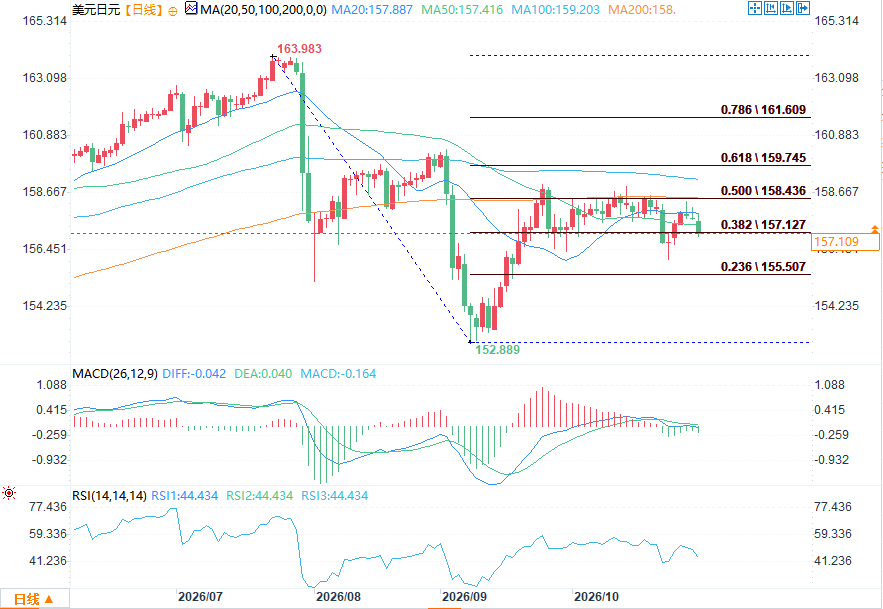 (USD/JPY Daily Chart Source: FX678) From a Fibonacci retracement perspective, the current USD/JPY decline from a high of 163.983 to a low of 152.889 is currently stabilizing around the 0.382 retracement level at 157.127. This level is the first key bullish defense zone in this downtrend, having been tested multiple times recently and found support, forming a short-term consolidation range. The 0.236 retracement level at 155.507 provides stronger support; if this consolidation pattern breaks, this level will be a crucial support level for the bulls to watch. On the upside, Fibonacci resistance levels are arranged sequentially, with the first target at the 0.5 level at 158.436, which coincides with the 50-day moving average (MA50), creating a confluence of resistance. Further key resistance lies at the 0.618 level at 159.745, a key level that could determine the nature of any rebound. Only a sustained close above the 0.618 Fibonacci retracement level on the daily chart can define the current movement as a deep rebound; otherwise, it can only be considered a Fibonacci correction after a decline. Supported by the secondary chart indicators, the MACD remains slightly weak near the zero line, while the RSI is in the neutral range around 44, without showing overbought or oversold conditions, consistent with the oscillation characteristics of a Fibonacci retracement phase. Currently, the price is fluctuating between the 0.382 support and the 0.5 resistance. Until a clear breakout of either Fibonacci level is achieved, it should be treated as a range-bound market, awaiting a directional move. The speculative price range for USD/JPY is expected to be between 156.200 and 159.900. Caution must be exercised when seeking upside opportunities in USD/JPY. From a technical perspective, this may mean waiting for further pullbacks before looking for reversal opportunities. For retail traders, seizing short-term, quick-in-and-out trading opportunities may be a reliable strategy for participating in USD/JPY in the current and coming weeks. However, the market is volatile, and reversals remain frequent.
The market is still debating whether the Bank of Japan's next interest rate hike will be in December or January, but the general expectation is that the policy rate will rise to around 2.00% next summer. The Bank of Japan is also paying attention to the interest rate hikes of overseas central banks, and it is likely aware that if it does not follow the Fed and ECB in raising rates in December, the yen may weaken further. We currently judge that the Bank of Japan will raise rates in December, and will most likely raise them again in March or April of the following year. ING believes that the USD/JPY pair fell slightly today due to the hawkish stance of holding rates steady, while the dollar as a whole generally weakened. We believe that the exchange rate will maintain buying support, fluctuating at the upper end of the wide range of 155-160, before turning downwards in the second quarter of next year. The Bank of Japan and its repeated intervention commitments Traders are not only worried about the impact of the Bank of Japan and the Fed (and the US Treasury) on USD/JPY, but the rising bond yields in both countries are also causing turmoil in the foreign exchange market. Furthermore, the current interest rate policies of the two central banks are also under scrutiny. While high inflation in the US is primarily driven by energy costs, Japan's inflation faces other factors—one of which is the persistent weakness of the yen. USD/JPY continues to trade in a highly risky area, a playground for both retail traders and large institutions seeking speculation. However, a major obstacle to USD/JPY trading remains the intervention threatened and actually implemented by the Bank of Japan (BOJ). The BOJ tends to keep the yen relatively weak against the dollar, but will decisively intervene when the exchange rate is deemed "unreasonably high." The dilemma for traders is that the BOJ keeps the threat of "intervention at any time" a real possibility, while never announcing the timing of its actions in advance. This can cause USD/JPY positions to suddenly turn from profitable to significantly loss, even wiping out trading accounts. Coordinated Action Against USD/JPY Upside Traders involved in USD/JPY trading must always be mindful of risk management. This currency pair is not suitable for inexperienced beginners to attempt or "practice" trading. Trading USD/JPY can be quite risky, especially given the current alignment between the Bank of Japan and the Federal Reserve/US Treasury in their public statements—similar to the coordinated intervention months ago by the US Treasury, the New York Fed, and the Bank of Japan to push USD/JPY lower. This currency pair is highly volatile, so setting appropriate stop-loss orders is crucial to prevent them from being triggered before the USD/JPY position truly takes effect. Patience is paramount in forex trading, but understanding the pair's inherent characteristics is equally essential. Large institutions and financial institutions continue to bet against the Bank of Japan, but even for them, such a bet could be costly should the Bank of Japan decide to intervene with large-scale yen purchases—which it certainly has the capacity to do if necessary. Technical Analysis (USD/JPY Daily Chart Source: FX678) From a Fibonacci retracement perspective, the current USD/JPY decline from a high of 163.983 to a low of 152.889 is currently stabilizing around the 0.382 retracement level at 157.127. This level is the first key bullish defense zone in this downtrend, having been tested multiple times recently and found support, forming a short-term consolidation range. The 0.236 retracement level at 155.507 provides stronger support; if this consolidation pattern breaks, this level will be a crucial support level for the bulls to watch. On the upside, Fibonacci resistance levels are arranged sequentially, with the first target at the 0.5 level at 158.436, which coincides with the 50-day moving average (MA50), creating a confluence of resistance. Further key resistance lies at the 0.618 level at 159.745, a key level that could determine the nature of any rebound. Only a sustained close above the 0.618 Fibonacci retracement level on the daily chart can define the current movement as a deep rebound; otherwise, it can only be considered a Fibonacci correction after a decline. Supported by the secondary chart indicators, the MACD remains slightly weak near the zero line, while the RSI is in the neutral range around 44, without showing overbought or oversold conditions, consistent with the oscillation characteristics of a Fibonacci retracement phase. Currently, the price is fluctuating between the 0.382 support and the 0.5 resistance. Until a clear breakout of either Fibonacci level is achieved, it should be treated as a range-bound market, awaiting a directional move. The speculative price range for USD/JPY is expected to be between 156.200 and 159.900. Caution must be exercised when seeking upside opportunities in USD/JPY. From a technical perspective, this may mean waiting for further pullbacks before looking for reversal opportunities. For retail traders, seizing short-term, quick-in-and-out trading opportunities may be a reliable strategy for participating in USD/JPY in the current and coming weeks. However, the market is volatile, and reversals remain frequent.
- Risk Warning and Disclaimer
- The market involves risk, and trading may not be suitable for all investors. This article is for reference only and does not constitute personal investment advice, nor does it take into account certain users’ specific investment objectives, financial situation, or other needs. Any investment decisions made based on this information are at your own risk.