Gold prices fell below $4,000, silver prices plummeted, and the Strait of Hormuz attack pushed up oil prices.
2026-10-30 21:52:23
Gold and silver prices fell sharply during the early US trading session on Friday (October 30). The renewed attack on merchant ships in the Strait of Hormuz pushed up oil prices, coupled with new signs of slowing US wage growth, but persistent inflation concerns weighed on precious metals. Following Thursday's decline, selling pressure continued in the precious metals market, with gold prices falling below $4,000 per ounce and silver prices hitting their lowest level this year. Spot gold traded around $3,932.28 per ounce, down $88.84, or 2.21%; spot silver was quoted at approximately $49.746 per ounce, down $2.402, or 4.61%. Gold prices are likely to close lower for the second consecutive month; silver continued to underperform gold, dragged down by concerns about industrial demand and tight monetary policy.  The latest U.S. employment cost data shows that inflationary pressures from labor costs have eased somewhat, but wage growth remains high. The employment cost index rose 0.8% quarter-over-quarter in the third quarter, in line with market expectations and down from 0.9% in the second quarter. Wages rose 0.7% quarter-over-quarter, lower than the 0.9% in the previous quarter; benefits costs rose 0.9% quarter-over-quarter, also lower than the 1.0% in the second quarter. Total compensation costs rose 3.4% year-over-year, the same as the year-over-year growth rate in June; of which wages rose 3.1% year-over-year, and benefits costs rose 3.9% year-over-year. The slowdown in quarterly wage growth has somewhat alleviated market concerns about labor costs continuing to push up inflation, but annual wage growth is still higher than the reasonable level corresponding to the Fed's long-term 2% inflation target. This employment cost report was released after the U.S. released better-than-expected third-quarter GDP data, while inflation indicators favored by the Fed rose again. U.S. GDP grew 3.4% quarter-over-quarter in the third quarter, higher than the 2.2% in the second quarter, with consumer spending and business investment remaining resilient, becoming the pillars of economic growth. September's personal consumption expenditures (PCE) inflation rose 0.5% month-over-month and 3.6% year-over-year; core PCE rose 0.3% month-over-month and 3.1% year-over-year. Accelerated economic growth coupled with persistent core inflation weakens the case for a shift to looser monetary policy, despite Friday's wage data showing a marginal cooling in labor costs. The market's current focus is on whether the Fed will raise interest rates again in December, following Wednesday's decision to keep the benchmark rate unchanged. The Fed maintained the target range for the federal funds rate at 3.75%-4.00%, with a vote of 10 in favor and 2 against. Two members wanted an immediate 25 basis point hike. Following the release of this economic data, the futures market priced in an approximately 83% probability of a December rate hike, while the latest wage data partially offset this expectation. On Thursday, the yield on the 10-year US Treasury note fell 7 basis points to approximately 4.932%, as weakness in technology stocks drove the market to buy US Treasuries as a safe haven. Even with declining US Treasury yields, gold prices continued to fall, reflecting inflation concerns, expectations of further policy tightening, and the dominant force of profit-taking in the precious metals market. On Friday, the situation in the Strait of Hormuz and US-Iran relations deteriorated further, with another commercial oil tanker attacked in the shipping lane, highlighting renewed risks to Middle Eastern energy supplies. Maritime security agencies confirmed that an oil tanker was attacked by an explosive device planted by a small boat; the perpetrators have not yet been identified. Regional shipping threats persist, and the prospects for restarting US-Iran negotiations remain unclear. Diplomatic efforts by Qatar and other mediators have not yet yielded an agreement; disagreements over sanctions, maritime security, and broader regional conflicts hinder a lasting reconciliation. Stimulated by the attack, crude oil prices surged, with December Brent crude futures approaching $113.04 per barrel and West Texas Intermediate (WTI) crude rising to approximately $103.79 per barrel. Brent crude saw a monthly increase of about 13%, and WTI crude about 15%, as the market continues to worry about Gulf oil supplies and the risk of escalating conflict remains. With the US midterm elections approaching on November 3rd, the uncertain future of US-Iran relations further inflates geopolitical risk premiums for crude oil prices. While some oil can be exported via alternative routes, mitigating the impact of shipping disruptions in the Gulf to some extent, repeated attacks on oil tankers and rising maritime security costs remain major obstacles to the resumption of normal commercial shipping in the Strait of Hormuz. Geopolitical conflict should have provided safe-haven support for gold, but the inflationary effect of rising oil prices has strengthened market expectations that the Federal Reserve will maintain a tight monetary policy for a longer period. Even with geopolitical tensions and declining US Treasury yields, gold prices still fell, indicating that in the short term, long position liquidation pressure and the interest rate outlook are the dominant factors. Silver saw an even larger decline, with a general sell-off in precious metals, coupled with concerns about industrial demand, high energy costs, and tightening lending conditions, all contributing to the downward pressure on silver prices. Silver prices broke through previous technical support levels, triggering more selling and further exacerbating the downside risk. Global stock markets weakened before the US market opened, with corporate earnings falling short of expectations, coupled with concerns about the investment prospects of the artificial intelligence sector, putting pressure on technology stocks. Following a sharp drop in Alphabet Group's stock price on Thursday, Amazon and Intel issued cautious earnings guidance, further pressuring large-cap tech stocks. European stocks were mixed, while most Asian stocks closed lower, as investors weighed corporate earnings, rising oil prices, and the outlook for global monetary policy. Higher oil prices, increased financing costs, and uncertainty surrounding large-scale AI investments collectively dampened market risk appetite; funds flowed into US Treasuries for safety, but this provided only limited support for precious metals.
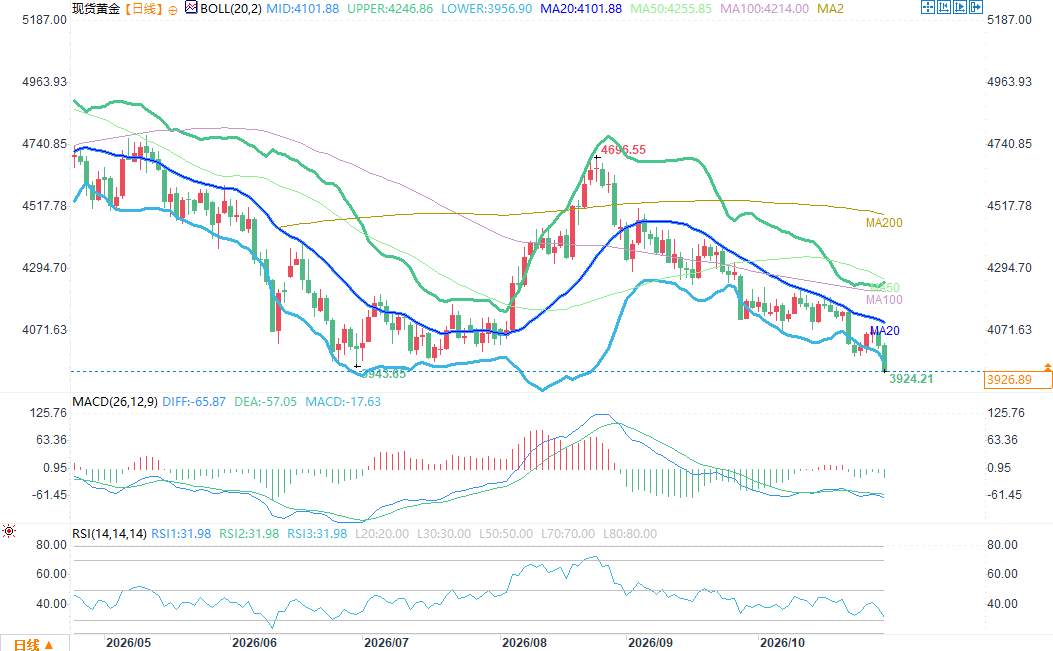 (US Dollar Index Daily Chart Source: FX678) Major External Markets: WTI crude oil on the New York Mercantile Exchange rose, trading around $103.79 per barrel; December Brent crude oil futures were around $117.15 per barrel, with renewed concerns about energy supply in the Gulf. The 10-year US Treasury yield traded around 4.932% after falling on Thursday. The US dollar remained relatively strong, and expectations of further tightening by the Federal Reserve and high oil prices weakened the upward momentum gold gained from the geopolitical crisis. Gold Technical Analysis: The next upside target for spot gold bulls is to push prices above the $4015.00-$4039.00 resistance range; only a decisive break above the upper limit of this range can alleviate the current bearish technical pressure. The short-term downside target for bears is a break below $3975.00, with a further target of $3943.00. The first resistance level is $4015.00, followed by $4039.00; the first support level is $3975.00, followed by $3943.00. Silver Technical Analysis: The next upside target for spot silver is a return to the $52.690-$54.680 resistance zone; only a break above this zone can improve the short-term technical outlook. The downside target for bears is a break below $50.710, with a further target of $49.510. The first resistance level is $52.690, followed by $54.680; the first support level is $50.710, followed by $49.510.
The latest U.S. employment cost data shows that inflationary pressures from labor costs have eased somewhat, but wage growth remains high. The employment cost index rose 0.8% quarter-over-quarter in the third quarter, in line with market expectations and down from 0.9% in the second quarter. Wages rose 0.7% quarter-over-quarter, lower than the 0.9% in the previous quarter; benefits costs rose 0.9% quarter-over-quarter, also lower than the 1.0% in the second quarter. Total compensation costs rose 3.4% year-over-year, the same as the year-over-year growth rate in June; of which wages rose 3.1% year-over-year, and benefits costs rose 3.9% year-over-year. The slowdown in quarterly wage growth has somewhat alleviated market concerns about labor costs continuing to push up inflation, but annual wage growth is still higher than the reasonable level corresponding to the Fed's long-term 2% inflation target. This employment cost report was released after the U.S. released better-than-expected third-quarter GDP data, while inflation indicators favored by the Fed rose again. U.S. GDP grew 3.4% quarter-over-quarter in the third quarter, higher than the 2.2% in the second quarter, with consumer spending and business investment remaining resilient, becoming the pillars of economic growth. September's personal consumption expenditures (PCE) inflation rose 0.5% month-over-month and 3.6% year-over-year; core PCE rose 0.3% month-over-month and 3.1% year-over-year. Accelerated economic growth coupled with persistent core inflation weakens the case for a shift to looser monetary policy, despite Friday's wage data showing a marginal cooling in labor costs. The market's current focus is on whether the Fed will raise interest rates again in December, following Wednesday's decision to keep the benchmark rate unchanged. The Fed maintained the target range for the federal funds rate at 3.75%-4.00%, with a vote of 10 in favor and 2 against. Two members wanted an immediate 25 basis point hike. Following the release of this economic data, the futures market priced in an approximately 83% probability of a December rate hike, while the latest wage data partially offset this expectation. On Thursday, the yield on the 10-year US Treasury note fell 7 basis points to approximately 4.932%, as weakness in technology stocks drove the market to buy US Treasuries as a safe haven. Even with declining US Treasury yields, gold prices continued to fall, reflecting inflation concerns, expectations of further policy tightening, and the dominant force of profit-taking in the precious metals market. On Friday, the situation in the Strait of Hormuz and US-Iran relations deteriorated further, with another commercial oil tanker attacked in the shipping lane, highlighting renewed risks to Middle Eastern energy supplies. Maritime security agencies confirmed that an oil tanker was attacked by an explosive device planted by a small boat; the perpetrators have not yet been identified. Regional shipping threats persist, and the prospects for restarting US-Iran negotiations remain unclear. Diplomatic efforts by Qatar and other mediators have not yet yielded an agreement; disagreements over sanctions, maritime security, and broader regional conflicts hinder a lasting reconciliation. Stimulated by the attack, crude oil prices surged, with December Brent crude futures approaching $113.04 per barrel and West Texas Intermediate (WTI) crude rising to approximately $103.79 per barrel. Brent crude saw a monthly increase of about 13%, and WTI crude about 15%, as the market continues to worry about Gulf oil supplies and the risk of escalating conflict remains. With the US midterm elections approaching on November 3rd, the uncertain future of US-Iran relations further inflates geopolitical risk premiums for crude oil prices. While some oil can be exported via alternative routes, mitigating the impact of shipping disruptions in the Gulf to some extent, repeated attacks on oil tankers and rising maritime security costs remain major obstacles to the resumption of normal commercial shipping in the Strait of Hormuz. Geopolitical conflict should have provided safe-haven support for gold, but the inflationary effect of rising oil prices has strengthened market expectations that the Federal Reserve will maintain a tight monetary policy for a longer period. Even with geopolitical tensions and declining US Treasury yields, gold prices still fell, indicating that in the short term, long position liquidation pressure and the interest rate outlook are the dominant factors. Silver saw an even larger decline, with a general sell-off in precious metals, coupled with concerns about industrial demand, high energy costs, and tightening lending conditions, all contributing to the downward pressure on silver prices. Silver prices broke through previous technical support levels, triggering more selling and further exacerbating the downside risk. Global stock markets weakened before the US market opened, with corporate earnings falling short of expectations, coupled with concerns about the investment prospects of the artificial intelligence sector, putting pressure on technology stocks. Following a sharp drop in Alphabet Group's stock price on Thursday, Amazon and Intel issued cautious earnings guidance, further pressuring large-cap tech stocks. European stocks were mixed, while most Asian stocks closed lower, as investors weighed corporate earnings, rising oil prices, and the outlook for global monetary policy. Higher oil prices, increased financing costs, and uncertainty surrounding large-scale AI investments collectively dampened market risk appetite; funds flowed into US Treasuries for safety, but this provided only limited support for precious metals. (US Dollar Index Daily Chart Source: FX678) Major External Markets: WTI crude oil on the New York Mercantile Exchange rose, trading around $103.79 per barrel; December Brent crude oil futures were around $117.15 per barrel, with renewed concerns about energy supply in the Gulf. The 10-year US Treasury yield traded around 4.932% after falling on Thursday. The US dollar remained relatively strong, and expectations of further tightening by the Federal Reserve and high oil prices weakened the upward momentum gold gained from the geopolitical crisis. Gold Technical Analysis: The next upside target for spot gold bulls is to push prices above the $4015.00-$4039.00 resistance range; only a decisive break above the upper limit of this range can alleviate the current bearish technical pressure. The short-term downside target for bears is a break below $3975.00, with a further target of $3943.00. The first resistance level is $4015.00, followed by $4039.00; the first support level is $3975.00, followed by $3943.00. Silver Technical Analysis: The next upside target for spot silver is a return to the $52.690-$54.680 resistance zone; only a break above this zone can improve the short-term technical outlook. The downside target for bears is a break below $50.710, with a further target of $49.510. The first resistance level is $52.690, followed by $54.680; the first support level is $50.710, followed by $49.510.
- Risk Warning and Disclaimer
- The market involves risk, and trading may not be suitable for all investors. This article is for reference only and does not constitute personal investment advice, nor does it take into account certain users’ specific investment objectives, financial situation, or other needs. Any investment decisions made based on this information are at your own risk.