A chart shows that the Baltic Dry Index has fallen for the second consecutive month, putting pressure on large vessels.
2026-10-31 00:46:25
The latest data shows that the Baltic Dry Index (BDI) reached 2714 points on October 30, 2026, a new high since October 13, 2026, up 0.07% month-on-month, marking the third consecutive day of increase (including zero growth). Looking at the short-term charts, the recent 11 BDI data points show: 7 positive increases, 4 negative increases, and 0 zero increases. Specifically, the Panamax Freight Index (BPI) was 1889 points, down 1.67% from the previous value; the Capesize Freight Index (BCI) was 4126 points, up 0.88%; and the Supramax Freight Index (BSI) was 1865 points, down 0.27%. For detailed 720-day and 10-year trend charts of the Baltic Dry Index and its three main sub-indices, please refer to the charts specially created by FX678. 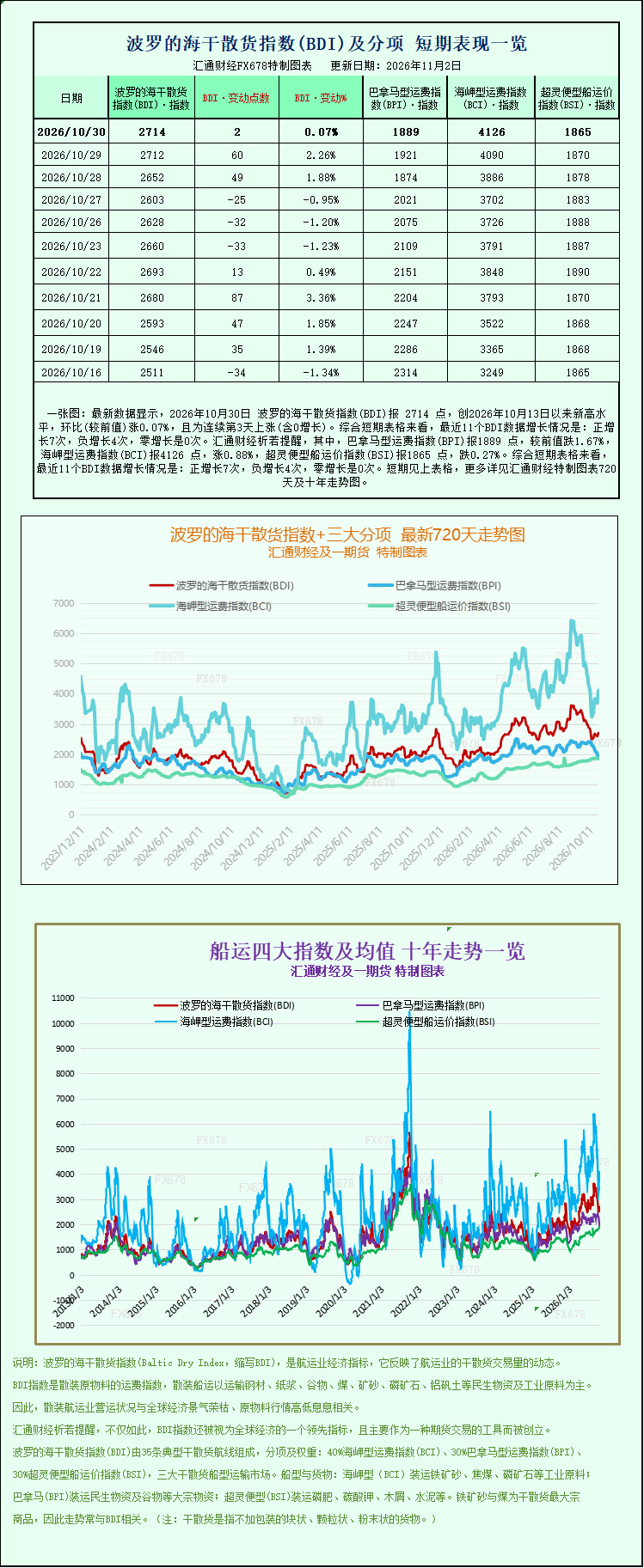 On October 30th, the Baltic Dry Index (BDI), the benchmark index for dry bulk shipping released by the Baltic Exchange, rose slightly, but the overall trend remains unfavorable. The index rose slightly by 2 points, or 0.07%, to close at 2714 points, its highest level since October 13th. Despite the single-day rebound, from a medium-term perspective, the index is facing its second consecutive month of decline, with a cumulative drop of over 12% in October, reflecting significant downward pressure on both the supply and demand sides of the dry bulk shipping market. The BDI is the most crucial indicator for measuring the health of the dry bulk market, weighted by freight rates for the three main vessel types: Capesize, Panamax, and Supramax. It is considered a "barometer" of global commodity trade activity. Behind this weakening index, there is a clear divergence in performance among different vessel types: large vessels continue to face pressure, while small and medium-sized vessels have shown relative resilience, highlighting the increasingly prominent structural characteristics of the market. Large Vessels: Capesize Index Leads Decline As the most heavily weighted component of the Baltic Dry Index (BDI), the Capesize bulk carrier index rose 36 points, or 0.88%, to close at 4126 points, also reaching its highest point since October 12th. However, the index has fallen by approximately 16% cumulatively in October, marking its second consecutive monthly decline. Capesize vessels typically carry around 150,000 tons of cargo, primarily bulk commodities such as iron ore and coal, and are the largest and most volatile vessel type in the dry bulk market. The continuous decline in their freight rates directly reflects the weakness in demand for bulk commodities. From a fundamental perspective, iron ore is the core demand source for Capesize vessel capacity, and its price movement is highly correlated with freight rates. This Friday, iron ore futures prices retreated, giving back some of the gains from the previous trading day. This was mainly due to the continued rebound in port inventories and rising inventory pressure, while steel mill profitability remained weak, suppressing restocking demand for iron ore. The weakness of the steel industry is the underlying reason for the decline in Capesize freight rates. Currently, steel mill profit margins are being squeezed, production enthusiasm is dampened, and the pace of purchasing raw materials such as iron ore has slowed, which in turn affects the demand side of shipping, making the supply and demand of Capesize vessels more relaxed. Looking at daily revenue data, the average daily revenue of Capesize vessels increased by $325 to $33,917, but this level has clearly fallen from the previous high, and the downward trend in industry prosperity has not been fundamentally reversed. Panamax vessels: Deepest decline, hitting a multi-month low Among the three major vessel types, Panamax vessels performed the weakest. The Panamax index fell 32 points, a drop of 1.67%, closing at 1889 points, the lowest level since April 13th, and is expected to have a cumulative decline of 20.76% this month, making it the sector most heavily pressured in this downward cycle. Panamax vessels typically carry 60,000 to 70,000 tons of cargo, primarily coal and grain. The average daily revenue for this vessel type decreased by $290 to $16,999. The sharp decline in Panamax freight rates reflects the weakening of the coal and grain trade. On the one hand, global coal demand continues to be under pressure against the backdrop of global energy transition and clean energy substitution; on the other hand, seasonal fluctuations in the trade of agricultural products such as grains have exacerbated the decline in freight rates. As a key shipping capacity connecting the two basic demands of energy and food, the continued decline in Panamax freight rates further confirms the current insufficient demand momentum in the overall dry bulk market. Small and Medium-Sized Vessels: Supramax bucks the trend with increases, market differentiation is obvious In stark contrast to the continued weakness of larger vessel types, smaller vessel types, represented by Supramax, have shown strong resilience. The Supramax bulk carrier index fell slightly by 5 points, or 0.27%, to close at 1865 points, hitting its lowest point since October 15. However, from a medium-term perspective, the index is expected to rise for the third consecutive month, with a cumulative increase of 3.8%. Supramax vessels are mainly used to transport small and medium-sized bulk cargoes such as grain, fertilizer, and steel, with a more diversified cargo structure and lower dependence on any single commodity. While large vessels are under pressure due to weak demand for iron ore and coal, Supramax vessels have maintained relatively stable freight rates thanks to the seasonal peak in grain trade and their diversified cargo structure. This "weak large vessels, strong small vessels" pattern highlights the current structural differentiation in the dry bulk market—weak demand is mainly concentrated in bulk commodities such as iron ore and coal, while the more segmented and dispersed small and medium-sized bulk cargo trade continues to maintain a certain level of vitality. Market Outlook: Short-Term Pressure Remains, Structural Opportunities Remain to be Observed Overall, the Baltic Dry Index (BDI) fell for the second consecutive month, mainly due to the continued weakness in Capesize and Panamax freight rates, especially Panamax, which hit a more than six-month low, reflecting a general slowdown in demand for core commodities such as steel, coal, and grain. In the short term, the rebound in iron ore port inventories coupled with weak steel mill profitability is expected to continue to put downward pressure on Capesize freight rates; the long-term weakening trend in coal demand also means that Panamax freight rates lack strong support for a rebound. Meanwhile, smaller vessels such as Supramax, relying on diversified cargo sources and seasonal demand, are expected to maintain relatively stable performance. Looking ahead, the recovery of the dry bulk market will depend on several key variables: first, whether the pace of global steel production recovery can drive a rebound in seaborne iron ore demand; second, the changing demand for coal in the context of energy transition; and third, the duration and strength of the peak season for grain trade. On the supply side, the pace of fleet capacity deployment and new ship orders will also affect the direction of the supply-demand balance. Overall, structural differentiation in the market is likely to continue, and freight rates for each type of vessel will depend more on changes in the fundamentals of their corresponding cargo type rather than on a uniform industry cycle.
- Risk Warning and Disclaimer
- The market involves risk, and trading may not be suitable for all investors. This article is for reference only and does not constitute personal investment advice, nor does it take into account certain users’ specific investment objectives, financial situation, or other needs. Any investment decisions made based on this information are at your own risk.