The USD/JPY pair continues its range-bound trading amid a tug-of-war between support from the USD/JPY interest rate differential and the risk of intervention.
2026-11-02 11:38:24
The US dollar continued its rebound against the Japanese yen in Asian trading on Monday, trading around 157.85, up about 0.4% from Friday's low of around 157.20. The pair regained its upward momentum after a brief pullback following the Bank of Japan's decision, reflecting that the US-Japan interest rate differential remains the core variable driving exchange rate movements.  Japanese Finance Minister Satsuki Katayama stated on Monday that the joint US-Japan foreign exchange statement remains valid, and the government is prepared to take action to curb excessive or disorderly depreciation of the yen. However, this statement failed to provide effective support for the yen – continued market uncertainty regarding the timing of future Bank of Japan interest rate hikes, coupled with the significant interest rate differential between Japan and other major economies, continued to put pressure on the low-yielding yen. Strengthening expectations of a Federal Reserve rate hike are another key factor supporting the rise of the USD/JPY. US macroeconomic data released last Thursday showed continued economic resilience and persistent price pressures, coupled with inflation concerns stemming from high oil prices, further reinforcing expectations of further tightening of monetary policy by the Federal Reserve. According to the CME Group's FedWatch tool, traders are currently pricing in a 75% chance of a Fed rate hike in December. This means that the path of least resistance for the dollar and USD/JPY remains upward. Geopolitically, progress in Middle East diplomacy is putting some pressure on the safe-haven dollar. Iranian negotiators held their third day of talks with Qatari mediators on Sunday to advance an agreement to end the US-Israel war against Iran; Iran also proposed a 48-hour plan to reopen the Strait of Hormuz if the US meets its conditions. US President Trump stated that negotiations were progressing well and that Iran hoped to reach an agreement, but he added that further military action could not be ruled out after the November 3 midterm elections. Furthermore, Iran's Supreme Leader Khamenei ordered senior military commanders to prepare for a new round of confrontation with the US and Israel, and the new attack on a Russian oil refinery in Ukraine also kept geopolitical risk premiums at play. These factors, while supporting the US dollar, also limited its upside potential. On the 1-hour chart, USD/JPY is mildly bullish, currently testing the 23.6% Fibonacci retracement level near 157.80. The pair is holding above the 100-period simple moving average (SMA) near 157.75, indicating that pullback buying is still present, and the pair is moving towards the upper end of the recent retracement structure. On the upside resistance front, the next key resistance is at the cycle high anchor point near 158.34; a decisive break above this level would open up room for a broader bullish continuation. The first support level to watch is 157.80 (23.6% Fibonacci retracement), with deeper support at 157.47 (38.2% retracement) and 157.21 (50.0% retracement).
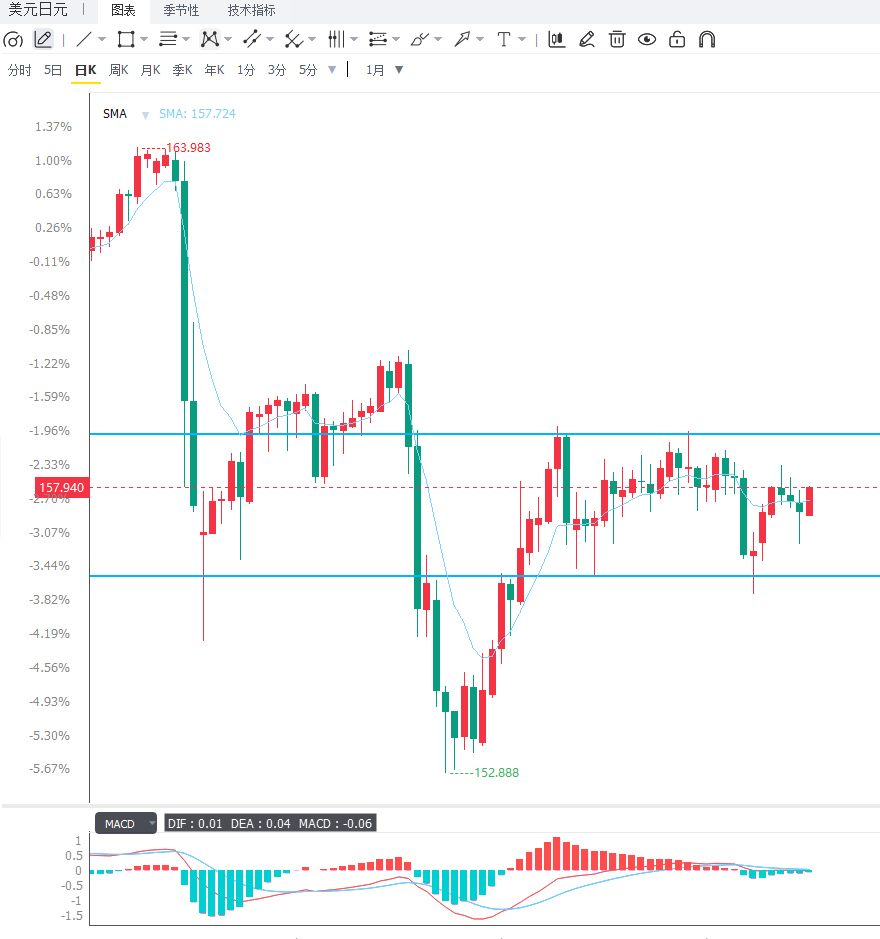 Editor's Summary: The core contradiction in the USD/JPY exchange rate currently lies in the tug-of-war between "support from the USD/JPY interest rate differential" and "the risk of Japanese intervention + easing of diplomatic tensions in the Middle East." In the short term, the exchange rate is consolidating within the 157.20-157.85 range, with key resistance levels at 157.80 and 158.34, and support levels at 157.47 and 157.21. Three key variables need to be monitored: first, changes in the Fed's December rate hike expectations; if inflation data continues to strengthen tightening expectations, the exchange rate may break through 158.34 and continue its upward trend; second, the policy moves of the Japanese Ministry of Finance and the Bank of Japan; if certain risks escalate substantially, the exchange rate may fall rapidly; and third, substantial developments in the Middle East situation; if diplomatic negotiations break down or military conflict escalates, safe-haven buying may push the USD/JPY further higher.
Japanese Finance Minister Satsuki Katayama stated on Monday that the joint US-Japan foreign exchange statement remains valid, and the government is prepared to take action to curb excessive or disorderly depreciation of the yen. However, this statement failed to provide effective support for the yen – continued market uncertainty regarding the timing of future Bank of Japan interest rate hikes, coupled with the significant interest rate differential between Japan and other major economies, continued to put pressure on the low-yielding yen. Strengthening expectations of a Federal Reserve rate hike are another key factor supporting the rise of the USD/JPY. US macroeconomic data released last Thursday showed continued economic resilience and persistent price pressures, coupled with inflation concerns stemming from high oil prices, further reinforcing expectations of further tightening of monetary policy by the Federal Reserve. According to the CME Group's FedWatch tool, traders are currently pricing in a 75% chance of a Fed rate hike in December. This means that the path of least resistance for the dollar and USD/JPY remains upward. Geopolitically, progress in Middle East diplomacy is putting some pressure on the safe-haven dollar. Iranian negotiators held their third day of talks with Qatari mediators on Sunday to advance an agreement to end the US-Israel war against Iran; Iran also proposed a 48-hour plan to reopen the Strait of Hormuz if the US meets its conditions. US President Trump stated that negotiations were progressing well and that Iran hoped to reach an agreement, but he added that further military action could not be ruled out after the November 3 midterm elections. Furthermore, Iran's Supreme Leader Khamenei ordered senior military commanders to prepare for a new round of confrontation with the US and Israel, and the new attack on a Russian oil refinery in Ukraine also kept geopolitical risk premiums at play. These factors, while supporting the US dollar, also limited its upside potential. On the 1-hour chart, USD/JPY is mildly bullish, currently testing the 23.6% Fibonacci retracement level near 157.80. The pair is holding above the 100-period simple moving average (SMA) near 157.75, indicating that pullback buying is still present, and the pair is moving towards the upper end of the recent retracement structure. On the upside resistance front, the next key resistance is at the cycle high anchor point near 158.34; a decisive break above this level would open up room for a broader bullish continuation. The first support level to watch is 157.80 (23.6% Fibonacci retracement), with deeper support at 157.47 (38.2% retracement) and 157.21 (50.0% retracement). Editor's Summary: The core contradiction in the USD/JPY exchange rate currently lies in the tug-of-war between "support from the USD/JPY interest rate differential" and "the risk of Japanese intervention + easing of diplomatic tensions in the Middle East." In the short term, the exchange rate is consolidating within the 157.20-157.85 range, with key resistance levels at 157.80 and 158.34, and support levels at 157.47 and 157.21. Three key variables need to be monitored: first, changes in the Fed's December rate hike expectations; if inflation data continues to strengthen tightening expectations, the exchange rate may break through 158.34 and continue its upward trend; second, the policy moves of the Japanese Ministry of Finance and the Bank of Japan; if certain risks escalate substantially, the exchange rate may fall rapidly; and third, substantial developments in the Middle East situation; if diplomatic negotiations break down or military conflict escalates, safe-haven buying may push the USD/JPY further higher.
- Risk Warning and Disclaimer
- The market involves risk, and trading may not be suitable for all investors. This article is for reference only and does not constitute personal investment advice, nor does it take into account certain users’ specific investment objectives, financial situation, or other needs. Any investment decisions made based on this information are at your own risk.