Multiple institutions simultaneously raise their forecasts to $105: Consensus and disagreement on the Brent crude oil price outlook.
2026-11-02 15:52:25
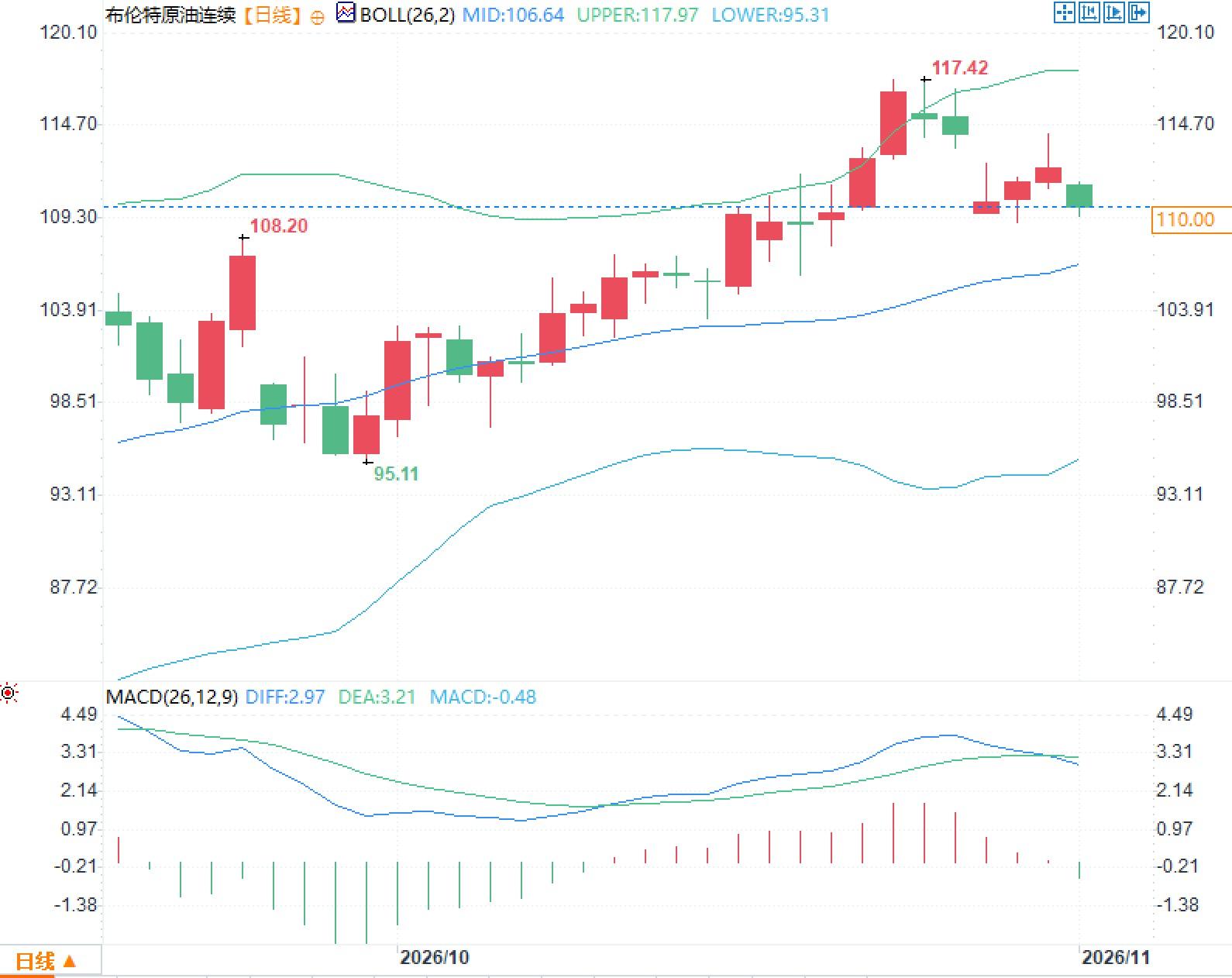
On Monday, November 2nd, Brent crude oil entered a consolidation phase at high levels after a cumulative increase of approximately 14% in October. It recently touched a six-month high of around $117.5 per barrel, even though crude oil exports from the Middle East have gradually recovered to near pre-conflict levels. Several institutions simultaneously raised their year-end and 2027 price outlooks, primarily driven by the continued pricing of supply disruption risk premiums. The market is placing greater weight on potential weakening of Middle Eastern supply following the US midterm elections. Current futures prices are trading around $110 per barrel, reflecting the continued significant volatility driven by events. 
The rationale behind institutions raising their outlook
Goldman Sachs raised its December Brent price outlook to $105 per barrel from $90 per barrel, and its 2027 average price forecast to $88 per barrel from approximately $80 per barrel, an increase of about 10%. It also raised its West Texas Intermediate (WTI) crude oil outlook. Morgan Stanley raised its fourth-quarter Brent price outlook to $105 per barrel, and ANZ Bank also raised its year-end Brent futures outlook to the same level. These adjustments are based on significant downside risks to Middle Eastern supply, with analysts noting that the timing and location of disruptions are almost unpredictable. Therefore, the baseline scenario includes a global supply disruption reserve of 1 million barrels per day in 2027. The maintenance of the risk premium is not due to an absolute shortage of current flows, but rather to the increased weighting of pricing in potential upgrade paths. OPEC+ recently maintained its production target, but actual output remains below the target, further supporting this logic.The Persistent Characteristics of Supply Risks in the Middle East
After months of conflict, Middle Eastern crude oil supplies have rebounded to near pre-conflict levels, but escalating shipping attacks and infrastructure damage remain key variables that could trigger further price increases. Reports indicate that Iran has instructed commanders to prepare for a possible renewed standoff, and there have been repeated hints of a possible resumption of airstrikes. Furthermore, risks related to the conflict in Ukraine are also being considered. In the baseline scenario, 2027 includes a contingency reserve of 1 million barrels per day for potential disruptions, reflecting the challenges forecasters face with a wide range of potential outcomes. In the upside scenario, if Persian Gulf output is 3.5 million barrels per day lower than the previous year's average, the average Brent price in 2027 could reach $130 per barrel; in the downside scenario, it could fall back to the $60 range. The speed and completeness of supply recovery, the stability of shipping routes, and the integrity of infrastructure collectively form the core support for the risk premium.Market equilibrium and scenario framework uncertainty
Beyond its core viewpoints, the institution outlined a bull and bear market framework, spanning approximately $70, highlighting the difficulty of forecasting. Key variables include the supply recovery path, shipping safety, infrastructure integrity, and geopolitical developments. The market is increasingly pricing in post-US midterm election developments, and the duration and scale of supply disruptions will determine the sustainability of premiums. OPEC+ maintained its December production target at its November 1st meeting, but actual output remains below target, indicating a gap between nominal quotas and effective supply. This gap is amplified in the context of conflict, making market equilibrium assessments more reliant on real-time supply data rather than static targets. The broad scenario range reflects forecasters' high uncertainty regarding the size and duration of disruptions.Observation of Price Structure and Volatility Characteristics
Looking at recent price movements, Brent crude oil prices retreated after reaching approximately $117.5 per barrel at the end of October, trading around $110 in early November. Volatility remained high, reflecting a strong event-driven characteristic. The Bollinger Bands indicator shows that prices retreated after touching the upper band, while the MACD indicator is in neutral territory. Fundamental risk premiums and supply uncertainty remain the dominant factors, with the market focusing on the actual evolution of supply data and the actual occurrence of disruption events. The consolidation at higher levels reflects more of a weighing of potential escalation and supply recovery forces than a confirmation of a single trend.Frequently Asked Questions
Question 1: What are the main bases for institutions raising their oil price outlook? Answer: The core basis is the significant downside risk to Middle East supply. The market is giving greater weight to the potential supply weakening after the US midterm elections, while also incorporating multiple factors such as shipping attacks, infrastructure damage, and the conflict in Ukraine. The baseline scenario includes a contingency reserve of 1 million barrels per day for disruptions. Question 2: Why are prices still high even though supply has recovered to near pre-conflict levels? Answer: Although exports have rebounded, the market is focused on the unpredictability of potential disruptions and the possibility of escalation. A risk premium persists, rather than being based solely on current flow levels. Question 3: What are the key differences between the upside and downside scenarios? Answer: The upside scenario assumes that Persian Gulf output remains low by 3.5 million barrels per day, with an average price potentially reaching $130 per barrel; the downside scenario is based on a faster recovery in regional output, with prices potentially entering the $60 range, a range of approximately $70.- Risk Warning and Disclaimer
- The market involves risk, and trading may not be suitable for all investors. This article is for reference only and does not constitute personal investment advice, nor does it take into account certain users’ specific investment objectives, financial situation, or other needs. Any investment decisions made based on this information are at your own risk.