Demand for safe-haven assets has eased somewhat, and the US dollar continues to fluctuate at high levels.
2026-11-02 17:00:26
The dollar index, which measures the dollar's performance against six major currencies, traded sideways around 101.5 during Monday's Asian trading session, ending a slight upward trend from the previous day. Geopolitically, while concerns about US military action against Iran persist, three consecutive days of talks between Qatari and Iranian officials, aiming to reach a ceasefire agreement before the US midterm elections, represented progress in diplomatic efforts. This directly weakened safe-haven buying of the dollar, becoming the main reason for the index's short-term decline. However, the supporting logic from an inflation perspective has not disappeared. Market surveys show that CME Group tools indicate the market maintains a 75% probability of a Fed rate hike in December. Recent US economic data has shown resilience, with the pace of inflation cooling slowing, continuously pushing up expectations for further monetary policy tightening.  Brown Brothers Harriman's interpretation of the US September PCE report indicates that the pace of inflation improvement has stalled. Overall PCE rose 0.5% month-over-month, compared to 0.3% in August, and increased to 3.6 % year-over-year, higher than the previous 3.4%. Core PCE remained at 0.3% month-over-month, but rose to 3.1 % year-over-year, compared to 3.0% in August. The close correlation between overall and core inflation provides underlying support for the US dollar. Currently, in addition to inflation indicators, the market is also closely monitoring wage trends and overall US growth expectations, with trade concerns temporarily taking a backseat. Market participants are awaiting a series of key data releases this week, including October non-farm payrolls, ISM manufacturing and services PMIs, and speeches from several Federal Reserve officials. These statements will likely continue to adjust market pricing of a December rate hike, influencing the volatility of US Treasury yields and the US dollar index. From a daily chart perspective, the medium-term upward trend of the US dollar index has not been completely broken. Currently, the price is retracing to a key consolidation range, with upward momentum clearly weakening. The RSI indicator has fallen back to the neutral zone and has not entered oversold territory. The first resistance level is at 102.00 , followed by 102.45 . Only by regaining and stabilizing above 102.00 can the bulls have the conditions for another upward attack. The first support level is at 101.20 , with deeper support at 100.80 . If it effectively breaks below 101.20, the current rebound structure will weaken further. On the 4-hour chart, the short-term trend has turned to a slightly bearish consolidation. Short-term moving averages are providing resistance, and indicators are operating in the neutral zone, without a clear signal of sustained downward movement. The price faces two possible paths: if inflation and employment data continue to be stronger than expected, the index is likely to stabilize and rebound; if the data weakens, it will further test the lower support levels. The market awaits macroeconomic signals to determine its direction.
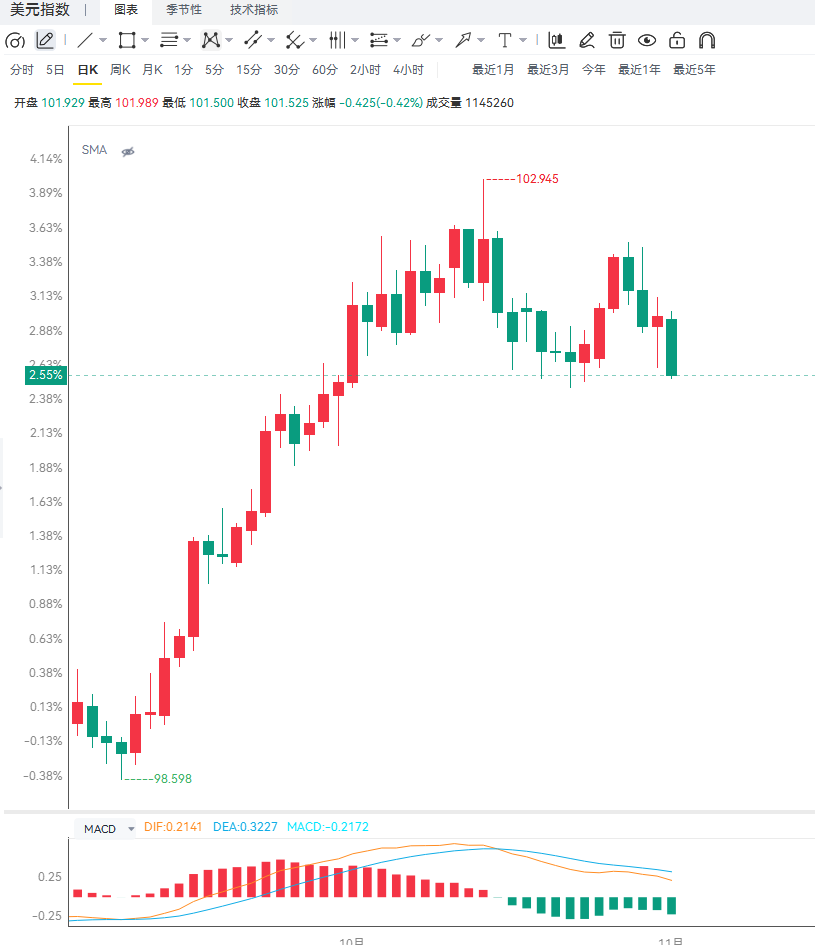 Editor's Summary: The US dollar index is currently caught in a tug-of-war between waning geopolitical risk aversion and persistent inflationary pressures supporting interest rate hike expectations. 101.5 is a short-term key level. Short-term risks lie in a renewed surge in safe-haven demand due to renewed tensions in the Middle East, or a significant slowdown in US inflation and employment data, lowering expectations for a December rate hike and driving the index further down. Potential opportunities lie in resilient economic data, increasing the probability of a rate hike and pushing the index back above 102. In terms of trading, it is not advisable to blindly buy the dip or short at the current level. It is recommended to wait for data releases and confirmation of key support and resistance levels before entering a position, paying particular attention to liquidity shocks and rapid fluctuations before and after data releases.
Brown Brothers Harriman's interpretation of the US September PCE report indicates that the pace of inflation improvement has stalled. Overall PCE rose 0.5% month-over-month, compared to 0.3% in August, and increased to 3.6 % year-over-year, higher than the previous 3.4%. Core PCE remained at 0.3% month-over-month, but rose to 3.1 % year-over-year, compared to 3.0% in August. The close correlation between overall and core inflation provides underlying support for the US dollar. Currently, in addition to inflation indicators, the market is also closely monitoring wage trends and overall US growth expectations, with trade concerns temporarily taking a backseat. Market participants are awaiting a series of key data releases this week, including October non-farm payrolls, ISM manufacturing and services PMIs, and speeches from several Federal Reserve officials. These statements will likely continue to adjust market pricing of a December rate hike, influencing the volatility of US Treasury yields and the US dollar index. From a daily chart perspective, the medium-term upward trend of the US dollar index has not been completely broken. Currently, the price is retracing to a key consolidation range, with upward momentum clearly weakening. The RSI indicator has fallen back to the neutral zone and has not entered oversold territory. The first resistance level is at 102.00 , followed by 102.45 . Only by regaining and stabilizing above 102.00 can the bulls have the conditions for another upward attack. The first support level is at 101.20 , with deeper support at 100.80 . If it effectively breaks below 101.20, the current rebound structure will weaken further. On the 4-hour chart, the short-term trend has turned to a slightly bearish consolidation. Short-term moving averages are providing resistance, and indicators are operating in the neutral zone, without a clear signal of sustained downward movement. The price faces two possible paths: if inflation and employment data continue to be stronger than expected, the index is likely to stabilize and rebound; if the data weakens, it will further test the lower support levels. The market awaits macroeconomic signals to determine its direction. Editor's Summary: The US dollar index is currently caught in a tug-of-war between waning geopolitical risk aversion and persistent inflationary pressures supporting interest rate hike expectations. 101.5 is a short-term key level. Short-term risks lie in a renewed surge in safe-haven demand due to renewed tensions in the Middle East, or a significant slowdown in US inflation and employment data, lowering expectations for a December rate hike and driving the index further down. Potential opportunities lie in resilient economic data, increasing the probability of a rate hike and pushing the index back above 102. In terms of trading, it is not advisable to blindly buy the dip or short at the current level. It is recommended to wait for data releases and confirmation of key support and resistance levels before entering a position, paying particular attention to liquidity shocks and rapid fluctuations before and after data releases.
- Risk Warning and Disclaimer
- The market involves risk, and trading may not be suitable for all investors. This article is for reference only and does not constitute personal investment advice, nor does it take into account certain users’ specific investment objectives, financial situation, or other needs. Any investment decisions made based on this information are at your own risk.