Oil prices eased on the third day of US-Iran talks, with a cluster of positive factors but unresolved differences.
2026-11-02 16:32:27
International oil prices retreated sharply on Monday (November 2nd). The indirect negotiations between the US and Iran, brokered by Tal, have continued for several days, while my country dispatched a special envoy to the Middle East to facilitate talks. This undoubtedly represents a turning point in the Middle East geopolitical crisis and oil price expectations. Iran proposed a "two-day passage plan," demanding that the US first implement relevant conditions, including easing sanctions, before resuming shipping through the Strait of Hormuz. However, it should be noted that this plan is only an Iranian proposal; the core differences between the two sides remain unresolved, negotiations are deadlocked, and the prospects for passage through the Strait are unclear, continuously injecting a geopolitical risk premium into the oil market. Even though there has been a significant easing of tensions recently, and Iran has updated the 7-day agreement to allow passage in 2 days, we must remain wary of the possibility that the positive impact on international oil prices will be quickly realized, and that the positive factors will not lead to price increases and will maintain the existing trend. This is because the US is in an awkward position where it cannot win a war, but losing face if it does not, needing a tough stance on Iran to deal with the regional elections, yet fearing limited gains and thus hesitant to hold a meeting of its war department. 
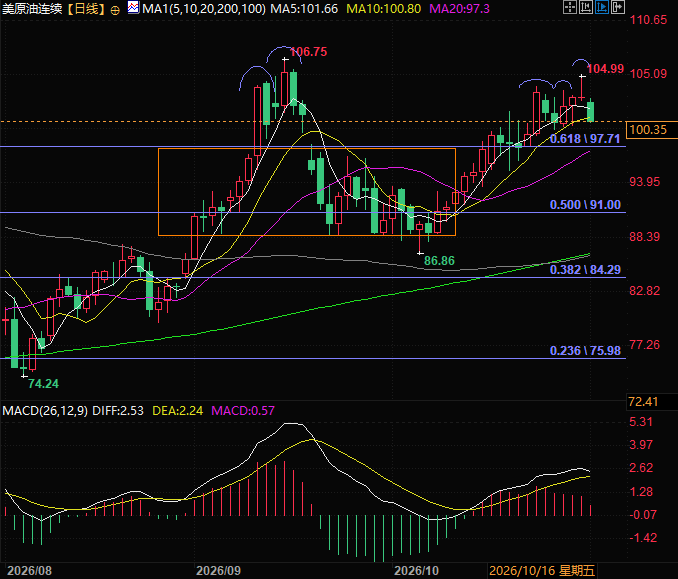 (WTI crude oil futures daily chart, source: EasyTrade) At 16:27 Beijing time, WTI crude oil futures are currently trading at $100.33 per barrel.
Negotiations between the US, Iran, and Qatar have stalled, and the proposed two-day resumption of flights has yet to be finalized.
With Qatar mediating, the US and Iran have held three rounds of indirect communication, and Iran's Deputy Foreign Minister traveled to Doha to participate in the consultations. However, the two sides have been unable to reach an agreement on their core demands. Iran has compressed its previous seven-day plan for resuming navigation into a two-day proposal: the US would fulfill its commitments to ease sanctions on the first day, and Iran would reopen the Strait of Hormuz and resume oil shipping on the second day. However, this proposal is only from Iran; the US has not accepted the preconditions. Negotiations are stalled on key terms such as the lifting of sanctions and control of the Strait, making a formal agreement unlikely in the short term.The US is exerting strong external pressure, and there are serious doubts within the military about the outcome of the battle.
Driven by political considerations surrounding the midterm elections, the United States has continued to send strong signals to the world. Israeli Prime Minister Netanyahu has repeatedly called Trump, urging him to immediately resume military strikes against Iran after the November 3rd election. However, significant divisions have emerged within the White House: Trump has begun to question the overly optimistic pre-war assessments by senior military officials, noting that the war's duration and economic costs have far exceeded expectations. Defense Secretary Hergsays and Chairman of the Joint Chiefs of Staff Kaine are facing accountability pressures; the Pentagon is unable to accurately assess whether a new round of airstrikes can quickly achieve its strategic objectives; the offensive plan has been delayed in being formally issued; and the military operation remains in limbo, with the geopolitical risk premium refusing to fully subside.The United States has made numerous attempts to alleviate energy inflation, but global mediation has yielded limited results.
The continued rise in oil prices is pushing up domestic inflation in the United States, prompting the White House to urgently seek ways to cool down the energy market. On the one hand, the US is pushing for a partial humanitarian ceasefire between Russia and Ukraine in an attempt to ease global geopolitical tensions; on the other hand, it is planning to circumvent EU sanctions and transship Russian natural gas through intermediaries to alleviate global energy pressures caused by the European diesel shortage. Meanwhile, China has dispatched multiple special envoy teams to the Gulf, the Red Sea, and the Horn of Africa to comprehensively promote peace talks and de-escalate tensions in the Middle East. However, with the main conflict in the Middle East currently at a stalemate and the global energy supply gap difficult to fill, it will be difficult to completely suppress the upward trend in oil prices in the short term.Negotiations and power struggles on the Russia-Ukraine front have escalated simultaneously, further intensifying the conflict.
Although both Russia and Ukraine have signaled their willingness to negotiate, with Zelenskyy proposing a meeting with Putin in Turkey and Russia not rejecting the framework for trilateral talks, bargaining chips must be obtained through battlefield victories. Consequently, the confrontation on the front lines has intensified. Ukraine continues to attack Russian military facilities, including oil refineries, while Russia concentrates its firepower on energy infrastructure across Ukraine, causing widespread power and water outages in Kyiv and other cities. The humanitarian silence in Oreshki has expired, and the front lines have returned to a state of free-for-all. The ongoing conflict between Russia and Ukraine continues to disrupt shipping in the Black Sea, further exacerbating the global shortage of refined oil products.Major institutions have raised their oil price forecasts, indicating clear upward pressure on the oil market.
Amid escalating geopolitical risks and a significant overdraft of global inventories, investment banks have raised their crude oil price forecasts. Goldman Sachs raised its December Brent crude oil price forecast to $105 per barrel, a substantial increase from its previous prediction. The core logic is that the market is continuously pricing in the risk of a renewed escalation of conflict in the Middle East following the midterm elections, leading to weaker crude oil supply and a prolonged period of high geopolitical premiums. An executive at Abu Dhabi National Oil Company stated that since the closure of the Strait of Hormuz, global crude oil inventories have been reduced by nearly 1 billion barrels, severely compressing the global energy buffer, with diesel inventories falling to a 35-year low. Domestic institutions similarly believe that, supported by low inventories and geopolitical disturbances, crude oil prices are more likely to rise than fall, with geopolitical conflicts continuing to provide strong support for oil prices.Summary and Technical Analysis:
The current crude oil market is dominated by multiple geopolitical conflicts: During the US-Iran negotiations, the US is caught in a dilemma, making it difficult to quickly resolve concerns about the US-Iran issue and driving up crude oil premiums. The ongoing conflict between Russia and Ukraine, involving territorial disputes, also cannot be resolved quickly, putting continued pressure on energy transportation in the Black Sea. Finally, global crude oil inventories have reached low levels, and much of this inventory is actually unusable, as it would physically impact storage facilities, leading to a severe shortage of energy supply buffers. Therefore, the current positive factors easing oil prices are concentrated but may not last long. Readers need to prepare for scenarios where positive factors fail to lead to price increases and maintain keen observation to grasp the pulse of oil prices, as oil prices currently determine the trends of various global asset classes. Technically, the WTI oil price daily chart shows a short-term triple top pattern. If 99 is broken, the triple top will be confirmed, with support around 97.97. (WTI crude oil futures daily chart, source: EasyTrade) At 16:27 Beijing time, WTI crude oil futures are currently trading at $100.33 per barrel.
- Risk Warning and Disclaimer
- The market involves risk, and trading may not be suitable for all investors. This article is for reference only and does not constitute personal investment advice, nor does it take into account certain users’ specific investment objectives, financial situation, or other needs. Any investment decisions made based on this information are at your own risk.