Gold Trading Alert: Oil Price Crash Provides a Lifeline, Gold Prices Rebound Nearly 2%! The Midterm Elections: The Real Test?
2026-11-03 07:52:25
After a sudden and dramatic downturn, the gold market finally found some respite. On Monday (November 2nd), gold prices rebounded strongly by nearly 2% from the one-year low hit in the previous trading day, with spot gold closing at $3946.47 per ounce, having reached a high of $3970.23 during the session. This rebound was particularly noteworthy given that gold prices had plunged 3.6% last Friday, hitting their lowest level since October 2025. December-delivery US gold futures also rose 1.8%, settling at $3969.60 per ounce. On the surface, this appears to be a simple technical correction, but a deeper analysis of the underlying drivers reveals that the plunge in oil prices, a weakening dollar, subtle changes in expectations for a Fed rate hike, and the upcoming US midterm elections have all woven a complex market network, with gold at its center. On Tuesday (November 3rd) in early Asian trading, spot gold traded in a narrow range, currently hovering around $3945 per ounce. 
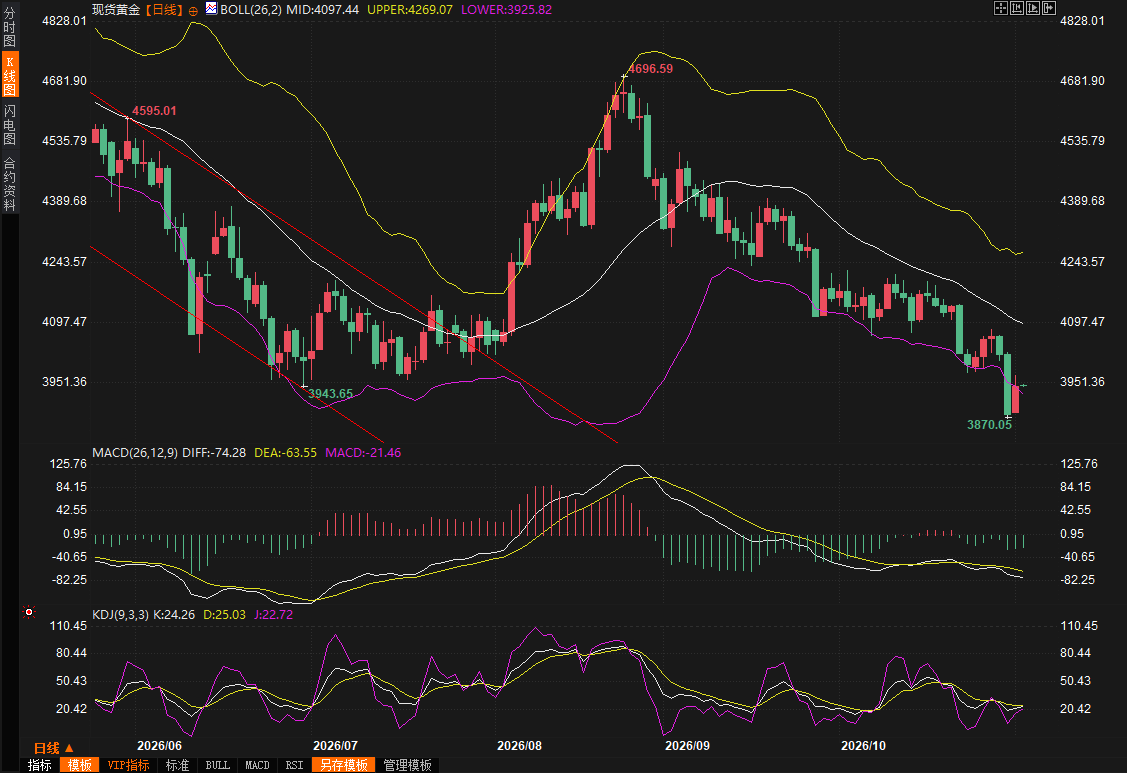 (Spot gold daily chart, source: FX678) At 07:49 Beijing time, spot gold is currently trading at $3947.53 per ounce.
Oil price plunge: Inflation concerns ease, gold prices find key support
The primary driver of this gold price rebound came from the sharp fluctuations in the oil market. On Monday, oil prices plunged more than 7%, with Brent crude futures closing down $8.66, or 7.63%, at $104.77 per barrel; U.S. crude futures also fell $7.66, or 7.36%, to $96.46 per barrel. Earlier in the session, Brent crude had fallen as low as $103.28 and U.S. crude as low as $95.15, reflecting the extent of market panic. The trigger for the sharp drop in oil prices was the third consecutive day of talks between Iranian and Qatari officials aimed at ending the U.S.-Israeli war against Iran. Iranian President Peskhchiyan stated that Supreme Leader Mojtaba Khamenei had granted the government "certain powers" to conduct peace negotiations, and said that Tehran "will strive to resolve the issue through dialogue." U.S. President Trump also stated that Iran hopes to reach an agreement to end the war, and that such an agreement is "possible." Qatari mediators traveled to Tehran Monday evening to meet with Iranian Foreign Minister Araqchi on a potential US-Iran deal. Raymond James analyst Pavel Molchanov noted that signs of progress in US-Iran negotiations were the main reason for the decline in oil prices, but he also cautiously cautioned that skepticism is justified given the market's repeated disappointments over the past few months. Regardless, the drop in oil prices directly eased market concerns about inflation, which is exactly what gold bulls wanted. Peter Grant, Vice President and Senior Metals Strategist at Zaner Metals, stated bluntly: "Weaker oil prices have provided some support in easing inflation concerns." The cooling of inflation expectations reduces the short-term urgency of gold as an inflation hedge, but also alleviates the pressure on the Federal Reserve to aggressively raise interest rates, thus providing another layer of support for gold prices.Slight Adjustment in Fed Rate Hike Expectations and a Weaker Dollar: Another Favorable Factor for Gold Prices
The ripple effects of falling oil prices quickly spread to the foreign exchange market. The US dollar weakened on Monday, with the dollar index falling 0.15% to 101.80, after earlier dropping to 101.42, its lowest level since September 30. The dollar's weakness was due to two factors: the drag from the plunge in oil prices and the decline in US Treasury yields. For gold, which is priced in US dollars, a weaker dollar means lower costs of holding gold, thus stimulating some buying. Meanwhile, expectations for a Federal Reserve rate hike are also subtly shifting. According to the CME Group's FedWatch tool, traders believe there is a 75% probability of a US rate hike in December, down from 80% a week ago. Although this probability remains high, the marginal decline is enough to offer some comfort to gold bulls. Peter Grant also noted that the market still expects the Fed to raise rates in December, although this probability has slightly decreased in the past few trading days, and the dollar has provided some support for gold prices. It should be noted that data released by the Institute for Supply Management (ISM) shows that the manufacturing purchasing managers' index (PMI) rose to 55.5 in October from 54.5 in September, with input prices remaining high. This indicates that the US economy still possesses a certain degree of resilience, and the pressure for the Federal Reserve to raise interest rates has not completely dissipated. However, in the short term, the slight decrease in expectations of interest rate hikes and the weakening of the dollar have indeed provided additional impetus for the rebound in gold prices.Technical Correction and Safe-Haven Fund Flows: A Natural Rebound After Oversold Conditions
From a technical analysis perspective, the recent rebound in gold prices has its own inherent logic. The 14-day Relative Strength Index (RSI) for gold rose to around 37 on Monday from below 30 on Friday. This indicator measures whether an asset is overbought or oversold; a level below 30 is generally considered oversold. After gold prices plunged 3.6% on Friday, the RSI fell below 30, indicating excessive selling in the short term. Monday's RSI rebound to around 37 suggests that gold has moved out of the technically oversold zone, with some short sellers taking profits, leading to a surge in technical buying. Furthermore, the sell-off in technology and AI-related stocks on Friday affected other markets, prompting margin calls that led investors to sell safe-haven assets like gold to raise cash. This forced selling pressured gold prices in the short term but also laid the groundwork for the subsequent rebound. As margin call pressure eased, some funds flowed back into the gold market, driving Monday's rebound. Marc Chandler, chief market strategist at Bannockburn Capital Markets, commented, “Going into the weekend, everything looked terrible. Stocks were selling off, and December U.S. crude oil rose to a new high for the contract. But after the weekend, everyone breathed a collective sigh of relief.” This sense of relief was vividly reflected in the gold market.Midterm Election Outlook: Dual Variables of Fiscal Policy and Geopolitics
However, the sustainability of the gold price rebound largely depends on the upcoming US midterm elections this week. Market focus is currently shifting to the November 3rd vote to assess its potential impact on fiscal policy, geopolitics, and overall market sentiment. US voters will head to the polls on Tuesday to decide whether the Democrats can wrest control of Congress from President Trump's Republican Party. The economy and high prices are key issues for voters. It is widely predicted that the Democrats will win the House of Representatives, but gaining control of the Senate may be more difficult. For gold, the midterm elections will have two main impact paths. First, if the Democrats win the House, it could lead to a fiscal policy deadlock, cooling expectations for large-scale fiscal stimulus, which could put some pressure on gold prices. On the other hand, a political deadlock could also create market uncertainty, thereby boosting safe-haven demand for gold. Second, the election results could affect the geopolitical landscape, especially the direction of US policy toward Iran. Peace negotiations between Iran and Qatar are currently underway. If US foreign policy shifts after the election, the evolution of the Middle East situation will directly affect oil and gold prices. In addition, the market will see a large amount of labor market data this week, culminating in the highly anticipated US government's October non-farm payrolls report on Friday. Several central banks will also announce their monetary policy decisions, including the central banks of the UK, Australia, Norway, and Sweden. These events, coupled with the midterm elections, constitute a highly concentrated week of risk events, and gold volatility is likely to remain at a high level.In summary: A short-term rebound has occurred, but the long-term trend remains to be seen.
In summary, Monday's rebound in gold prices was the result of a confluence of factors. The plunge in oil prices eased inflation concerns, a weaker dollar lowered the cost of holding gold, a slight decrease in expectations of a Fed rate hike reduced pressure, and technical oversold correction provided the impetus for a natural rebound. However, this does not mean that gold has completely escaped its predicament. The probability of a Fed rate hike in December remains as high as 75%, US manufacturing data remains resilient, and input prices are high; all these factors limit the upside potential for gold prices. More importantly, the outcome of the US midterm elections and the dense schedule of economic data and central bank decisions this week will provide new guidance for the next move in gold's direction. If the election results lead to a fiscal policy deadlock or increased geopolitical uncertainty, gold's safe-haven properties may become prominent again; conversely, if the election results are smooth and economic data is strong, gold prices may face new pressure. For investors, the current gold market is at a juncture where short-term rebounds and long-term uncertainties intertwine. Maintaining vigilance and closely monitoring the midterm elections and subsequent policy signals are crucial to seizing opportunities amidst volatility. (Spot gold daily chart, source: FX678) At 07:49 Beijing time, spot gold is currently trading at $3947.53 per ounce.- Risk Warning and Disclaimer
- The market involves risk, and trading may not be suitable for all investors. This article is for reference only and does not constitute personal investment advice, nor does it take into account certain users’ specific investment objectives, financial situation, or other needs. Any investment decisions made based on this information are at your own risk.