Crude Oil Trading Alert: As US-Iran negotiations continue, geopolitical premiums decline, leading to accelerated adjustments in US crude oil prices.
2026-11-03 09:48:25
US benchmark crude oil WTI rebounded to around $ 96.76 in early Asian trading on Tuesday, recovering after falling to a low of $94.30 in the previous session. Market research indicates that Iran stated that negotiations between the US and Iran aimed at ending the eight-month-long conflict are ongoing. After multiple rounds of mediation talks, the two sides have reached a revised agreement, but no major consensus has been reached yet. Iranian Foreign Minister Araqchi stated that communication through mediators has been frequent, and Iran has presented its conditions and proposals; the future direction depends on the rationality of US policy. On the US side, the president previously stated that there would be no attack on Iran before the US midterm elections, and the Iranian president also signaled a preference for resolving differences through dialogue.  The head of commodity strategy at TD Securities pointed out that a large part of the recent market rise stemmed from the risk premium brought about by expectations of escalating conflict. If negotiations achieve a substantial breakthrough, it will put significant downward pressure on crude oil prices. However, the institution also cautioned that as long as the conflict remains unresolved and tanker attacks and Red Sea-related incidents continue, diplomatic news alone will hardly be enough to completely eliminate the geopolitical risk premium in crude oil prices. Recent positive diplomatic news has already taken away some of the risk premium, and coupled with high market liquidity, the impact of geopolitical news on oil prices has been significantly amplified. However, the conditions for a complete elimination of the premium are not yet in place. In the short term, the market focus shifts to the American Petroleum Institute (API) crude oil inventory report to be released Tuesday evening. If the decline in crude oil inventories exceeds market expectations, it will confirm the resilience of demand, providing support for oil prices; conversely, if the increase in inventories is higher than estimated, it will reflect weak demand or oversupply, putting downward pressure on WTI prices. Currently, trade concerns have a limited impact; geopolitical news and US inventory data are the two core variables driving oil prices in the short term. From a daily chart perspective, WTI crude oil prices remain above the 100-day moving average, indicating that the medium-term bullish foundation remains intact. Prices are currently trading in the upper half of the recent Bollinger Bands, near the middle band. This rebound has not yet entered an accelerated upward phase. The 14-period RSI is around 48, suggesting a neutral overall momentum. The first resistance level is the middle Bollinger Band at 96.80 , with stronger resistance at the upper Bollinger Band at 104.95 . On the downside, immediate buying interest is concentrated within the current consolidation range, with deeper support at the lower Bollinger Band at 88.70 and the 100-day moving average at 85.85 . A significant pullback to these moving averages is expected to attract buying support, protecting the medium-term upward trend. On the 4-hour chart, the market has formed a corrective rebound structure from the low point in the short term. The short-term moving averages have turned upward, and the indicators are gradually recovering from the low levels and have not yet entered the overbought zone. In the short term, there is potential to continue testing the upper resistance. However, if there is new news of easing tensions in the negotiations, or if API inventory increases significantly, the rebound may be interrupted and fall back to test the lower support. The market needs fundamental signals to confirm the sustainability of the rebound.
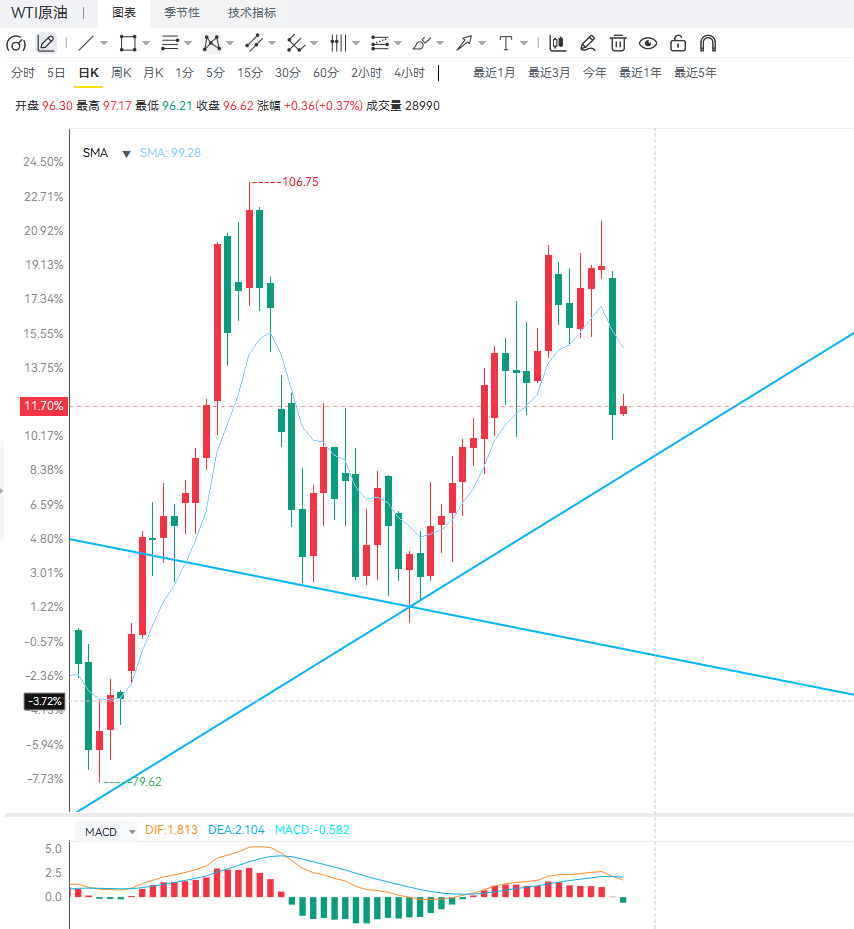 Editor's Summary: The core theme of this round of oil price fluctuations is the repricing of geopolitical risk premiums. Continued diplomatic maneuvering led to some premium retracement, becoming the main trigger for the previous oil price correction. However, with the conflict unresolved and shipping disruptions persisting, the risk premiums cannot be cleared all at once, and medium-term support remains. Short-term risks lie in substantial progress in negotiations leading to a rapid decline in the premium, or a significant accumulation of US inventories, suppressing oil prices again. Potential opportunities lie in a stalemate in negotiations and an increase in shipping attacks, which could re-erase geopolitical premiums and drive oil prices upward. In trading, it is not advisable to blindly chase the rally. Closely monitor API inventory data and real-time news from Middle East negotiations, wait for confirmation signals at key support and resistance levels, and be wary of sharp price fluctuations caused by rapid shifts in geopolitical news.
The head of commodity strategy at TD Securities pointed out that a large part of the recent market rise stemmed from the risk premium brought about by expectations of escalating conflict. If negotiations achieve a substantial breakthrough, it will put significant downward pressure on crude oil prices. However, the institution also cautioned that as long as the conflict remains unresolved and tanker attacks and Red Sea-related incidents continue, diplomatic news alone will hardly be enough to completely eliminate the geopolitical risk premium in crude oil prices. Recent positive diplomatic news has already taken away some of the risk premium, and coupled with high market liquidity, the impact of geopolitical news on oil prices has been significantly amplified. However, the conditions for a complete elimination of the premium are not yet in place. In the short term, the market focus shifts to the American Petroleum Institute (API) crude oil inventory report to be released Tuesday evening. If the decline in crude oil inventories exceeds market expectations, it will confirm the resilience of demand, providing support for oil prices; conversely, if the increase in inventories is higher than estimated, it will reflect weak demand or oversupply, putting downward pressure on WTI prices. Currently, trade concerns have a limited impact; geopolitical news and US inventory data are the two core variables driving oil prices in the short term. From a daily chart perspective, WTI crude oil prices remain above the 100-day moving average, indicating that the medium-term bullish foundation remains intact. Prices are currently trading in the upper half of the recent Bollinger Bands, near the middle band. This rebound has not yet entered an accelerated upward phase. The 14-period RSI is around 48, suggesting a neutral overall momentum. The first resistance level is the middle Bollinger Band at 96.80 , with stronger resistance at the upper Bollinger Band at 104.95 . On the downside, immediate buying interest is concentrated within the current consolidation range, with deeper support at the lower Bollinger Band at 88.70 and the 100-day moving average at 85.85 . A significant pullback to these moving averages is expected to attract buying support, protecting the medium-term upward trend. On the 4-hour chart, the market has formed a corrective rebound structure from the low point in the short term. The short-term moving averages have turned upward, and the indicators are gradually recovering from the low levels and have not yet entered the overbought zone. In the short term, there is potential to continue testing the upper resistance. However, if there is new news of easing tensions in the negotiations, or if API inventory increases significantly, the rebound may be interrupted and fall back to test the lower support. The market needs fundamental signals to confirm the sustainability of the rebound. Editor's Summary: The core theme of this round of oil price fluctuations is the repricing of geopolitical risk premiums. Continued diplomatic maneuvering led to some premium retracement, becoming the main trigger for the previous oil price correction. However, with the conflict unresolved and shipping disruptions persisting, the risk premiums cannot be cleared all at once, and medium-term support remains. Short-term risks lie in substantial progress in negotiations leading to a rapid decline in the premium, or a significant accumulation of US inventories, suppressing oil prices again. Potential opportunities lie in a stalemate in negotiations and an increase in shipping attacks, which could re-erase geopolitical premiums and drive oil prices upward. In trading, it is not advisable to blindly chase the rally. Closely monitor API inventory data and real-time news from Middle East negotiations, wait for confirmation signals at key support and resistance levels, and be wary of sharp price fluctuations caused by rapid shifts in geopolitical news.
- Risk Warning and Disclaimer
- The market involves risk, and trading may not be suitable for all investors. This article is for reference only and does not constitute personal investment advice, nor does it take into account certain users’ specific investment objectives, financial situation, or other needs. Any investment decisions made based on this information are at your own risk.