Falling oil prices eased inflation concerns, and spot gold rebounded after a sharp drop, awaiting a stress test.
2026-11-03 10:18:25
On Tuesday morning in Asian trading, spot gold (XAU/USD) rebounded to around $ 3950 , as declining oil prices eased inflation concerns, driving a recovery in precious metals from previous lows. Market participants will closely watch for policy narrative shifts following the US midterm elections. Iran stated on Monday that negotiations between the US and Iran aimed at ending the eight-month-long conflict are ongoing. Following multiple rounds of consultations between Iranian officials and Qatari mediators, a revised proposal has been produced, but no key breakthrough has been achieved. Iranian Foreign Ministry spokesman Bagheei stated that the ceasefire plan submitted by Iran in September remains the core of the negotiations, and also confirmed Foreign Minister Araghchi's statement that the proposal may be streamlined and adjusted.  Peter Grant, Vice President and Senior Metals Strategist at Zaner Metals, pointed out that weaker oil prices have alleviated market concerns about inflation to some extent. However, the market is still pricing in a possible Fed rate hike in December, although the probability of such a hike has slightly declined in the past few trading days. The upcoming US midterm elections may shift the market narrative back to issues related to inflation and fiscal deficits, which could be beneficial for safe-haven assets like gold in the short term. CME data shows that the market is currently pricing in a Fed rate hike probability of nearly 73% in December, compared to about 80% a week ago. This marginal cooling of rate hike expectations creates conditions for a gold price rebound. HSBC analysts stated that a relatively stable US dollar can mitigate the downside risk for gold prices, which is supported by multiple factors including diversified central bank gold purchases, geopolitical uncertainties, and fiscal uncertainty. However, the institutions also cautioned that oil prices will fluctuate wildly with geopolitical news, and uncertainty in the energy sector will continue to spread outwards. In emerging markets, some African economies benefited from bullish expectations for precious metals, but geopolitical uncertainties continue to drag down the region's performance. Asian emerging markets have shown resilience thanks to the global AI supply chain, but institutions are becoming more cautious in their asset selection. From an industry perspective, some sectors are undervalued, and large companies are showing strong cash flow and dividend performance, providing fundamental support. However, regional conflicts are likely to continue until the end of the year, and infrastructure damage will hinder a rapid economic recovery. Geopolitical risks will continue to weigh on the fundamentals. Trade concerns are not the core driver at present; interest rate expectations and geopolitical events are dominating short-term gold price fluctuations. Looking at the daily chart, the overall downward pressure on spot gold has not reversed. Prices are trading below the 20-period Bollinger Band and the 100-day moving average, with the market generally suppressed by the upper moving averages. Prices are consolidating near recent lows. The 14-period Relative Strength Index (RSI) is at 36.88 , just out of oversold territory, indicating weakening downward momentum, but not completely exhausted. Before regaining the upper moving averages, there is still room for further weakening. Initial resistance is at the Bollinger Band middle line at 4090 , the 100-day moving average at 4210 , and the upper Bollinger Band at 4255 , forming a strong supply zone. If the rebound continues, these levels will face strong selling pressure. The nearest support level is the lower Bollinger Band at 3920. If this support is broken, gold prices will open up new downside potential. If prices hold above 3920, gold will remain within a bearish consolidation range under the pressure of moving averages. On the 4-hour chart, a short-term rebound has occurred from the lows, with prices testing higher levels, but still below major moving averages. Indicators have rebounded from oversold territory but have not yet entered overbought territory. The rebound is more of a technical correction. Only a firm hold above the 4090 resistance level can improve the short-term weak structure. Conversely, if the rebound falters and prices fall back, the key support level of 3920 will be tested again.
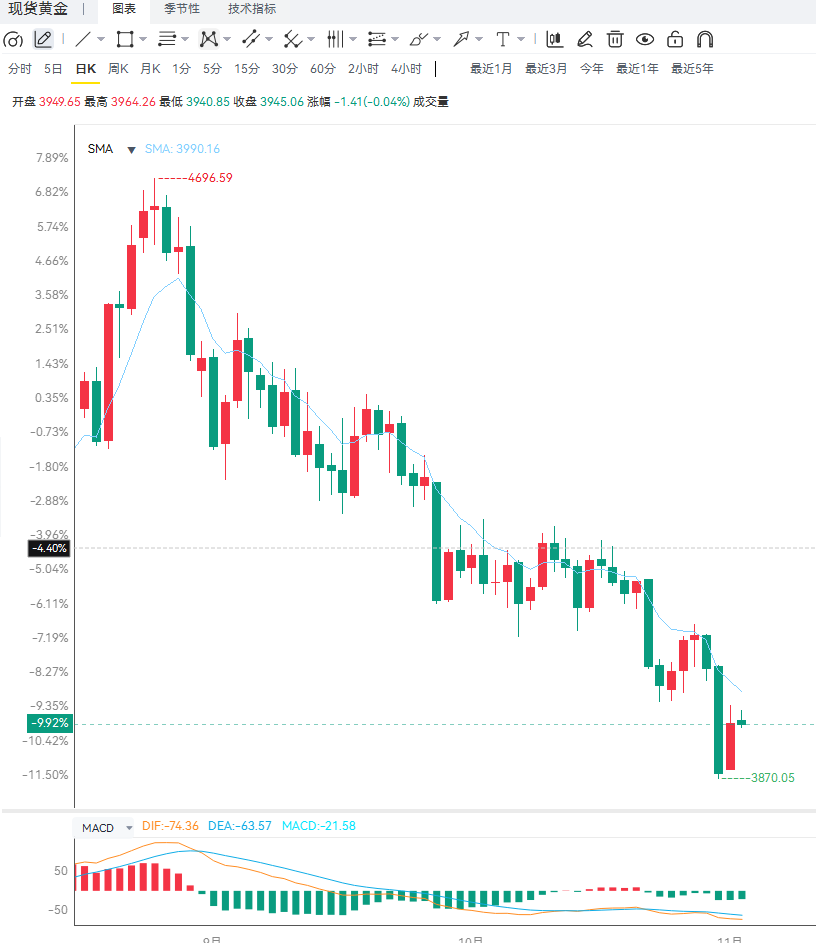 Editor's Summary: Gold is currently in a phase of tug-of-war between bulls and bears. The decline in oil prices has eased inflation expectations, slightly reduced the probability of a Fed rate hike in December, and coupled with potential safe-haven demand following the midterm elections, have jointly driven a rebound in gold prices from their lows. However, medium-term prices remain suppressed by the 100-day moving average, and the overall bearish sentiment has not fundamentally changed. The long-term support logic of central bank gold purchases has not disappeared, but short-term market movements are highly dependent on the results of the US midterm elections, Fed policy expectations, and developments in the Middle East. Short-term risks lie in a renewed strengthening of the US dollar and a resurgence of rate hike expectations, which could suppress gold prices and cause them to break below key support levels again. Potential opportunities lie in escalating geopolitical conflicts or a deterioration in the US fiscal and inflation narratives, activating safe-haven buying in gold. It is not advisable to blindly expect a bullish reversal; instead, one should wait for a valid breakout signal from key resistance or support levels, and be particularly wary of the risk of significant asset price volatility before and after the midterm elections.
Peter Grant, Vice President and Senior Metals Strategist at Zaner Metals, pointed out that weaker oil prices have alleviated market concerns about inflation to some extent. However, the market is still pricing in a possible Fed rate hike in December, although the probability of such a hike has slightly declined in the past few trading days. The upcoming US midterm elections may shift the market narrative back to issues related to inflation and fiscal deficits, which could be beneficial for safe-haven assets like gold in the short term. CME data shows that the market is currently pricing in a Fed rate hike probability of nearly 73% in December, compared to about 80% a week ago. This marginal cooling of rate hike expectations creates conditions for a gold price rebound. HSBC analysts stated that a relatively stable US dollar can mitigate the downside risk for gold prices, which is supported by multiple factors including diversified central bank gold purchases, geopolitical uncertainties, and fiscal uncertainty. However, the institutions also cautioned that oil prices will fluctuate wildly with geopolitical news, and uncertainty in the energy sector will continue to spread outwards. In emerging markets, some African economies benefited from bullish expectations for precious metals, but geopolitical uncertainties continue to drag down the region's performance. Asian emerging markets have shown resilience thanks to the global AI supply chain, but institutions are becoming more cautious in their asset selection. From an industry perspective, some sectors are undervalued, and large companies are showing strong cash flow and dividend performance, providing fundamental support. However, regional conflicts are likely to continue until the end of the year, and infrastructure damage will hinder a rapid economic recovery. Geopolitical risks will continue to weigh on the fundamentals. Trade concerns are not the core driver at present; interest rate expectations and geopolitical events are dominating short-term gold price fluctuations. Looking at the daily chart, the overall downward pressure on spot gold has not reversed. Prices are trading below the 20-period Bollinger Band and the 100-day moving average, with the market generally suppressed by the upper moving averages. Prices are consolidating near recent lows. The 14-period Relative Strength Index (RSI) is at 36.88 , just out of oversold territory, indicating weakening downward momentum, but not completely exhausted. Before regaining the upper moving averages, there is still room for further weakening. Initial resistance is at the Bollinger Band middle line at 4090 , the 100-day moving average at 4210 , and the upper Bollinger Band at 4255 , forming a strong supply zone. If the rebound continues, these levels will face strong selling pressure. The nearest support level is the lower Bollinger Band at 3920. If this support is broken, gold prices will open up new downside potential. If prices hold above 3920, gold will remain within a bearish consolidation range under the pressure of moving averages. On the 4-hour chart, a short-term rebound has occurred from the lows, with prices testing higher levels, but still below major moving averages. Indicators have rebounded from oversold territory but have not yet entered overbought territory. The rebound is more of a technical correction. Only a firm hold above the 4090 resistance level can improve the short-term weak structure. Conversely, if the rebound falters and prices fall back, the key support level of 3920 will be tested again. Editor's Summary: Gold is currently in a phase of tug-of-war between bulls and bears. The decline in oil prices has eased inflation expectations, slightly reduced the probability of a Fed rate hike in December, and coupled with potential safe-haven demand following the midterm elections, have jointly driven a rebound in gold prices from their lows. However, medium-term prices remain suppressed by the 100-day moving average, and the overall bearish sentiment has not fundamentally changed. The long-term support logic of central bank gold purchases has not disappeared, but short-term market movements are highly dependent on the results of the US midterm elections, Fed policy expectations, and developments in the Middle East. Short-term risks lie in a renewed strengthening of the US dollar and a resurgence of rate hike expectations, which could suppress gold prices and cause them to break below key support levels again. Potential opportunities lie in escalating geopolitical conflicts or a deterioration in the US fiscal and inflation narratives, activating safe-haven buying in gold. It is not advisable to blindly expect a bullish reversal; instead, one should wait for a valid breakout signal from key resistance or support levels, and be particularly wary of the risk of significant asset price volatility before and after the midterm elections.
- Risk Warning and Disclaimer
- The market involves risk, and trading may not be suitable for all investors. This article is for reference only and does not constitute personal investment advice, nor does it take into account certain users’ specific investment objectives, financial situation, or other needs. Any investment decisions made based on this information are at your own risk.