A chart shows that the Baltic Dry Index has fallen to a more than two-week low, with weaker freight rates across all vessel types putting downward pressure on prices.
2026-11-03 22:38:25
Latest data shows that the Baltic Dry Index (BDI) closed at 2590 points on November 3, 2026, a new low since October 19, 2026, down 2.19% month-on-month, marking the second consecutive day of decline (including zero growth). Looking at the short-term charts, the BDI has seen positive growth 6 times, negative growth 5 times, and zero growth in the last 11 BDI data points. Specifically, the Panamax Freight Index (BPI) closed at 1866 points, down 0.43% from the previous value; the Capesize Freight Index (BCI) closed at 3821 points, down 3.58%; and the Supramax Freight Index (BSI) closed at 1846 points, down 0.54%. For detailed charts of the Baltic Dry Index and its three main sub-indices, including the latest 720-day and 10-year trends, please refer to the charts provided by FX678. 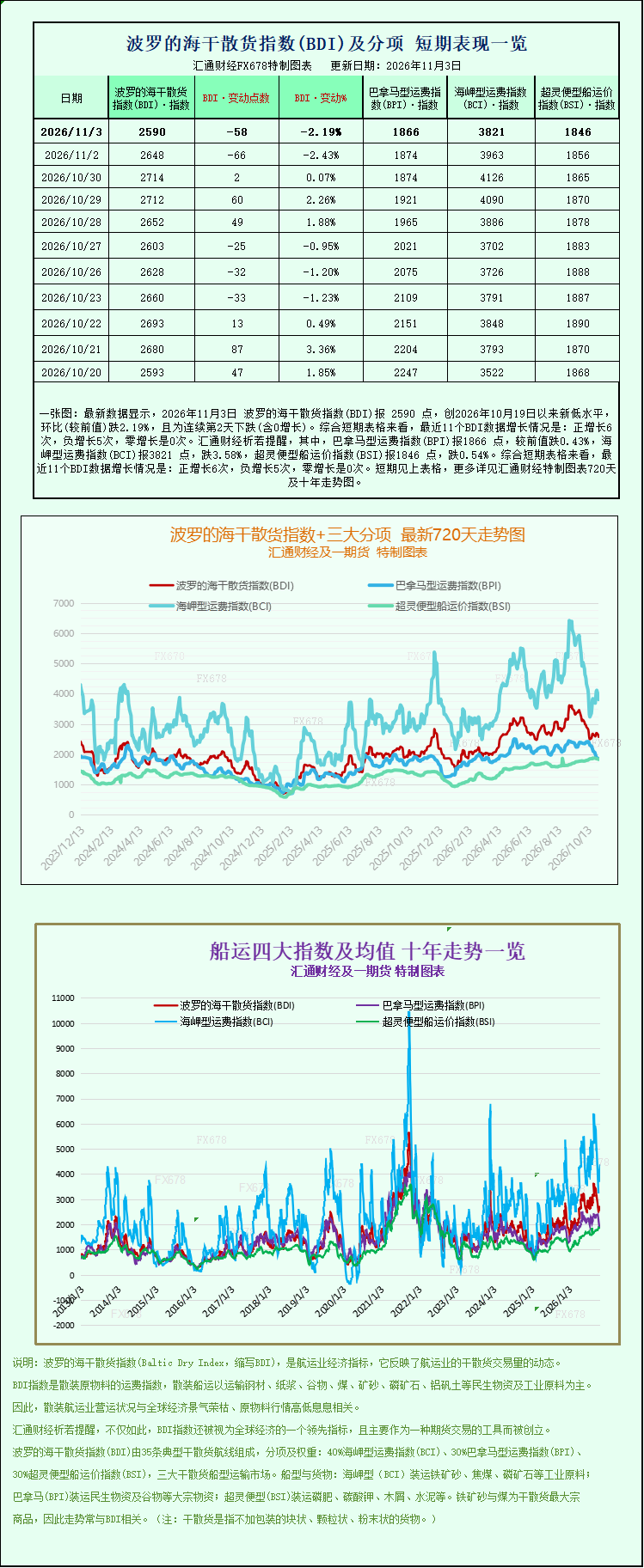 The Baltic Dry Index (BDI) fell to its lowest level in over two weeks on Tuesday, mainly due to a general weakening of freight rates across all vessel types, putting overall market pressure on prices. The BDI is a key indicator of the global dry bulk shipping market, comprehensively reflecting the freight rate trends of vessels carrying bulk commodities such as iron ore, coal, and grains. As a "barometer" of the global shipping market, its fluctuations not only reflect the rise and fall of ship freight rates themselves but also reflect the overall health of global commodity trade—dry bulk shipping carries more than 40% of the world's ocean-bound bulk cargo, and its health is highly correlated with economic cycles, industrial production, and infrastructure investment. This decline in the index indicates that the shipping sector is becoming more cautious about short-term cargo volume prospects, and a wait-and-see attitude has increased. Looking at the market data, the main index tracking the three major dry bulk carrier types—Capesize, Panamax, and Supramax—fell 58 points, or 2.19%, to close at 2,590 points, the lowest closing level since October 19th. Combined with recent trends, the index has been declining for several consecutive days, indicating that dry bulk shipping demand is experiencing a period of cooling. By vessel type, the Capesize index saw the most significant drop, plunging 142 points, or 3.58%, to 3,821 points, a one-week low. Capesize vessels are the largest dry bulk carrier type, typically carrying approximately 150,000 tons of cargo per vessel, primarily handling the long-distance transport of bulk raw materials such as iron ore and coal. Their freight rates are highly sensitive to demand for iron ore shipping. Correspondingly, the average daily earnings also narrowed significantly, decreasing by $1,293 to $31,148. The weakening of Capesize freight rates is closely related to the fundamentals of the iron ore market. Iron ore prices fell again on Tuesday, dragged down by both supply and demand: on the one hand, major miners continued to increase shipments and supply, resulting in ample market supply; on the other hand, China, the world's largest iron ore consumer, remained weak in its demand for steel raw materials, with steel mills showing little willingness to replenish their inventories, significantly suppressing demand for iron ore and its shipping volume. The Panamax index continued its decline, falling for the 15th consecutive trading day, dropping slightly by 8 points, or 0.43%, to 1,866 points, a new low since April 13. Panamax vessels typically carry 60,000 to 70,000 tons of coal or grain, and their average daily earnings fell by $76 to $16,791. The continued decline in freight rates for this vessel type indicates that demand for grain and coal trade transportation also lacks strong support. Analysts believe that the prolonged weakness is also related to seasonal fluctuations in global grain trade—a slowdown in grain exports from North and South America and more conservative purchasing arrangements by major Asian importing countries have resulted in insufficient support for cargo volume in this segment. Regarding smaller vessels, the Supramax index fell 10 points, or 0.54%, to 1,846 points, hitting its lowest level since October 14th. Supramax and Handysize vessels mainly serve regional trade and small-volume bulk shipping; their weakening freight rates also reflect a decline in the activity of small and medium-sized cargoes, with lackluster cargo volume performance on Southeast Asian and coastal routes. Thus, freight rates for all three vessel types have weakened, demonstrating a widespread and consistent downward trend in the dry bulk market. In summary, this round of decline in the dry bulk market is essentially a transmission of weakening demand for upstream commodities to the shipping sector. The cooling of trade in core commodities such as iron ore and coal has directly lowered spot freight rates and shipowner profits for all vessel types, and has also exacerbated market disagreements regarding future cargo volume prospects. From a broader perspective, the market is currently in a phase where demand expectations are recovering while supply pressures persist: if China's policies to stabilize economic growth continue to take effect and infrastructure and real estate demand improve marginally, it may drive a recovery in demand for raw materials via sea freight; conversely, if end-user demand remains weak and volatile, freight rates may continue to fluctuate weakly. The industry's overall view on short-term freight rates is cautious, awaiting clearer signals from the demand side.
- Risk Warning and Disclaimer
- The market involves risk, and trading may not be suitable for all investors. This article is for reference only and does not constitute personal investment advice, nor does it take into account certain users’ specific investment objectives, financial situation, or other needs. Any investment decisions made based on this information are at your own risk.