Gold Trading Alert: A strong dollar and rising US Treasury yields continue to put pressure on gold prices; the midterm election results remain the biggest variable.
2026-11-04 07:54:25
Global gold markets saw wide fluctuations on Tuesday (November 3) before closing slightly lower. Spot gold fell more than 1% in Asian trading, hitting a low of $3895.26 per ounce, before briefly rebounding on support from falling oil prices that eased some inflation concerns. It reached a high of $3970.87 in European trading but ultimately failed to hold onto its gains, closing at $3930.52, down 0.4% from the previous trading day. Meanwhile, US gold futures for December delivery fell 0.7% to $3940.40. The core logic of the market is clear: the continued strengthening of the US dollar and the simultaneous rise in US Treasury yields have created a double pressure on gold prices, while investors are closely watching the results of the US midterm elections, trying to find clues about future fiscal policy directions. On Wednesday (November 4) in early Asian trading, spot gold fluctuated narrowly, currently trading around $3935 per ounce. 
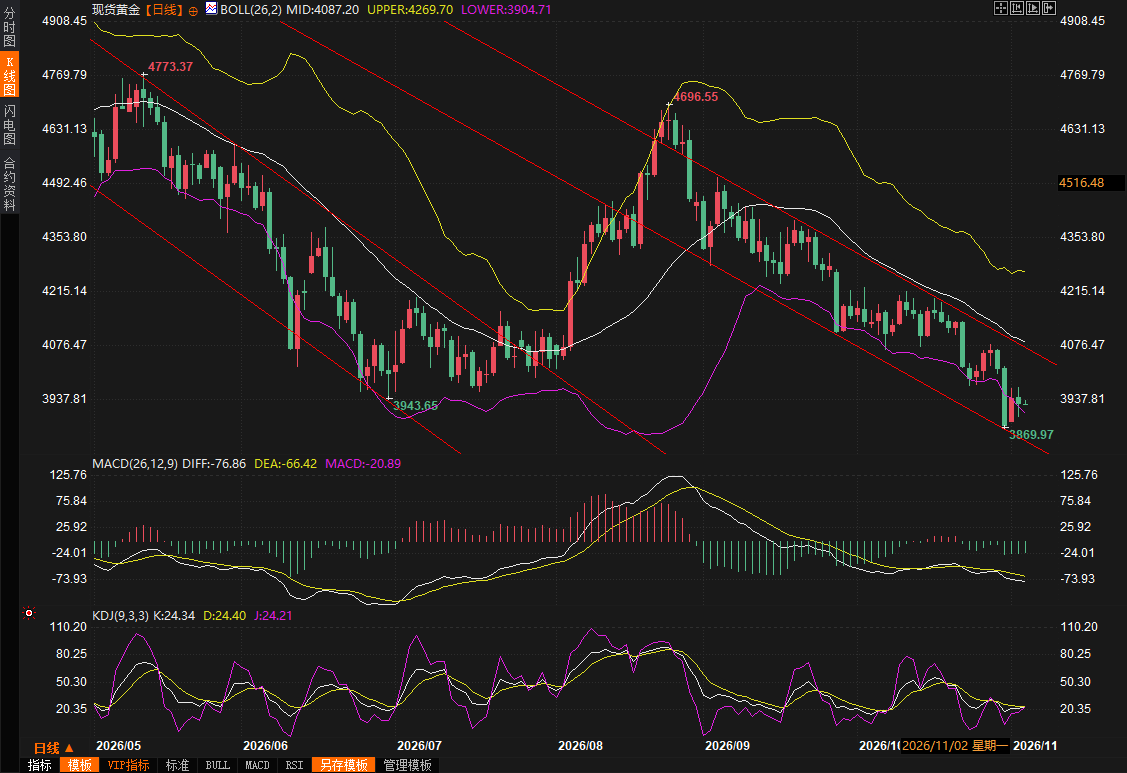 (Spot gold daily chart, source: FX678) At 07:51 Beijing time, spot gold is currently trading at $3934.24 per ounce.
The rise in both the US dollar and yields directly pressured gold prices.
As a non-interest-bearing asset, gold prices typically exhibit a negative correlation with the US dollar and US Treasury yields. This relationship was once again confirmed on Tuesday. The dollar index, which measures the dollar against a basket of currencies, rose slightly by 0.07% to 101.83. The dollar's strength was not without its ups and downs—it fell as much as 0.17% earlier in the day, but quickly rebounded after the US Department of Labor released its Job Openings and Labor Turnover Survey (JOLTS) data showing a significant increase of 333,000 job openings to 7.523 million in September. This figure far exceeded market expectations of 7.1 million, reinforcing the assessment that the labor market remains resilient, thereby pushing up the dollar's exchange rate. Meanwhile, US long-term Treasury yields climbed significantly. The 10-year Treasury yield rose 5.4 basis points to 4.948%; the 30-year yield rose 5.2 basis points to 5.321%; and the two-year yield also rose 3.1 basis points to 4.614%. Phillip Streible, chief market strategist at Blue Line Futures, explicitly pointed out that the continued strengthening of the US dollar, coupled with rising yields, is putting direct pressure on gold. Higher real yields increase the attractiveness of holding interest-bearing assets such as US Treasuries, thereby reducing gold's relative advantage as a safe-haven and store of value tool. It's worth noting that the decline in oil prices provided a temporary buffer for gold prices. Brent crude futures fell about 1%, closing at $103.60 per barrel, a near four-week low; US crude closed at $96.09. The decline in oil prices was mainly due to market optimism regarding the end of negotiations related to the conflict between Ukraine and Iran, which alleviated inflation concerns to some extent, giving gold some upward momentum during the session. However, this support ultimately failed to offset the suppressive effect of the US dollar and yields.The midterm elections have become the biggest focus of the market, and uncertainty surrounding fiscal policy has increased.
The market's attention is currently focused on the results of the US midterm elections. Polls and independent analysts generally expect the Democrats to regain control of the House of Representatives from the Republicans, while control of the Senate remains highly uncertain. Historical experience shows that the incumbent president's party almost always loses seats in Congress during midterm elections, and the pressure on the Republicans under Trump's leadership is particularly pronounced this time—the war between the US and Iran and the resulting rise in fuel prices have led to high voter dissatisfaction with the cost of living. The election results will directly influence the direction of US fiscal policy over the next two years. If a divided Congress emerges with each party controlling one house and the other the other, the ability of either side to advance a large-scale policy agenda will be limited, which will have a profound impact on US Treasury supply, debt ceiling negotiations, and the overall pace of fiscal expansion. Thomas Urano, co-chief investment officer at Sage Advisory, points out that only after the election dust settles can the market more clearly judge the direction of US fiscal policy, the debt ceiling, and the supply of public debt, all of which will directly affect the bond market and indirectly influence gold pricing. In the lead-up to the election, investors generally adopted a wait-and-see attitude, resulting in a decrease in market liquidity. Ed Al-Hussainy, a fixed-income portfolio manager at Columbia Threadneedle, stated that there's no need to invest heavily in the market before the outcome is clear, leading to significant yield fluctuations from any news. This cautious sentiment has also spilled over into the gold market, exacerbating price volatility. Geopolitics and Central Bank Gold Purchase Expectations: Support and Suppression Coexist. Geopolitical news is equally complex. A senior Iranian official stated that Iran and the United States are still far from reaching an agreement to end the conflict, and Qatar is intensifying mediation to prevent further escalation after the midterm elections. The United States carried out a limited "defensive" strike on Iran's Qeshm Island, while Trump reiterated that he would not rule out military action if necessary. Meanwhile, Russia confirmed that it will hold trilateral peace talks with Ukraine and the United States in Abu Dhabi on November 10-11. These intertwined signals bring both hope for peace negotiations and the risk of further escalation, keeping the safe-haven premiums for oil and gold in a state of dynamic adjustment. On the demand side, the World Gold Council lowered its forecast for gold investment growth this year from 400 tons to 200 metric tons, but at the same time raised its forecast for central bank gold purchases. The continued gold purchases by central banks remain an important source of medium- to long-term support for gold, especially given the unchanged trend of global reserve diversification.Summarize
In summary, Tuesday's decline in gold prices was a result of a stronger dollar, rising yields, and a temporary easing of market risk aversion. In the short term, the final outcome of the US midterm elections will be a key variable for gold price movements—if the election results exacerbate fiscal uncertainty or political friction, the dollar may come under pressure, thus providing room for a gold price rebound; conversely, if market confidence in economic resilience further strengthens, upward pressure on yields and the dollar may continue to suppress gold. In the medium to long term, central bank gold purchases, geopolitical risk premiums, and the evolution of real interest rates will still determine whether gold can regain a higher level. Investors need to closely monitor the aftermath of the elections, subsequent employment data this week, and progress in Middle East negotiations, looking for clear directional signals amidst the volatility. (Spot gold daily chart, source: FX678) At 07:51 Beijing time, spot gold is currently trading at $3934.24 per ounce.
- Risk Warning and Disclaimer
- The market involves risk, and trading may not be suitable for all investors. This article is for reference only and does not constitute personal investment advice, nor does it take into account certain users’ specific investment objectives, financial situation, or other needs. Any investment decisions made based on this information are at your own risk.