Why hasn't a US-Canada agreement been reached yet, given that the US has lowered its demands and made more concessions?
2026-11-04 08:00:26
On Wednesday (November 4) during Asian trading hours, the US dollar fluctuated slightly lower against the Canadian dollar, currently trading around 1.4000. Mark Carney's latest remarks have come into focus for investors. Canadian Prime Minister Mark Carney stated that trade negotiations with the United States will become more intensive. He reported progress in the negotiations while warning that key areas remain unresolved and an agreement has not yet been reached. Carney stated that some red lines in the negotiations have been removed, but others still need to be addressed. He described Washington's shift in position as a "lower demands and more concessions" from the US, while emphasizing that the two sides have not yet reached that point. He also downplayed the necessity of a formal round of negotiations, stating that Canadian trade negotiators do not always need to speak directly with the US Trade Representative's office because communication channels between the two governments are open. 
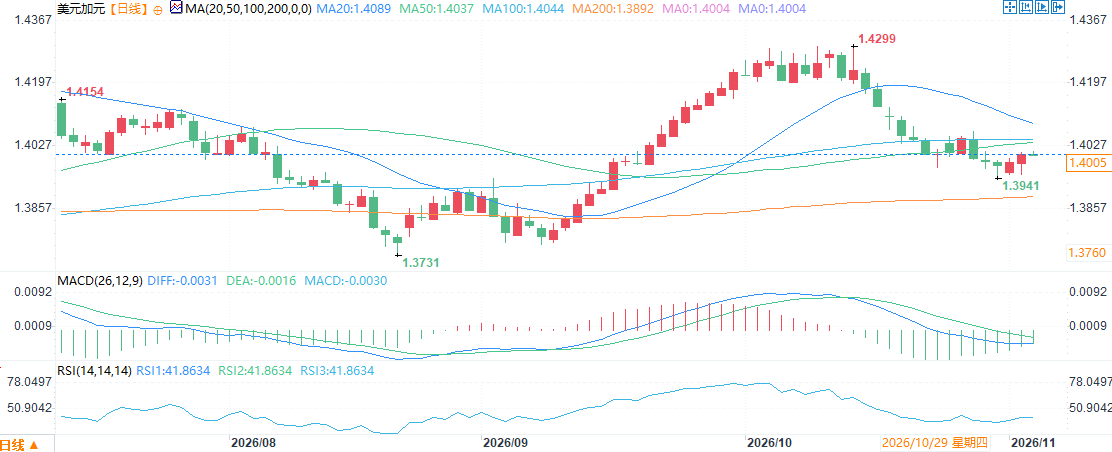 (USD/CAD daily chart, source: EasyForex) At 7:55 Beijing time, USD/CAD was trading at 1.4003/04.
Background of the negotiations: 50% tariffs and reciprocal countermeasures following the breakdown of negotiations in August.
These statements build on Carney's weekend update, when he said he had a good conversation with President Trump and that both teams would work on the framework of an agreement in the coming weeks. Trump said last week he expected a new agreement soon, but provided no details. The negotiations are an attempt to repair relations that deteriorated sharply in August when they broke down, prompting Trump to impose a 50% tariff on about C$20 billion worth of Canadian goods, equivalent to about 5.5% of Canadian exports. Ottawa responded with retaliatory tariffs covering U.S. steel, dairy products, appliances, agricultural equipment, pulp and paper, and electronics.A shift in tone: more optimistic but without commitments; the most difficult issues remain on the table.
Carney's tone was noticeably more optimistic than at any point since negotiations broke down in August, but his wording deliberately avoided suggesting an agreement was imminent. He repeatedly mentioned unresolved areas and remaining red lines, indicating that the most difficult issues remained on the table, and he did not provide a timetable for a final agreement. The coexistence of phrases like "some red lines removed" and "important areas unresolved" suggests that progress is real, but a signed agreement is still some way off.Market Implications: Tariff easing is beneficial to the Canadian dollar, but the lack of a timetable limits the premium.
Carney's comments provided mild support for the Canadian dollar, as any easing of the 50% tariffs would alleviate the burden on Canadian exporters and growth prospects. However, the lack of a timetable limits the extent to which a trade agreement premium can accumulate, making the USD/CAD pair more likely to remain sensitive to the midterm election results and oil prices in the short term. Canada is the largest foreign supplier of crude oil to the United States, and a broader solution would also reduce a source of uncertainty regarding North American energy flows. If negotiations are successful, sectors hit by Canadian retaliatory tariffs—including U.S. steel, dairy, and agricultural equipment exporters—would benefit the most.Progress in negotiations is providing support for the Canadian dollar, but its direction remains primarily driven by the election and oil prices.
There is a mild but limited transmission chain between Carney's negotiating statements and the USD/CAD exchange rate. For the Canadian dollar, the most direct benefit comes from the expectation of tariff easing—the 50% tariff imposed by the US in August on approximately CAD 20 billion of Canadian goods, equivalent to about 5.5% of Canadian exports, would, if this burden were eased, substantially improve the prospects for Canadian exporters and growth, thus restoring the fundamentals of the Canadian dollar. Carney's statement of "lower demands and more concessions" is the source of this expectation, forming downside support for the Canadian dollar. However, the strength of this support is limited by two factors. First, the lack of a timetable. With no agreement reached and the most difficult issues still on the table, it means that the trade agreement premium is unlikely to accumulate fully in the short term, limiting the Canadian dollar's appreciation potential to "improved expectations" rather than "substantial implementation." Second, the more important drivers lie elsewhere. The short-term direction of the USD/CAD exchange rate is still dominated by the US midterm election results and oil prices: the election results affect the safe-haven demand for the US dollar and policy expectations, while oil prices directly affect the Canadian dollar through Canada's energy export revenue. Progress in trade negotiations is more of a marginal variable superimposed on these two main themes than a dominant force. Therefore, Carney's statement has a "supporting rather than driving" effect on the USD/CAD exchange rate—it reduces the downside risk for the Canadian dollar, but is insufficient to independently push the exchange rate out of its current range. Until an agreement is finalized or a timetable is clarified, the USD/CAD exchange rate will remain more sensitive to elections and changes in oil prices.Political Dimension: Midterm Elections and Key States – Shaping the White House's Compromise Space
The timing adds a political dimension. The US midterm elections are being held on Tuesday, and trade tensions with Canada are a real issue in states like Michigan and Maine. The election results could shape the White House's room for compromise in the coming weeks—if the political landscape changes, the US's willingness and extent of concessions in negotiations could also adjust, adding a second layer of uncertainty to the pace of trade negotiations beyond the election itself.in conclusion
Carney stated that US-Canada trade negotiations will become more intensive, with some red lines removed and the US making more concessions and lowering its demands. However, key areas remain unresolved, an agreement has not yet been reached, and no timetable has been provided. This tone is more optimistic than at any point since negotiations broke down in August, but the statement that "the most difficult issues are still on the table" indicates that an agreement is still far off. For the Canadian dollar, a reduction in the 50% tariffs would ease the burden on exporters and growth prospects, providing mild support; however, the lack of a timetable limits the accumulation of a trade agreement premium, and the USD/CAD exchange rate remains more sensitive to the midterm election results and oil prices in the short term. The election results could also indirectly affect the pace of negotiations by shaping the White House's room for compromise. If North American energy flows experience less uncertainty due to a broader solution, it would be an additional benefit for Canada, the largest foreign supplier of crude oil to the US. (USD/CAD daily chart, source: EasyForex) At 7:55 Beijing time, USD/CAD was trading at 1.4003/04.
- Risk Warning and Disclaimer
- The market involves risk, and trading may not be suitable for all investors. This article is for reference only and does not constitute personal investment advice, nor does it take into account certain users’ specific investment objectives, financial situation, or other needs. Any investment decisions made based on this information are at your own risk.