Trump's restraint versus Netanyahu's eagerness: Oil price variables amid US-Israel differences
2026-11-04 08:26:27
On Wednesday (November 4th) during Asian trading hours, US crude oil futures opened higher and fluctuated, currently trading around $96.50 per barrel. Trump's latest remarks have provided new pricing clues to the market. According to media reports, US President Trump stated that the US has no immediate plans to strike Iran. His signal is that even though the Israeli prime minister hinted at possible military action later this week, he remains comfortable with the current standoff. Trump stated that Washington seems to be getting everything it wants from the current situation. When asked about Israeli Prime Minister Netanyahu's strong hints about a possible attack within days, Trump responded that the US is fully prepared to act if necessary, but there may be no reason to do so. 
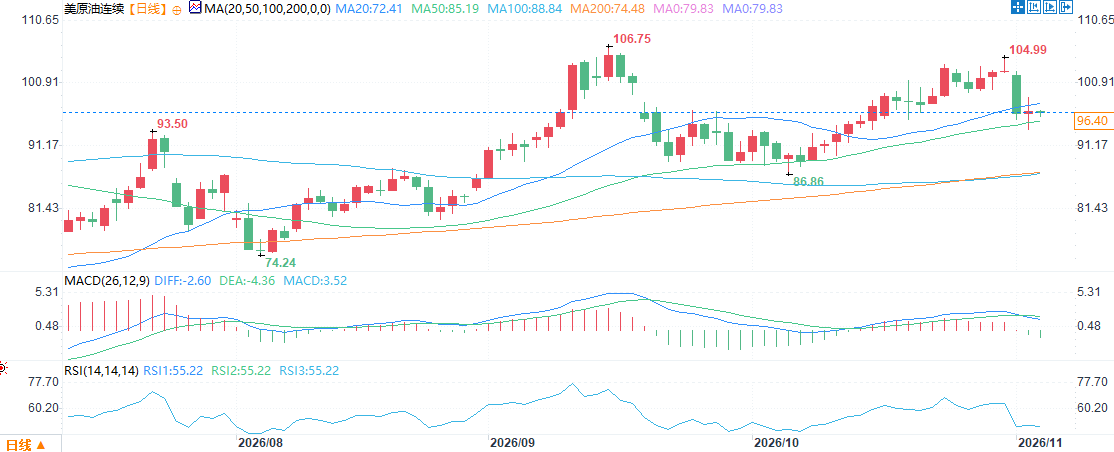 (US crude oil futures daily chart, source: FX678) At 8:22 Beijing time, US crude oil futures were trading at $96.49 per barrel.
US-Israel Differences: Netanyahu Pressures, Trump Makes No Commitments
Trump's public statements clearly outline the policy gap between Washington and Tel Aviv. According to the Associated Press, citing multiple officials, Israeli Prime Minister Netanyahu has been pressuring Trump to launch a new round of military strikes against Iran immediately after Tuesday's midterm elections. These officials privately pointed out that returning to a posture of full-scale conflict would help Netanyahu re-establish his right-wing allies and consolidate his ruling coalition after losing his parliamentary majority. In his weekend call with Netanyahu, Trump did not make any explicit commitment to strikes, but instead emphasized that the US was prepared, but there was "probably no reason" to act at present. The essence of this divergence lies in the misalignment of strategic pace and political objectives. For Trump, the current situation has given Washington the leverage it wants—to force Iran to make concessions on the Strait of Hormuz and port blockades through a combination of limited military response and diplomatic pressure, while avoiding the political and economic costs of a large-scale war. For Netanyahu, an escalation of external conflict could become a lifeline for domestic politics. The market must therefore price in both possibilities: the US will not escalate proactively, but Israel may still choose unilateral action. If Tel Aviv launches an attack without full US backing, the intensity of regional conflict will escalate rapidly, and the risk premium for oil supply will be pushed up again. Trump's statement that he "feels reassured" is itself a signal to the market that "the probability of a full-scale escalation led by the US has decreased," but it has not eliminated the upward variable of Israeli unilateralism.Military activity continues: Limited strikes and reports of explosions in the Strait on Monday.
Trump's de-escalation rhetoric does not mean the US military has withdrawn from the battlefield. According to the Associated Press, the US military conducted a limited strike on Monday against Iranian personnel who launched missiles at US forces in the Strait of Hormuz. Simultaneously, Iranian state media quickly reported explosions on islands near the Strait of Hormuz and around Bandar Abbas, indicating the conflict continues at a low intensity but persistent pace. The US has not yet officially announced details of the operation; this "strike first, then quietly resolve" approach precisely reflects the current US strategy: to respond precisely and limitedly to direct provocations while avoiding a public escalation into a full-blown war narrative. This stance of "not proactively escalating, but responding to provocations" is clearly distanced from a full-blown conflict. On the one hand, it sends a message to Iran that "attacking US forces or shipping targets will have consequences," and on the other hand, it shows the market that Washington is deliberately controlling the scope of the conflict and unwilling to let the situation spiral out of control. For the oil market, Monday's limited strikes and reports of explosions in the Strait mean that supply risks have not disappeared despite Trump's verbal de-escalation. As the world's most important oil shipping chokepoint, any missile launch, explosion, or shipping disruption in the Strait of Hormuz is quickly factored into the risk premium by traders. The US's choice not to publicly announce its actions reflects its desire to avoid excessive volatility in oil prices while preserving diplomatic space. In other words, the continued military activity prevents the market from interpreting Trump's statements as a substantial reduction in risk.Diplomacy continues: Qatar mediates framework for Hormuz blockade.
While maintaining military restraint, the diplomatic track has not been interrupted. Qatari mediators held two rounds of talks with Iranian officials last week and plan to continue this week. The core framework of the current discussions is: Iran to cease attacks on shipping and US military targets in the Strait of Hormuz in exchange for the US lifting its blockade of Iranian ports. Iran, on the other hand, has explicitly demanded credible guarantees from Washington to comply with any agreement, demonstrating a high degree of wariness of US enforcement capabilities. Substantial progress on this framework would have far greater implications for the oil market than any unilateral statement by Trump. The Strait of Hormuz handles approximately one-fifth of global seaborne oil trade. If attacks and blockades become a regular standoff, shipping insurance rates, freight costs, and shipping schedule uncertainties will continue to drive up oil prices. Conversely, if both sides can reach a verifiable arrangement for a "ceasefire in exchange for lifting the blockade," shipping risks in the strait will quickly decrease, and market risk premiums will shrink accordingly. Qatar's continued shuttle operations as a mediator signal that both sides are still willing to maintain a window for dialogue. The market therefore needs to track two dimensions simultaneously: Trump's publicly de-escalating political rhetoric, and whether the Qatar mediation can translate the framework into an enforceable agreement. The latter is the key variable that can truly alleviate supply concerns.Market Implications: Limited Cooling Response from Statements; Risk Premium Remains Concerning the Straits
Trump's statement that he had "no immediate plans to strike" did indeed reduce the market's pricing probability of a "US-led full-scale escalation" in the short term, thus having a cooling effect on oil prices. Especially after Netanyahu's strong hints that action might be taken within days, Trump's response served to temporarily stabilize expectations. However, any resulting relief is likely to be quite limited, as the core anchor of oil risk premiums remains the Strait of Hormuz itself—Iranian attacks, the US blockade of Iranian ports, and Monday's limited US strikes all keep supply disruption risks active. For the oil market, the bigger swing factor is not a single verbal statement from Washington, but whether Qatar's mediation can produce a substantive agreement on the Strait of Hormuz. Once the "ceasefire in exchange for unblocking" framework is established, shipping risks will significantly decrease; if negotiations stall, tensions in the strait could escalate again. Meanwhile, the public differences between Trump and Netanyahu leave room for Israel to act unilaterally without full US support. If this scenario materializes, the intensity of regional conflict will escalate rapidly, and oil prices could rise sharply. Therefore, the current market pricing logic is that the probability of a full-scale war led by the United States has decreased, but the risks of shipping in the Straits and the risks of unilateral actions by Israel still exist, and the premium is unlikely to substantively disappear.in conclusion
Trump stated that the US has no immediate plans to strike Iran and that it is getting everything it wants from the standoff, which reduced market pricing for a recent US-led escalation and provided a mild cooling for crude oil. However, the room for easing is limited: the core of the risk premium remains the Strait of Hormuz, with Iranian attacks, US port blockades, and Monday's limited strikes keeping supply risks active. The US-Israel divide is another variable—Netanyahu's pressure for a new round of strikes after the midterm elections, without Trump's commitment, increases the risk of unilateral Israeli action, which, if realized, would drive oil prices sharply higher. For the oil market, a larger swing factor is the Qatar-mediated framework negotiations on the Strait of Hormuz and port blockades, the progress of which has a far greater impact on easing shipping risks than any single statement. Since the conflict erupted on February 28, Iran's new Supreme Leader has ordered a response to any threat without geographical limitations, and the risk of escalation remains high beyond Washington's current intentions. (US crude oil futures daily chart, source: FX678) At 8:22 Beijing time, US crude oil futures were trading at $96.49 per barrel.
- Risk Warning and Disclaimer
- The market involves risk, and trading may not be suitable for all investors. This article is for reference only and does not constitute personal investment advice, nor does it take into account certain users’ specific investment objectives, financial situation, or other needs. Any investment decisions made based on this information are at your own risk.