Is Trump facing a "lame duck" crisis? A "blue wave" emerges in the midterm elections, South Carolina stages a stunning comeback, and the dollar and US stocks both fall to new lows.
2026-11-04 11:34:30
As of November 3, 2026, Eastern Time (Wednesday morning Beijing Time), the core suspense of the US midterm elections is not merely the outcome of a few states and seats, but rather who will gain control of Congress. For Donald Trump, this election will directly shape the political landscape for the final two years of his presidency: if Republicans retain control of Congress, Trump could still secure two years of near-unrestricted rule and continue pushing through major policy bills; if Democrats win one or two houses, Trump's remaining legislative priorities will be severely hampered, and even the basic functioning of the government could be stalled. Betting companies and polls before Election Day indicated that Democrats were in a relatively advantageous position, particularly poised to overturn the Republican-controlled House of Representatives, but the Senate race was exceptionally tight, with the final balance of power only determined after the vote count, a process that could take days, and in some cases, weeks; if Senate control rests with Alaska, the entire nation may have to wait for that state to finish counting its votes. The market has already priced in the expectation of a "blue wave" from the Democratic Party, with the dollar, Treasury yields, and stock futures all experiencing significant declines. The dollar index once hit a low of more than a month and a half, Treasury yields were close to a two-month low, and S&P 500 stock futures once hit a low of nearly three months. 
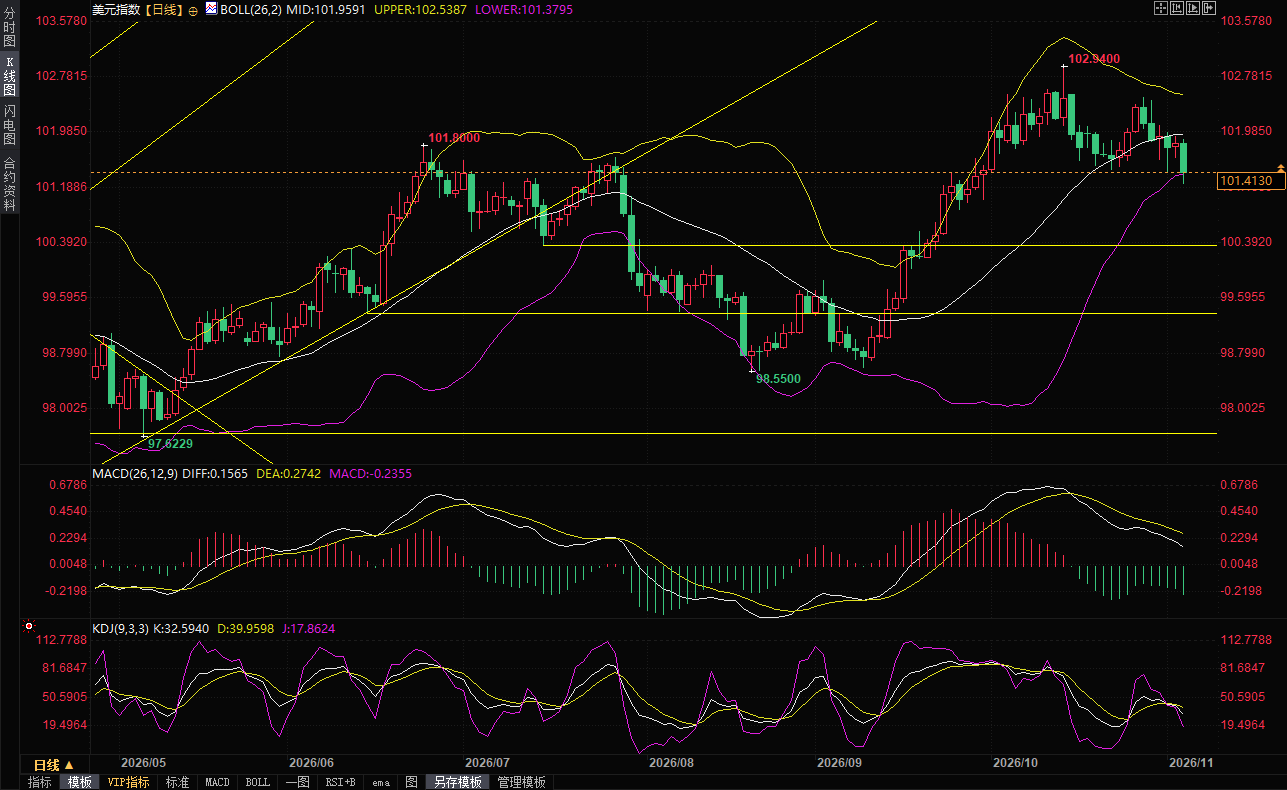 (US Dollar Index Daily Chart, Source: FX678) The first results are in, with Democratic Senator Jon Osoff winning re-election in Georgia, marking the first major election to reach a definitive conclusion. However, whether the Democrats can regain control of Congress from Trump's Republican Party remains to be seen and will require several hours to provide a clear answer. The yield on the 10-year US Treasury note fell as much as 1.5% to 4.890%, close to the nearly two-month low of 4.867% reached last Friday. Carol Kong, a foreign exchange strategist at Commonwealth Bank of Australia, stated that due to the current favorable outlook for the Democrats, the market expects them to potentially win both the House and Senate. If this prediction comes true, the US dollar could weaken further, as a complete Democratic victory would limit government spending during Trump's term. She also noted that investors are concerned about the risk of an escalation in the Middle East due to the election results. If the Republicans lose control of both houses, Trump has stated he will resume bombing operations against Iran after the election, so the market is closely watching. An escalation of the conflict could cause oil prices to surge, thus supporting the US dollar. Currently, US media outlets have made predictions for the winners of some House districts, with preliminary results favoring the Democrats, but voting is still ongoing in most parts of the country. The market believes the preliminary results of the US midterm elections favor the Democratic Party. Meanwhile, US stock index futures experienced a sell-off, with S&P 500 futures falling as much as 1.57% to a near three-month low, and Nasdaq futures falling more than 2.5%, hitting their lowest level since the end of July. Sean Carlow, a foreign exchange strategist at ITC Markets , stated that the foreign exchange market reaction has accelerated. US stock index futures declined as the market bets on the Democratic Party gaining a majority in Congress in the 2026 US midterm elections and winning gubernatorial elections in several key states. Data from the Kalshi platform shows that the probability of the Democrats controlling the Senate has risen to over 90%, indicating that traders are increasingly inclined to bet on a major Democratic victory in this election. Some on Wall Street believe that if the Democrats gain a significant advantage in the Senate, the market may face pressure, especially for stocks related to artificial intelligence infrastructure construction. In after-hours trading, large-cap tech stocks Microsoft, Amazon, and Nvidia all fell, while CoreWeave, considered a high-risk data center concept stock, fell 6% in overnight trading on Robinhood. SpaceX, owned by Elon Musk, saw its stock price fall 4% on the Robinhood platform. Lin Li of MUFG stated in a report that a sweeping Democratic victory could lead to a fiscal stalemate and lower market expectations for further US fiscal expansion, thereby dragging down US Treasury yields and the US dollar. This scenario would be beneficial for Asian currencies, but the impact may be limited because tariffs and trade policies remain primarily controlled by the president and executive branch.
I. The Core of the Election: Control of Congress Will Determine Trump's Second Half of the Campaign
This midterm election is first and foremost a national decision on control of Congress. American voters will decide whether Trump will maintain strong Republican control of Washington for the remaining two years, or become a "lame duck" president with a legislative agenda constrained by Congress after a Democratic victory. Republicans currently control not only the House of Representatives but also the Senate, with a larger majority in the Senate. A Republican victory could give Trump another two years of virtually unhindered congressional control, allowing him to push through major policy bills; a Democratic victory in one or two houses would severely hamper the president's remaining legislative priorities, and basic government operations could be stalled over issues such as funding and the debt ceiling. Stifel's Washington Policy Strategy Group wrote in an analysis report on Sunday (November 1st) that the election results could trigger an immediate market reaction, especially as the Senate outcome becomes clearer; the group predicts a Democratic victory in the House, while the Senate is too close to be certain, but the knee-jerk trading in the market could reverse as investors realize that a stalemate is the most likely policy outcome in either scenario.II. A Divided Parliament: Funding, Debt Ceiling, and Investigative Powers Become the Focus
If Democrats win one house of Congress, policymaking in Washington will become significantly more rigid. With the current narrow majority in Congress, unipartisan budget reconciliation bills, which are crucial for advancing most major spending and policy changes, will be impossible. Advancing legislation will require bipartisan cooperation, making essential bills such as government appropriations, defense spending, and the upcoming debt ceiling increase even more critical and contentious. In a divided Congress, the party not controlling the White House often uses opportunities like government appropriations and debt ceiling increases to pressure the majority party, potentially leading to brinkmanship. Stifel also writes that if Republicans defy expectations and retain a Senate majority, sectors that might react negatively to a Democratic victory are expected to rebound; Democrats will retain control of the House, resulting in a deadlock, with Senate Republicans simultaneously restraining both Democrats and many of Trump's populist impulses. Democrats are also widely expected to use any majority in Congress to investigate the White House and businesses that have worked with the Trump administration, gaining subpoena rights for congressional committees. Polls suggest a Democratic sweep of both the House and Senate is possible. In this scenario, Democrats might more aggressively push for budget reconciliation measures along their own lines. These measures wouldn't become law, but they would provide the party with a platform to voice its concerns before the 2028 presidential election. Trump would still have the ability to veto legislation passed by Congress, severely limiting the likelihood of Democratic bills becoming law. If Democrats control both houses of Congress, legislation that must pass would be relatively easier to pass, but deals with the White House would still be necessary, and the Senate's 60-seat blocking threshold could still be an obstacle requiring bipartisan cooperation. Regardless of which party wins control of the Senate, it is highly unlikely to have at least 60 seats. Analysts expect Trump to rely more on executive orders due to congressional gridlock, whether Congress is divided or unified. There is also the possibility that Republicans will maintain control of both houses of Congress. In this case, Trump's remaining legislative agenda could proceed, and the status quo would be maintained. Democrats would retain some influence, mainly due to the Senate's 60-seat blocking threshold, but would be limited in their investigations of the White House and corporations.III. Exit Polls: High Prices Weigh on Trump, Republican Voter Coalition Shows Signs of Weakening
Americans voted in Tuesday's midterm elections, deciding who will control Congress for the final two years of Trump's term. Exit polls show voters expressing dissatisfaction with Trump and his policy agenda, blaming him for high prices; a majority believe the country is headed in the wrong direction, and many say their situation is worse than two years ago. The exit polls were conducted by SSRS on behalf of a consortium of American media outlets, including major television news networks and the Associated Press. Nearly 90% of respondents cited the cost of living as a key or major factor influencing their vote, nearly two-thirds blamed Trump for high prices, and about three-quarters expressed anger or dissatisfaction with the country's direction, indicating a desire for change and concerns about government corruption. Trump promised to quickly address high inflation upon taking office, but most voters believe his policies, such as the war with Iran and tariffs on foreign goods, have worsened the economy. The exit polls also show that Trump's recent intensive campaigning for Republican candidates in 19 states has had little effect on boosting his support. The voter coalition that helped Trump win the 2024 election is showing initial signs of division. Exit polls show a significant decline in Republican support among Black men, Latinos, young voters, evangelical Christians, and voters without a college degree. If the data is confirmed, the proportion of voters who supported Harris in 2024 may be higher than in this election. Voters aged 65 and older may help limit the Republicans' losses; this group is slightly Republican and their proportion in this midterm election is higher than in 2024. However, declining support among several key groups could drag down the party before the 2028 election and pose a challenge to Republican presidential candidates in rebuilding their electoral coalition. Latest news: Decision Desk (DDHQ), an election forecasting organization, predicts that Democrat Katie Hobbs will win the Arizona gubernatorial election. A major upset occurred in South Carolina, marking a significant turnaround for the Democrats. Anne Andrews unexpectedly won the South Carolina Senate election, defeating Republican candidate Darlene Graham, who was personally endorsed by President Trump, becoming the first Democrat to win a Senate election in the state in 28 years. Andrews, a pediatrician, will become the state's first Democratic senator in over 20 years. Two years ago, U.S. President Donald Trump led his opponent by more than 17 percentage points in South Carolina.IV. Market Reaction: A weaker dollar, lower US Treasury yields, and declining US stock futures.
The dollar weakened against most major currencies on Wednesday, with the dollar index falling as much as 0.59% to 101.25, its lowest level since September 30, as investors focused on the results of the U.S. midterm elections and prepared for a possible strong performance from the Democrats. (US Dollar Index Daily Chart, Source: FX678) The first results are in, with Democratic Senator Jon Osoff winning re-election in Georgia, marking the first major election to reach a definitive conclusion. However, whether the Democrats can regain control of Congress from Trump's Republican Party remains to be seen and will require several hours to provide a clear answer. The yield on the 10-year US Treasury note fell as much as 1.5% to 4.890%, close to the nearly two-month low of 4.867% reached last Friday. Carol Kong, a foreign exchange strategist at Commonwealth Bank of Australia, stated that due to the current favorable outlook for the Democrats, the market expects them to potentially win both the House and Senate. If this prediction comes true, the US dollar could weaken further, as a complete Democratic victory would limit government spending during Trump's term. She also noted that investors are concerned about the risk of an escalation in the Middle East due to the election results. If the Republicans lose control of both houses, Trump has stated he will resume bombing operations against Iran after the election, so the market is closely watching. An escalation of the conflict could cause oil prices to surge, thus supporting the US dollar. Currently, US media outlets have made predictions for the winners of some House districts, with preliminary results favoring the Democrats, but voting is still ongoing in most parts of the country. The market believes the preliminary results of the US midterm elections favor the Democratic Party. Meanwhile, US stock index futures experienced a sell-off, with S&P 500 futures falling as much as 1.57% to a near three-month low, and Nasdaq futures falling more than 2.5%, hitting their lowest level since the end of July. Sean Carlow, a foreign exchange strategist at ITC Markets , stated that the foreign exchange market reaction has accelerated. US stock index futures declined as the market bets on the Democratic Party gaining a majority in Congress in the 2026 US midterm elections and winning gubernatorial elections in several key states. Data from the Kalshi platform shows that the probability of the Democrats controlling the Senate has risen to over 90%, indicating that traders are increasingly inclined to bet on a major Democratic victory in this election. Some on Wall Street believe that if the Democrats gain a significant advantage in the Senate, the market may face pressure, especially for stocks related to artificial intelligence infrastructure construction. In after-hours trading, large-cap tech stocks Microsoft, Amazon, and Nvidia all fell, while CoreWeave, considered a high-risk data center concept stock, fell 6% in overnight trading on Robinhood. SpaceX, owned by Elon Musk, saw its stock price fall 4% on the Robinhood platform. Lin Li of MUFG stated in a report that a sweeping Democratic victory could lead to a fiscal stalemate and lower market expectations for further US fiscal expansion, thereby dragging down US Treasury yields and the US dollar. This scenario would be beneficial for Asian currencies, but the impact may be limited because tariffs and trade policies remain primarily controlled by the president and executive branch.V. Conclusion: A deadlock remains the most likely policy outcome
In summary, the key to the impact of the 2026 midterm elections on Trump's final two years lies not in the outcome of a single state or seat, but in how control of Congress is formed. A Republican sweep means Trump's legislative agenda can continue, and the status quo can be maintained; a Democratic victory in only one house means a divided Congress and a gridlock, with appropriations, the debt ceiling, and investigative powers becoming the focus of contention; a Democratic sweep of both houses means the Democrats gain a larger platform for their voice and investigative capabilities, but Trump's veto power, the 60-vote threshold in the Senate, and the need for deals with the White House will still limit their legislative achievements. The market has already priced in a Democratic victory, with a weaker dollar, lower Treasury yields, and declining stock futures reflecting investors' declining expectations for fiscal expansion and a fiscal gridlock; however, as Stifel points out, in either scenario, a gridlock remains the most likely policy outcome, and the knee-jerk trade could be reversed. For Trump, the last two years are more likely to be a period of increased executive orders, legislative obstruction, and intertwined investigations and counter-investigations; for both parties, this election will also be an important indicator of changes in voter alliances and policy narratives before the 2028 presidential election.Frequently Asked Questions
Q: Why will the 2026 midterm elections determine whether Trump will be a "lame duck" for the remaining two years? A: The core issue is control of Congress. If the Republicans retain control of both houses, Trump can continue to push through major policies; if the Democrats win one house, legislative priorities will be hindered, and legislation on appropriations, defense spending, and the debt ceiling will require bipartisan cooperation, potentially leading to a government gridlock and the president relying more on executive orders, thus creating a lame-duck effect. Q: What key signals did the exit polls reveal? A: Polls show that high prices are a core factor in voting, with nearly 90% of respondents citing the cost of living as a key or major factor, nearly two-thirds blaming Trump for inflation, and about three-quarters dissatisfied with the country's direction. Republican support is declining among Black men, Latinos, young voters, evangelicals, and those without a college degree, and the 2024 coalition is weakening; those over 65 are slightly more Republican and represent a larger percentage, which may limit losses. Q: What would it mean if the Democrats won the House or the Senate? A: Winning the House grants subpoena power to committees, allowing for the control of investigations into the White House and corporations, and the ability to obstruct legislation; winning the Senate influences personnel appointments and the legislative agenda, but the 60-vote threshold still requires bipartisan cooperation. A single-house victory leads to a deadlock; a unanimous victory makes passing legislation easier, but still requires deals with the White House, and Trump can still veto it. Q: Why did the market react so violently before the vote count was complete? A: The market is betting on a Democratic victory, with Kalshi showing a more than 90% probability of Democrats controlling the Senate. A Democratic sweep could lead to a fiscal deadlock, lowering expectations for fiscal expansion and dragging down the dollar and Treasury yields; the stock market is concerned about AI infrastructure spending and policy changes. If Republicans unexpectedly retain the Senate, the earlier knee-jerk trade could reverse. Q: What do the South Carolina upset and Arizona gubernatorial predictions indicate? A: They indicate a reversal in local elections. Anne Andrews defeated Trump-backed Darlene Graham in the South Carolina Senate election, becoming the first Democratic senator from the state in 28 years; DDHQ predicts Katie Hobbs will win the Arizona gubernatorial election. This strengthens the Democratic Party's momentum, but national control still requires a vote, and the Senate may depend on states like Alaska. At 11:30 Beijing time, the US dollar index was at 101.25.- Risk Warning and Disclaimer
- The market involves risk, and trading may not be suitable for all investors. This article is for reference only and does not constitute personal investment advice, nor does it take into account certain users’ specific investment objectives, financial situation, or other needs. Any investment decisions made based on this information are at your own risk.