A weakening dollar coupled with warnings of intervention from Japan caused the dollar to end its two-day rally against the yen and fall back again.
2026-11-04 13:52:27
The US dollar came under selling pressure against the Japanese yen during Wednesday's Asian trading session, ending its two-day rally. The yen had touched a near three-week high yesterday and is currently trading below 158.00, trending slightly lower as the market prepares for volatility following the US midterm election results.  The risk of Japanese intervention continues to loom over the market. Japanese Finance Minister Sachiko Katayama stated on Monday that the joint Japan-US foreign exchange statement remains valid, and the government is ready to intervene to curb the disorderly and excessive depreciation of the yen. This statement continues to constrain bullish sentiment, and coupled with a weakening dollar, it puts downward pressure on USD/JPY. Meanwhile, expectations of a US-Iran diplomatic reconciliation have cooled demand for the dollar as a safe haven, and Trump's statement that there are no plans to strike Iran has led the market to gradually eliminate geopolitical risk premiums, further dragging down the dollar. Preliminary vote counts in the US midterm elections indicate the possibility that Republicans may lose their majority in both the House and Senate, causing US Treasury yields to fall and putting pressure on the dollar. However, Tuesday's JOLTS job openings data showed a stronger-than-expected rebound, with job openings rising to 7.5 million in September, indicating a resilient labor market. Energy-driven inflationary concerns support expectations of further Fed rate hikes, limiting the downside potential of the exchange rate. The persistently high interest rate differential between the US and Japan remains the core medium- to long-term factor suppressing the yen. It is premature to conclude that this round of gains has peaked; stronger, sustained selling signals are needed to confirm the top. The North American session will see the release of ADP employment data and the ISM Services PMI, providing short-term guidance. On the daily chart, USD/JPY maintains a weak bias, with prices pressured below the 100-day simple moving average at 159.15 and the 61.8% Fibonacci retracement level at 159.75. Currently, the price is trading below the 50% retracement level at 158.45, a crucial short-term support/resistance level. A retest of this level would allow bulls a chance to correct towards higher Fibonacci levels. The first support level is the 38.2% retracement at 157.16, with deeper support at 155.56 and the cycle low at 152.97, where buying pressure is stronger. On the 4-hour chart, prices rallied and then retreated, turning downwards in the short term. Indicators have fallen from their highs, but there is no clear oversold condition at present. Before a decisive break below 157.16, the market is defined as undergoing a high-level consolidation and pullback; if it stabilizes above 158.45 again, the bullish trend is expected to resume. The market is currently experiencing high volatility due to rumors of intervention, US Treasury yields, and election news.
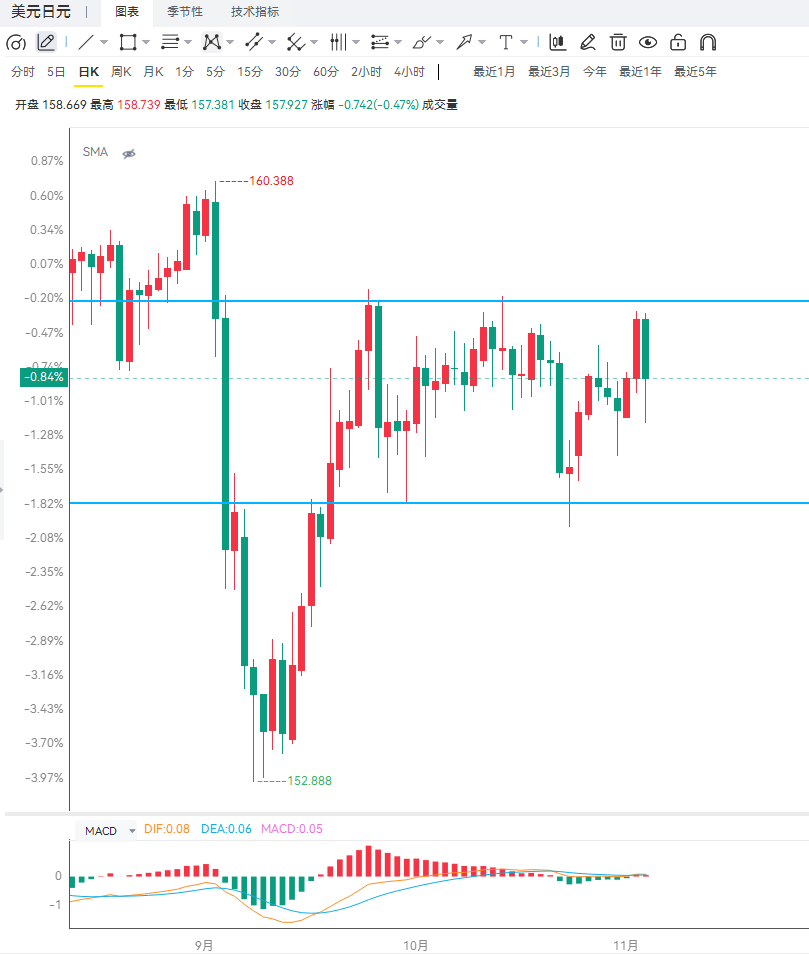 Editor's Summary: The current USD/JPY pair is in a relatively balanced position between bulls and bears. Short-term bearish factors include a weakening dollar, verbal warnings of intervention from Japan, and waning geopolitical risk aversion. Meanwhile, the USD/JPY interest rate differential and expectations of interest rate hikes driven by US employment data provide protection for the bulls. Short-term risks lie in the US election results and further declines in US Treasury yields, potentially causing the exchange rate to break below support. A potential opportunity is stronger-than-expected employment data, which could drive a dollar rebound and a return to an upward trend for the exchange rate. Closely monitor the 157.16–158.45 range for a potential breakout, while also being wary of rapid price movements due to sudden Japanese intervention in the foreign exchange market, and strictly manage risk.
The risk of Japanese intervention continues to loom over the market. Japanese Finance Minister Sachiko Katayama stated on Monday that the joint Japan-US foreign exchange statement remains valid, and the government is ready to intervene to curb the disorderly and excessive depreciation of the yen. This statement continues to constrain bullish sentiment, and coupled with a weakening dollar, it puts downward pressure on USD/JPY. Meanwhile, expectations of a US-Iran diplomatic reconciliation have cooled demand for the dollar as a safe haven, and Trump's statement that there are no plans to strike Iran has led the market to gradually eliminate geopolitical risk premiums, further dragging down the dollar. Preliminary vote counts in the US midterm elections indicate the possibility that Republicans may lose their majority in both the House and Senate, causing US Treasury yields to fall and putting pressure on the dollar. However, Tuesday's JOLTS job openings data showed a stronger-than-expected rebound, with job openings rising to 7.5 million in September, indicating a resilient labor market. Energy-driven inflationary concerns support expectations of further Fed rate hikes, limiting the downside potential of the exchange rate. The persistently high interest rate differential between the US and Japan remains the core medium- to long-term factor suppressing the yen. It is premature to conclude that this round of gains has peaked; stronger, sustained selling signals are needed to confirm the top. The North American session will see the release of ADP employment data and the ISM Services PMI, providing short-term guidance. On the daily chart, USD/JPY maintains a weak bias, with prices pressured below the 100-day simple moving average at 159.15 and the 61.8% Fibonacci retracement level at 159.75. Currently, the price is trading below the 50% retracement level at 158.45, a crucial short-term support/resistance level. A retest of this level would allow bulls a chance to correct towards higher Fibonacci levels. The first support level is the 38.2% retracement at 157.16, with deeper support at 155.56 and the cycle low at 152.97, where buying pressure is stronger. On the 4-hour chart, prices rallied and then retreated, turning downwards in the short term. Indicators have fallen from their highs, but there is no clear oversold condition at present. Before a decisive break below 157.16, the market is defined as undergoing a high-level consolidation and pullback; if it stabilizes above 158.45 again, the bullish trend is expected to resume. The market is currently experiencing high volatility due to rumors of intervention, US Treasury yields, and election news. Editor's Summary: The current USD/JPY pair is in a relatively balanced position between bulls and bears. Short-term bearish factors include a weakening dollar, verbal warnings of intervention from Japan, and waning geopolitical risk aversion. Meanwhile, the USD/JPY interest rate differential and expectations of interest rate hikes driven by US employment data provide protection for the bulls. Short-term risks lie in the US election results and further declines in US Treasury yields, potentially causing the exchange rate to break below support. A potential opportunity is stronger-than-expected employment data, which could drive a dollar rebound and a return to an upward trend for the exchange rate. Closely monitor the 157.16–158.45 range for a potential breakout, while also being wary of rapid price movements due to sudden Japanese intervention in the foreign exchange market, and strictly manage risk.
- Risk Warning and Disclaimer
- The market involves risk, and trading may not be suitable for all investors. This article is for reference only and does not constitute personal investment advice, nor does it take into account certain users’ specific investment objectives, financial situation, or other needs. Any investment decisions made based on this information are at your own risk.