The USD/CAD pair has retreated again after two consecutive days of gains; be wary of a potential break below the previous low.
2026-11-04 13:58:27
The US dollar weakened against the Canadian dollar during Wednesday's Asian trading session, reversing the upward trend of the previous two trading days, and is currently trading at 1.3970. This decline was mainly driven by the weakening of the US dollar and the decline in US Treasury yields. The yield on the 2-year US Treasury note fell 5 basis points to 4.566%, and the benchmark 10-year yield fell 6 basis points to 4.90%, with the overall weakening of the US Treasury yield curve reducing the attractiveness of the US dollar.  The US midterm elections are underway, a crucial juncture for the market to assess the policy direction of Trump's second term. Following early district voting, real-time data shows that 201 of the 435 House seats have been decided, with Democrats winning 124 and Republicans 77. Election progress continues to influence market risk appetite and the US dollar's performance. The Canadian dollar received additional support from the recovery in oil prices. US-Iran peace negotiations are still progressing; a spokesperson for the Qatari Foreign Ministry confirmed that both sides are assessing a new proposal put forward by the mediators, but a senior Iranian national security official stated that the US response was not yet satisfactory. The US president stated that there are no immediate plans to strike Iran, while the Israeli prime minister hinted at further military action. Repeated geopolitical expectations have driven oil prices to fluctuate and rebound, benefiting the Canadian dollar, which is highly tied to energy exports. Institutional views indicate that recent Canadian economic data is relatively light, with only trade data to be released on Wednesday. The core driver of short-term market movements is the US midterm election results and their impact on overall market sentiment. The Canadian dollar's movement is more closely correlated with the US dollar and oil prices, while domestic fundamentals are temporarily secondary. On the daily chart, USD/CAD rose and then fell back under pressure, dropping below the short-term moving averages, indicating insufficient bullish momentum. The RSI indicator turned downwards from the neutral-to-strong range, suggesting weakening bullish momentum and a short-term shift to a weak, range-bound pattern. The first resistance level is 1.4033, followed by 1.4047, with strong resistance at 1.4096. On the downside, the first support level is 1.3878, further support is 1.3820, and the key defensive level is 1.3763. If the daily chart continues to close below 1.4033, the bearish advantage will persist; a break above 1.4096 is needed to restart the upward trend. On the 4-hour chart, the candlesticks have closed lower for several consecutive days, with short-term moving averages forming a resistance pattern and the price center shifting downwards. Indicators are also falling, with no clear oversold signal yet, suggesting the possibility of further downward movement in the short term. The rebound should be viewed as a recovery. Before it can effectively stand above 1.4033, a bearish outlook should be maintained. Volatility is highly susceptible to fluctuations caused by the US dollar, crude oil, and election news, and rapid market jumps are likely.
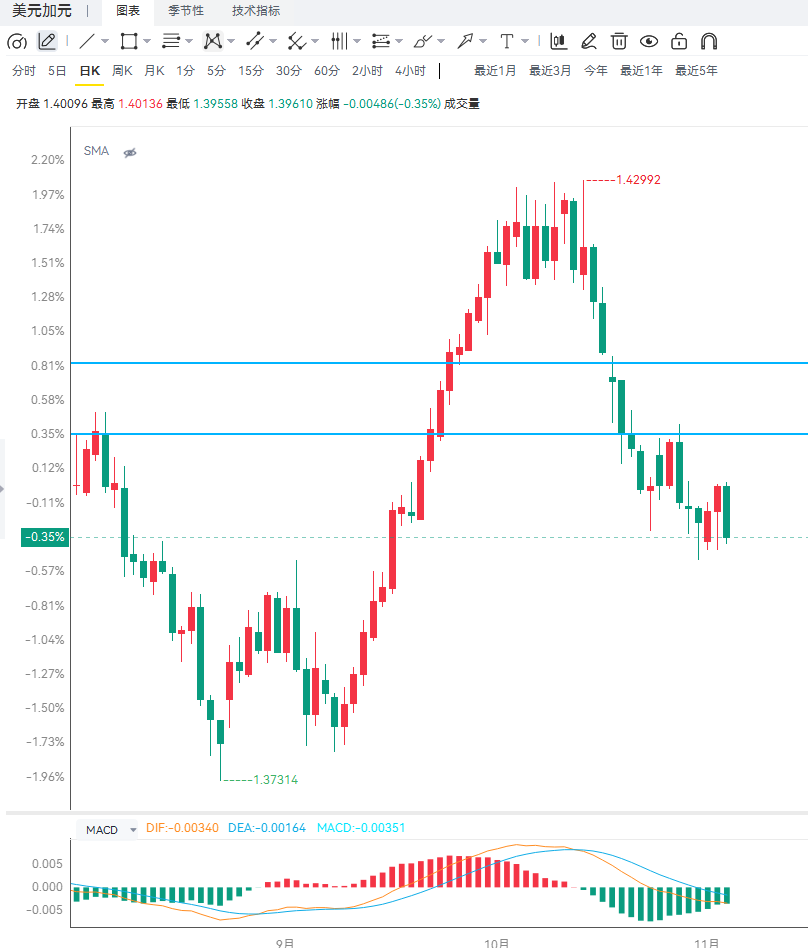 Editor's Summary: The USD/CAD pair is currently under pressure from both a weakening US dollar and a rebound in crude oil prices, bringing the previous two-day rally to a temporary halt. In the short term, Canada lacks significant fundamental catalysts, and the market is entirely anchored to the US midterm election results and oil price fluctuations driven by US-Iran geopolitical negotiations. If the election results further suppress the US dollar, the exchange rate is likely to continue testing support levels; conversely, if the election is positive for the US dollar and oil prices fall, the exchange rate is likely to rebound and test resistance levels again. Key areas to watch include the progress of the US election vote counting, crude oil prices, and Canadian trade data, as volatility is expected to rise during this event window.
The US midterm elections are underway, a crucial juncture for the market to assess the policy direction of Trump's second term. Following early district voting, real-time data shows that 201 of the 435 House seats have been decided, with Democrats winning 124 and Republicans 77. Election progress continues to influence market risk appetite and the US dollar's performance. The Canadian dollar received additional support from the recovery in oil prices. US-Iran peace negotiations are still progressing; a spokesperson for the Qatari Foreign Ministry confirmed that both sides are assessing a new proposal put forward by the mediators, but a senior Iranian national security official stated that the US response was not yet satisfactory. The US president stated that there are no immediate plans to strike Iran, while the Israeli prime minister hinted at further military action. Repeated geopolitical expectations have driven oil prices to fluctuate and rebound, benefiting the Canadian dollar, which is highly tied to energy exports. Institutional views indicate that recent Canadian economic data is relatively light, with only trade data to be released on Wednesday. The core driver of short-term market movements is the US midterm election results and their impact on overall market sentiment. The Canadian dollar's movement is more closely correlated with the US dollar and oil prices, while domestic fundamentals are temporarily secondary. On the daily chart, USD/CAD rose and then fell back under pressure, dropping below the short-term moving averages, indicating insufficient bullish momentum. The RSI indicator turned downwards from the neutral-to-strong range, suggesting weakening bullish momentum and a short-term shift to a weak, range-bound pattern. The first resistance level is 1.4033, followed by 1.4047, with strong resistance at 1.4096. On the downside, the first support level is 1.3878, further support is 1.3820, and the key defensive level is 1.3763. If the daily chart continues to close below 1.4033, the bearish advantage will persist; a break above 1.4096 is needed to restart the upward trend. On the 4-hour chart, the candlesticks have closed lower for several consecutive days, with short-term moving averages forming a resistance pattern and the price center shifting downwards. Indicators are also falling, with no clear oversold signal yet, suggesting the possibility of further downward movement in the short term. The rebound should be viewed as a recovery. Before it can effectively stand above 1.4033, a bearish outlook should be maintained. Volatility is highly susceptible to fluctuations caused by the US dollar, crude oil, and election news, and rapid market jumps are likely. Editor's Summary: The USD/CAD pair is currently under pressure from both a weakening US dollar and a rebound in crude oil prices, bringing the previous two-day rally to a temporary halt. In the short term, Canada lacks significant fundamental catalysts, and the market is entirely anchored to the US midterm election results and oil price fluctuations driven by US-Iran geopolitical negotiations. If the election results further suppress the US dollar, the exchange rate is likely to continue testing support levels; conversely, if the election is positive for the US dollar and oil prices fall, the exchange rate is likely to rebound and test resistance levels again. Key areas to watch include the progress of the US election vote counting, crude oil prices, and Canadian trade data, as volatility is expected to rise during this event window.
- Risk Warning and Disclaimer
- The market involves risk, and trading may not be suitable for all investors. This article is for reference only and does not constitute personal investment advice, nor does it take into account certain users’ specific investment objectives, financial situation, or other needs. Any investment decisions made based on this information are at your own risk.