Democrats win both houses of Congress; interest rates and geopolitical factors push gold prices back above $4,000.
2026-11-04 17:32:33
International gold prices surged over 2% on Wednesday, regaining the $4,000/ounce mark and currently trading around $4,044. The dollar fell to a four-week low, and US Treasury yields declined across the board, jointly boosting the attractiveness of gold as a non-interest-bearing asset. The core driver of this rally was the slightly better-than-expected US midterm election results, with the Democrats winning both the House and Senate. These moves, along with issues such as tariffs, the US-Iran conflict, and support for the technology industry, are reshaping macroeconomic pricing. 
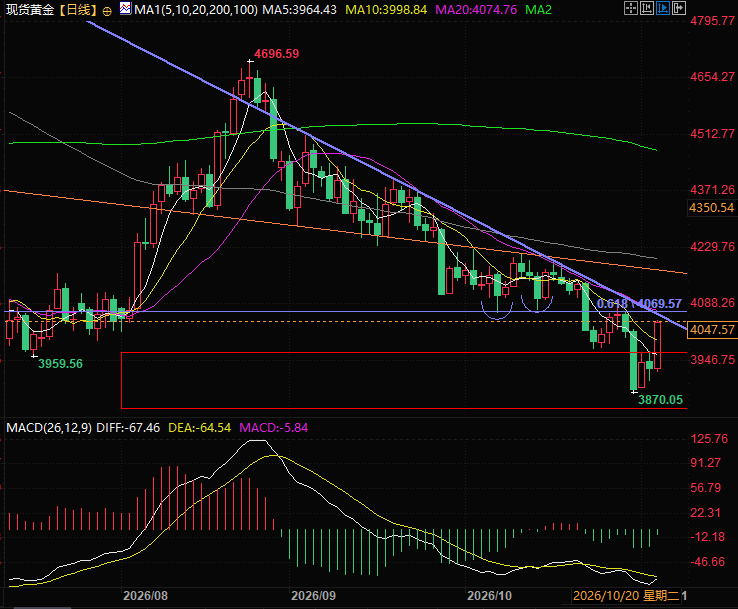 (Spot gold daily chart, source: EasyTrade) At 17:30 Beijing time, spot gold is currently trading at $4046 per ounce.
Geopolitical risks set a ceiling, and inflationary pressures ease marginally.
With the Democrats controlling both houses of Congress, the most direct constraint falls on their tough foreign policy. Market expectations that Trump's potential for escalating tariffs and pushing for a large-scale conflict with Iran have been reduced, significantly cooling tail risks in the energy sector, easing upward pressure on oil prices, and diminishing concerns about runaway inflation. Nomura economist Takahide Kiuchi points out that the momentum of Trump's aggressive policies will be curbed, and high-intensity military action against Iran and a new round of tariff increases face higher hurdles. However, he also cautions that the president retains considerable autonomy in foreign policy, and the possibility of Trump maintaining intermittent targeted strikes in the Middle East cannot be ruled out. A ceasefire agreement between the US and Iran remains a distant prospect, and geopolitical risks have not completely disappeared; only the upper limit of the conflict's escalation has been capped. Yesterday's article highlighted the opportunity for the US dollar, which, as a risk hedge, immediately experienced a deep correction. With inflation expectations slowing, the market is reassessing the pace of global monetary policy, and expectations for central banks to shift towards moderate easing and economic stimulus are rising, opening up medium- to long-term growth potential for gold.AI regulatory expectations are being repriced, putting downward pressure on the central level of US nominal interest rates.
Democratic policies lean towards tightening approvals for AI projects and strengthening regulations on data centers and computing power. Market expectations are that AI capital expenditure growth will slow, dragging down US economic growth expectations. Simultaneously, the demand for high-cost financing in the AI sector is declining, leading to a decrease in overall nominal interest rates and a collective pullback in US Treasury yields. This has created a unique funding chain: after the negative impact of AI regulations was fully priced in, the technology sector experienced a euphoric rebound, market liquidity improved, and gold, previously sold off due to liquidity constraints, was no longer used as collateral, further contributing to the gold price rebound.Institutional View: Short-term game continues; non-farm payrolls are the next key juncture.
Philip Nova analyst Priyanka Sachdeva noted that gold prices had previously dipped below $3,900, with investors watching the election results to see if they could reverse the trend. While the expected drop in oil prices eased inflation concerns, high US Treasury yields, a strong dollar, and expectations of a Fed rate hike had previously suppressed gold's upside potential. With the election settled, some funds began to buy on dips, but most traders remained on the sidelines, waiting for clearer signals regarding US Treasuries, the dollar, and risk factors. Chris Weston, head of research at Pepperstone, stated that the simultaneous decline in nominal and real US Treasury yields and a weakening dollar were the most direct support for gold's breakthrough of $4,000. A weaker dollar also made dollar-denominated gold cheaper for overseas buyers. Simultaneously, the market is hedging against a new risk: with strong checks and balances in Congress, Trump's policy path may become more unpredictable and confrontational, further supporting gold buying. According to CME FedWatch data, the market is currently pricing in a 79% probability of a Fed rate hike in December. The upcoming US non-farm payroll report on Friday will be the key signal to verify the Fed's policy path and the biggest short-term disruptor for gold prices.Summary and Technical Analysis:
Gold is currently in a window of multiple positive factors: reduced geopolitical black swan risks, cooling inflation expectations, declining US Treasury yields, and improved liquidity. However, it's important to distinguish between two layers of logic: the long-term benefit of declining interest rates has begun to materialize, while short-term expectations of a Fed rate hike have not completely subsided. Coupled with the ongoing stalemate in US-Iran negotiations, gold prices are likely to experience a volatile upward trend with repeated fluctuations. Two key variables to monitor going forward are: first, whether the non-farm payroll data will further fuel rate hike expectations and interrupt the downward trend in US Treasury yields; and second, whether there are any substantial signs of easing tensions in the US-Iran negotiations, which will simultaneously affect the safe-haven premium of both oil and gold. Technically, as mentioned in previous articles, a reversal in gold prices requires a break above the important 4940 level. Currently, gold prices are showing signs of a reversal, with key support between 3970 and 3940, and resistance near the 0.618 Fibonacci retracement level around 4070, which coincides with the descending trendline. (Spot gold daily chart, source: EasyTrade) At 17:30 Beijing time, spot gold is currently trading at $4046 per ounce.
- Risk Warning and Disclaimer
- The market involves risk, and trading may not be suitable for all investors. This article is for reference only and does not constitute personal investment advice, nor does it take into account certain users’ specific investment objectives, financial situation, or other needs. Any investment decisions made based on this information are at your own risk.